With the Trump administration pulling back support for electric vehicles (EVs), adding tariffs to automotive import vehicles and parts, and removing the $7,500 federal EV tax credit, it's going to be tough for the U.S. EV industry to expand in the near term. That creates a scary environment for young EV start-ups such as Rivian (RIVN 6.79%).
But here's a little good news for Rivian investors while they wait for the highly anticipated R2 to hit the roads next year.
One analyst believes
Rivian investors received a vote of confidence from Baird analyst Ben Kallo, as he upgraded Rivian shares from hold to buy and also bumped the price target from $14 up to $25 per share. Thirty percent of analysts covering the stock say its shares are a buy, according to FactSet. But what exactly is driving this analyst's belief?

NASDAQ: RIVN
Key Data Points
"2026 is the year of R2," Kallo wrote to investors. There's also a belief that new models can overcome broader weakening electric vehicle demand, which, in Kallo's min,d makes Rivian a buy heading into the new year. On top of that, the analyst pointed out that the R2 should be a boost for Rivian's brand, product demand, and by extension, the young company's stock. Another reason for the rating upgrade was that the firm wanted to own shares going into the new product cycle, which includes Rivian's custom-designed microchips.
Year of the R2
Investors won't be blamed for being apprehensive about the R2 launch, considering the waning demand for EVs following the end of the federal $7,500 tax credit. But Rivian CEO RJ Scaringe offers an alternative theory for that waning demand: A lack of choices.

Image source: Rivian.
Scaringe noted recently at the Fortune Brainstorm AI conference that Tesla continues to dominate sales and market share, with few other competitors making a noticeable impression on consumers. He took it a step further by noting that it's not a healthy market because there are 300 different gasoline-powered options compared to maybe one highly compelling EV choice -- this isn't an ideal market for consumers.
In part thanks to changing policies and tariffs, as well as EV demand being slower to gain traction than planned, automakers have been forced into massive decisions. Ford Motor Company (F 0.21%) is a good example. Company management noted that the automaker simply isn't seeing much demand at all in the high-end EV range, think around $50,000 to $80,000. Because of that, Ford has made a massive pivot to back off full-electric vehicles in favor of a focus on hybrids and extended-range vehicles in a move that cost the company $19.5 billion in write-offs. That puts more pressure on Rivian to continue cutting costs to preserve margins, as the R2 is expected to drop with a price tag right at the low end of that range. Rivian has made consistent progress improving its gross margins in its drive toward profitability, as you can see in the graph below, but work remains.
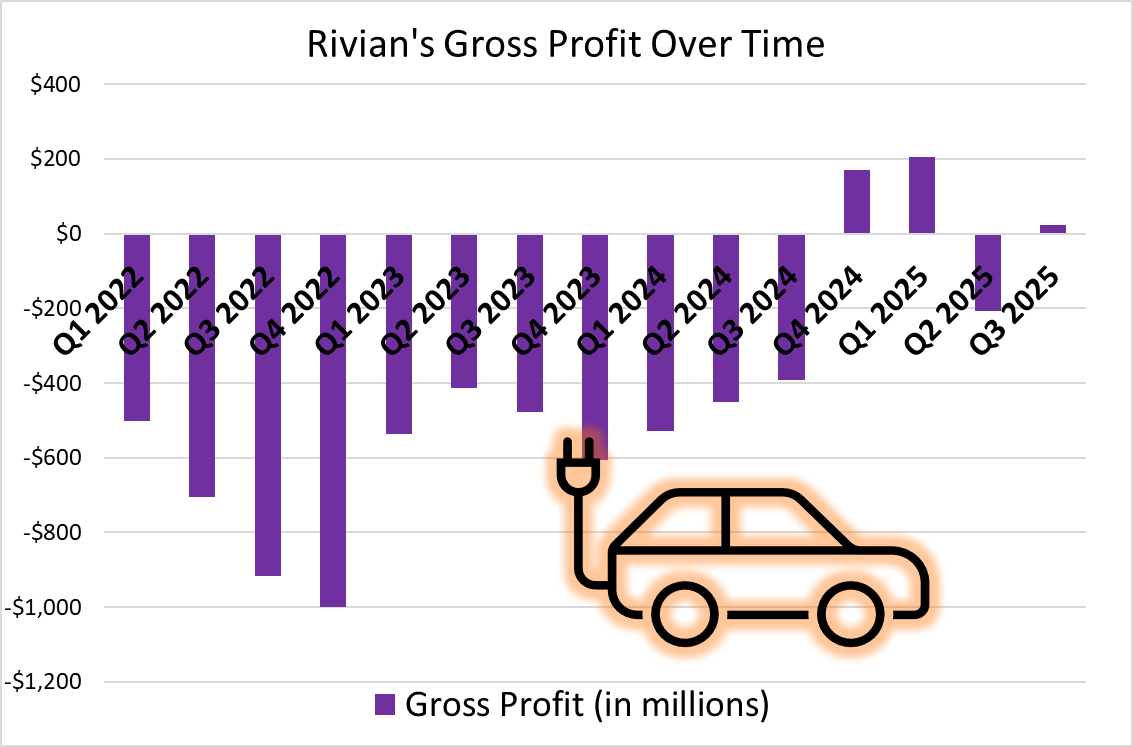
Data source: Rivian 10k SEC filings. Image source: Author.
Room to run?
Currently, Rivian's stock trades at roughly $20 per share, leaving a decent amount of room to run before Kallo's $25 price target. It's easy for investors to be optimistic about Rivian in the near term with its highly anticipated R2 coming out soon. However, while Rivian has made immense progress removing costs, the company will almost certainly continue burning through cash, has a long runway to scale up the business, and faces growing competition in a market struggling with demand -- it's not a great scenario for EV start-ups. Rivian has much potential, and developing its own microchip could pay huge dividends in the future, but investors might be wise to watch this stock from the sidelines.