This year wasn't the best for the "Magnificent Seven" stocks, a group of tech -- or tech-adjacent -- companies that are among the largest on the market. The grouping includes Alphabet (GOOG 0.49%) (GOOGL 0.29%), Amazon (AMZN 0.13%), Apple (AAPL +0.02%), Microsoft (MSFT 0.04%), Meta Platforms (META 0.98%), Nvidia (NVDA 2.12%), and Tesla (TSLA 2.85%).
Only three of them managed to beat the S&P 500 this year, while the remaining four are below the index year to date. There is one member of this group that left all the others in the dust: Alphabet. Shares of the Google parent company are up 63% as I write this, far above the second-best, Nvidia, at 37%. Are Alphabet's shares still attractive heading into 2026?

Image source: Getty Images.
Why Alphabet performed well this year
Alphabet actually didn't start the year strong. However, at least two things happened that helped it reverse course. First, Alphabet posted excellent financial results. The company's work in cloud computing and artificial intelligence (AI) has been tremendously helpful. The tech leader is showing that, despite competition from AI chatbots, it remains the leader in search, while providing in-demand AI services through the cloud.
Second, Alphabet had a major legal win, or at least, a loss that felt like a win. The tech giant was awaiting a decision from a judge on an antitrust lawsuit filed by the U.S. Department of Justice. Alphabet was accused of holding a monopoly in internet search, but the company managed to avoid the worst-case scenario of having to divest its Google Chrome browser, an important cog in its advertising machine. With that significant threat out of the way, Alphabet looks unstoppable.

NASDAQ: GOOGL
Key Data Points
What the future might hold
One more reason why Alphabet outperformed its Magnificent Seven peers was that it looked more reasonably valued, at least when considering traditional valuation metrics. That remains the case (check out the charts below), and that's a good reason to be optimistic about the company's medium-term prospects.
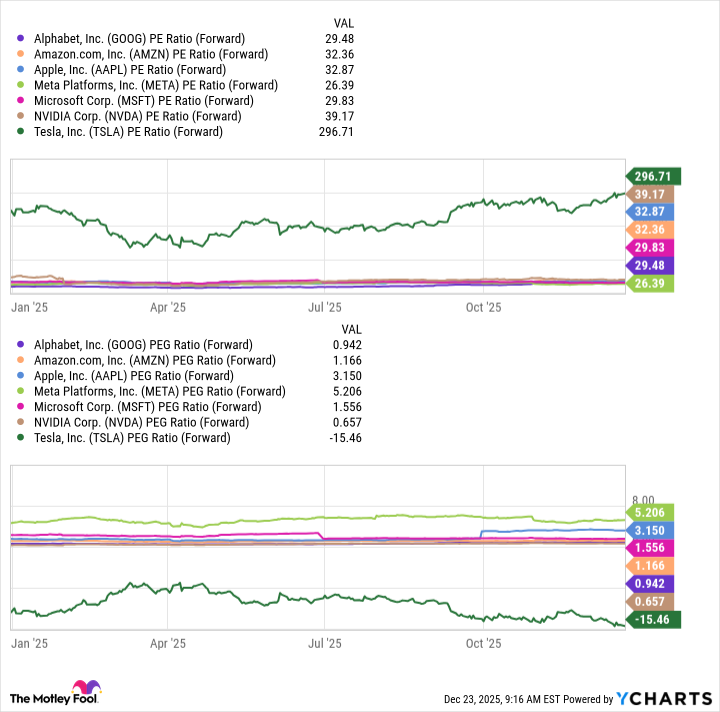
GOOG PE Ratio (Forward) data by YCharts
And one of Alphabet's most important growth drivers over the next five years will continue to be AI. It isn't just the products it offers through the cloud, or the Gemini 3 subscription available to individuals. Alphabet has implemented AI tools across its business to increase its profitability. For instance, it has improved its search algorithms using AI, as well as added AI mode and AI overviews. These initiatives lead to better results, more search volume, and higher revenue from ads. Alphabet has also used AI to help companies automate ad campaigns, making the process far easier and more productive. This also adds up to more ad revenue for Alphabet.
On the other side of the equation, the company uses AI-powered algorithms on platforms like YouTube to recommend content to users, resulting in increased engagement. Beyond AI, Alphabet's Google Cloud division should drive significant revenue growth in the next few years. It's a lower-margin business than advertising, but it is growing much faster right now -- and it likely won't stop anytime soon. As Alphabet stated during its third-quarter earnings conference call, Google Cloud backlog reached $155 billion, representing a 46% increase compared to the second quarter.
Alphabet also pointed out that Cloud operating margins are expanding while the company is signing new customers at a faster rate. And it is doing all this despite stiff competition from two of its Magnificent Seven peers -- Amazon and Microsoft -- both of which have a higher market share.
In my view, given the strength of its advertising and cloud computing businesses, Alphabet's shares still look deeply undervalued, especially when considering other growth avenues, such as its growing number of subscriptions, which create a recurring source of revenue. Alphabet still looks attractive heading into the new year. It may or may not be the best-performing Magnificent Seven stock of 2026, but it appears likely to outperform the market over the next five years.