Wall Street analysts at Bank of America have told clients the artificial intelligence (AI) industry remains "the place to be" in 2026. Two hot stocks in the sector include Navitas Semiconductor (NVTS -8.15%) and Astera Labs (ALAB -4.81%).
Both provide key semiconductor components to the data centers that house AI systems. This helped Astera shares soar nearly 30% in 2025 through Dec. 23, while Navitas stock rose over 100% in that time.
Global data center capacity is projected to more than triple by 2030 compared to 2025, driven by escalating demand for artificial intelligence. The situation provides Navitas and Astera with years of potential business growth.
But is one a better AI stock to invest in than the other? Let's dive into both companies to find out.

Image source: Getty Images.
The state of Navitas Semiconductor
Navitas constructs semiconductors used for power conversion and charging. Its competitive advantage is that its products make highly efficient use of electricity, a key characteristic given that some data centers can be the size of cities.
These strengths resulted in Nvidia choosing to partner with Navitas. Nvidia recognizes that data centers today aren't designed to support AI's power demands, which is why it's working with Navitas and other partners to set up the infrastructure needed for artificial intelligence.
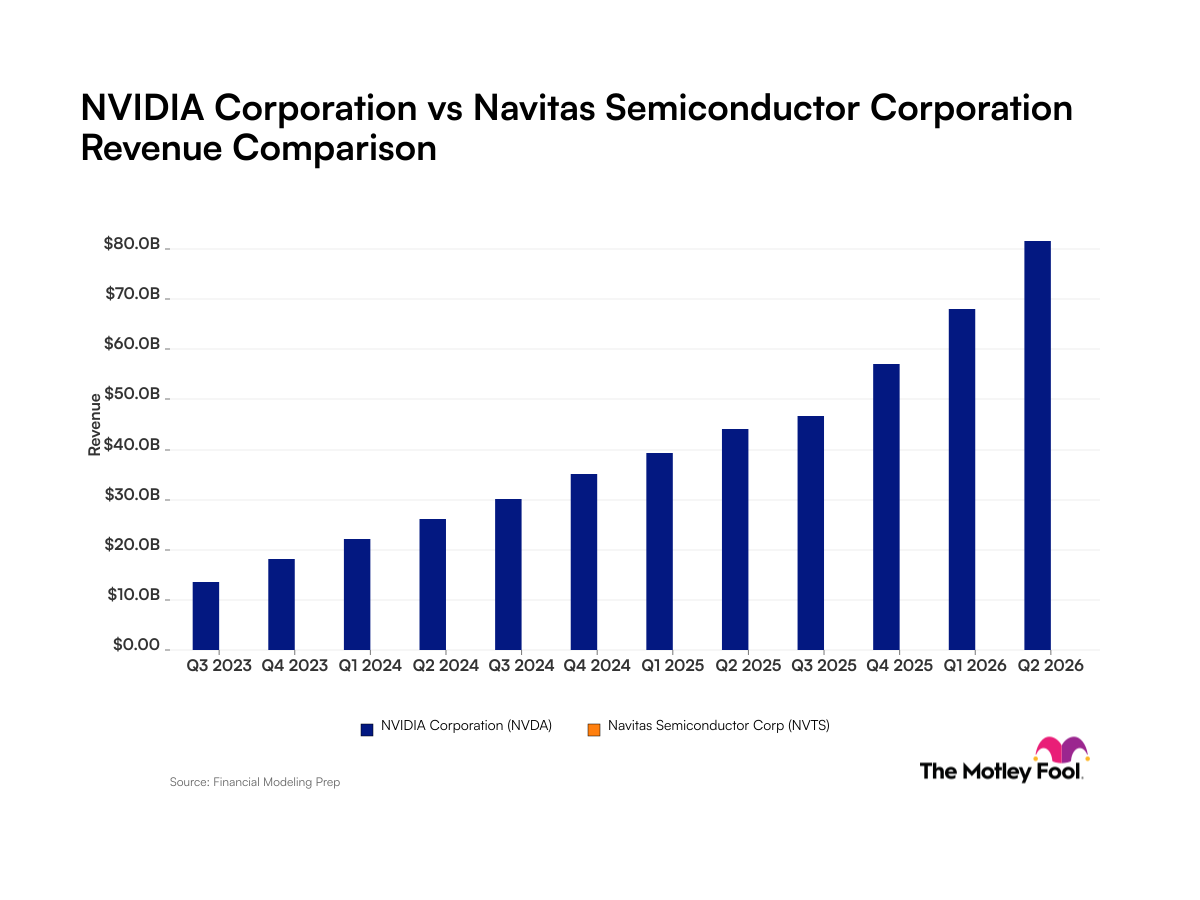
This partnership has propelled Navitas' share price but not its sales. The company's Q3 revenue plunged from $21.7 million in 2024 to $10.1 million in 2025. The 53% collapse in Q3 sales was the result of a decision to leave the mobile and consumer markets in China, which accounted for 60% of Navitas revenue in 2024.
Management decided to exit these markets to put resources toward what CEO Chris Allexandre calls "high-power, high-growth markets such as AI data centers." The company expects Q4 revenue to continue spiraling downward to about $7 million. That's a fraction of the $18 million generated in the prior year.

NASDAQ: NVTS
Key Data Points
A look into Astera Labs
Astera Labs specializes in connectivity solutions that allow AI servers to communicate efficiently with each other. In addition, it provides software tools for customers to manage complex AI infrastructure with ease.
These capabilities helped the company land a partnership with Nvidia. It also led to record Q3 revenue of $230.6 million for Astera, an impressive 104% year-over-year increase.
Strong sales growth is expected to continue in Q4 with revenue ranging between $245 million to $253 million. That would be a substantial increase from 2024's Q4 sales of $141.1 million.
The ongoing revenue growth illustrates the popularity of Astera's products. Its focus on connectivity, hardware and software integration, and its commitment to open standards, which enable a plug-and-play approach, are factors that can propel continued success in 2026.

NASDAQ: ALAB
Key Data Points
Picking between Navitas and Astera Labs
With revenue rising for Astera Labs as Navitas' sales go in the opposite direction, it seems the former would be the better choice for an AI investment. Not so fast.
But Navitas expects its declining sales to begin bouncing back in 2026 and to manifest a pattern of sequential quarterly growth. The company is also forecasting gradual gross margin expansion from Q4's anticipated 38.5%, since it's moving away from its low-margin business in China.
If Navitas' strategic pivot pays off, its shares could see upside in 2026. But that requires investors to put their faith in the company's AI vision.
Still, Navitas possesses an advantage over Astera when it comes to share price valuation. This can be seen in each stock's price-to-sales (P/S) ratio, which indicates how much investors are paying for every dollar of revenue generated over the past 12 months.

Data by YCharts.
The chart above shows Navitas is the better value compared to Astera, given its lower P/S multiple, and that's been the case for most of 2025.
Certainly, Astera stock warrants a higher valuation since its sales are growing. It's also a profitable business with Q3 net income of $91.1 million. Navitas meanwhile suffered a net loss of $19.2 million in the third quarter. However, despite its P/S ratio coming down from earlier in the year, Astera still trades at over 40 times trailing sales as of Dec. 23, making the stock quite pricey.
If the transition Navitas is undertaking sounds appealing, that may be the stock to choose. However, the prudent approach is to wait for its Q1 earnings report to confirm its claim of revenue growth in the new year.
Otherwise, Astera Labs' profitability and the strong demand for its products, as demonstrated by rapid revenue growth, make it a superior AI stock to Navitas. But given its lofty valuation, wait for the share price to drop before deciding to buy.