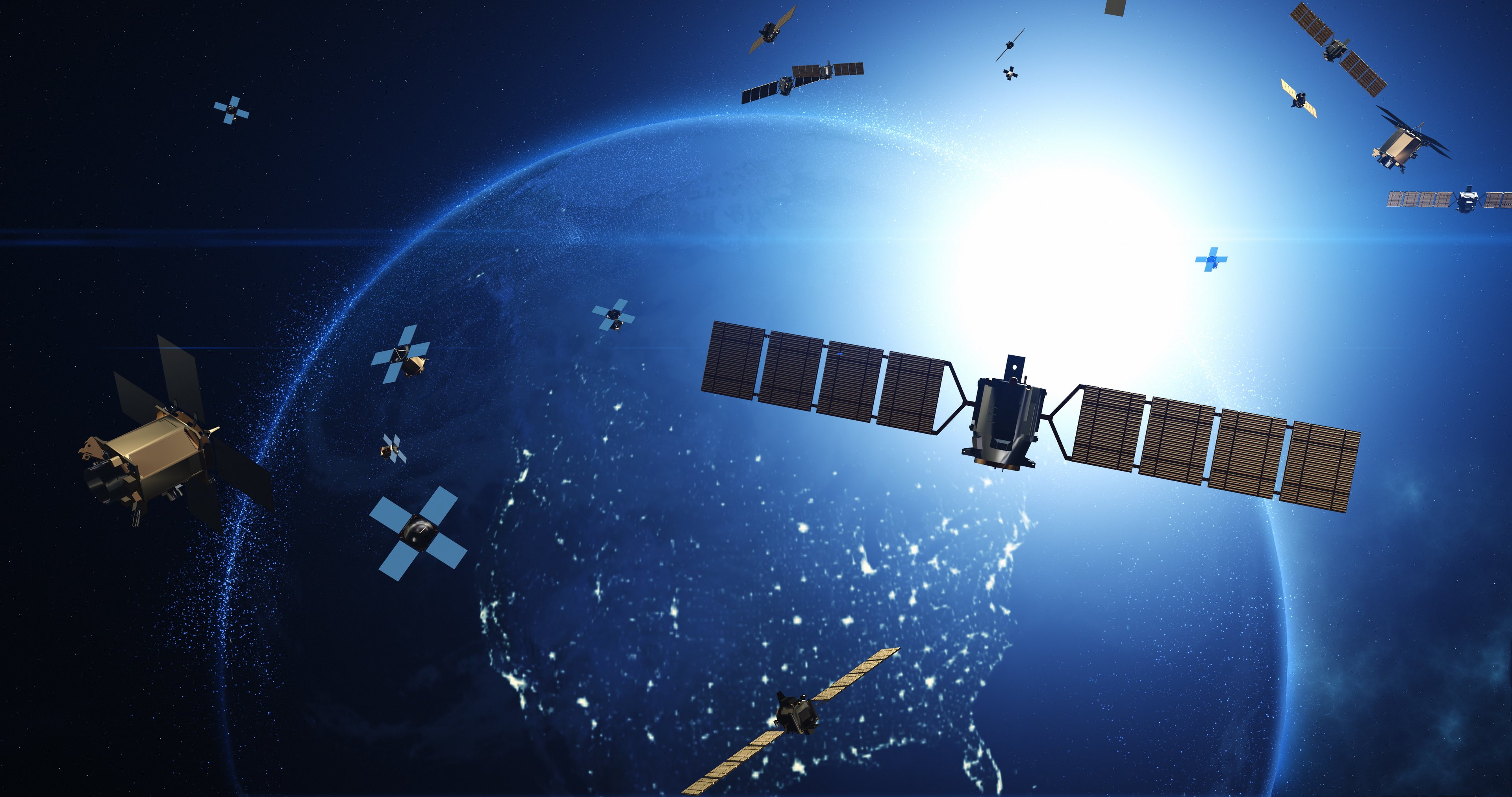
The news struck like a thunderbolt: 35 years after Ronald Reagan's "Strategic Defense Initiative" (a.k.a. "Star Wars") missile defense system quietly expired with the end of the Cold War, President Trump would revive the concept as a Golden Dome over America. Once complete, said the president, "the Golden Dome will be capable of intercepting missiles even if they are launched from other sides of the world."
Some pundits loved the idea. Others hated it. No one knew for certain much Golden Dome would cost.
But now we know.
Image source: Getty Images.
From $25 billion to $151 billion
When the president first announced Golden Dome in May 2025, we did get an idea of the down payment -- $25 billion would cover the cost of designing "an architecture for this state-of-the-art system." Actually building the thing, though, would cost tens of billions more, with estimates ranging as high as $175 billion.
How long will it take to go from $25 billion to $175 billion? This remains to be seen. But I can tell you one thing: It took barely six months to go from $25 billion to $151 billion! We know this because, on Dec. 2, the U.S. Department of Defense announced a $151 billion contract to something it called the "Scalable Homeland Innovative Enterprise Layered Defense (SHIELD)."
Agents of SHIELD
What is SHIELD, you ask? According to defense policy consulting firm Summit Strategy, SHIELD is "a major contract vehicle aimed at revolutionizing America's missile defense capabilities through next-generation technologies and innovative approaches." Not a company at all, SHIELD is just a receptacle for the tens of billions of dollars of defense contracts the Trump administration plans to pour into the Golden Dome project.
According to the U.S. Department of War website (Department of War is the working title of the Department of Defense under the current administration), SHIELD will be administered by the U.S. Missile Defense Agency, which is logical. And the $151 billion in funds on offer will take the form of a "multiple award, indefinite-delivery/indefinite-quantity contract."
What this usually means is that the number of specific subcontracts awarded, and their value -- and even their subject matter -- will be announced later on, and be funded under the initial umbrella contract that is SHIELD.
There are 2,100 separate companies that will share in this government largesse, with 1,014 awardees selected for the Dec. 2 contract, and another 1,086 picked two weeks later on Dec. 18. According to the DOW website, the initial $151 billion covers only "the first phase of staggered awards" to its defense contractors.
This appears to imply that additional funds will be awarded as Golden Dome takes shape, although it's not clear if such funds will be added during the course of the initial contract, which runs through 2035, or only afterwards.
Who won SHIELD contracts?
Curiously, the Pentagon did not specify which specific companies won awards in either of its contract announcements. Other sources, however, such as government contracts website govconwire.com, confirm that satellite companies, including Viasat (VSAT +9.20%) and Maxar Intelligence, won awards (apparently before Maxar changed its name to Vantor), as did Maxar's other half, the business now known as Lanteris Space Systems -- soon to become part of Intuitive Machines (LUNR +10.17%).
Large defense contractors and more general aerospace specialists also feature prominently among the awardees: Boeing (BA +4.91%), General Dynamics (GD +2.00%), Lockheed Martin (LMT +2.77%), Northrop Grumman (NOC +2.71%), and RTX (RTX +2.10%), for example.
Of particular interest, SpaceX does not appear to have yet been awarded a SHIELD contract (or at least its participation has not yet been made public).
What happens next?
With SHIELD expected to spend the next 10 years funding and building Golden Dome, it's still early innings in this game, and the details of the program remain in flux. Indeed, DOW says it's still "conducting market research and drafting Fair Opportunity Proposal Requests" for its awardees, and it seems no specific task orders have yet been issued.
To be crystal clear, DOW notes that "no funds will be obligated on the base IDIQ award; funds will be obligated at the order level." This means that, even for the companies that we know have won awards, we don't know how much money they've won, or will win, or what work they must do to earn it. All of that remains to be determined.
What we do know is that a veritable torrent of money is en route. And we've got a list of at least some of the stocks that might benefit from it. As for the details... stay tuned.