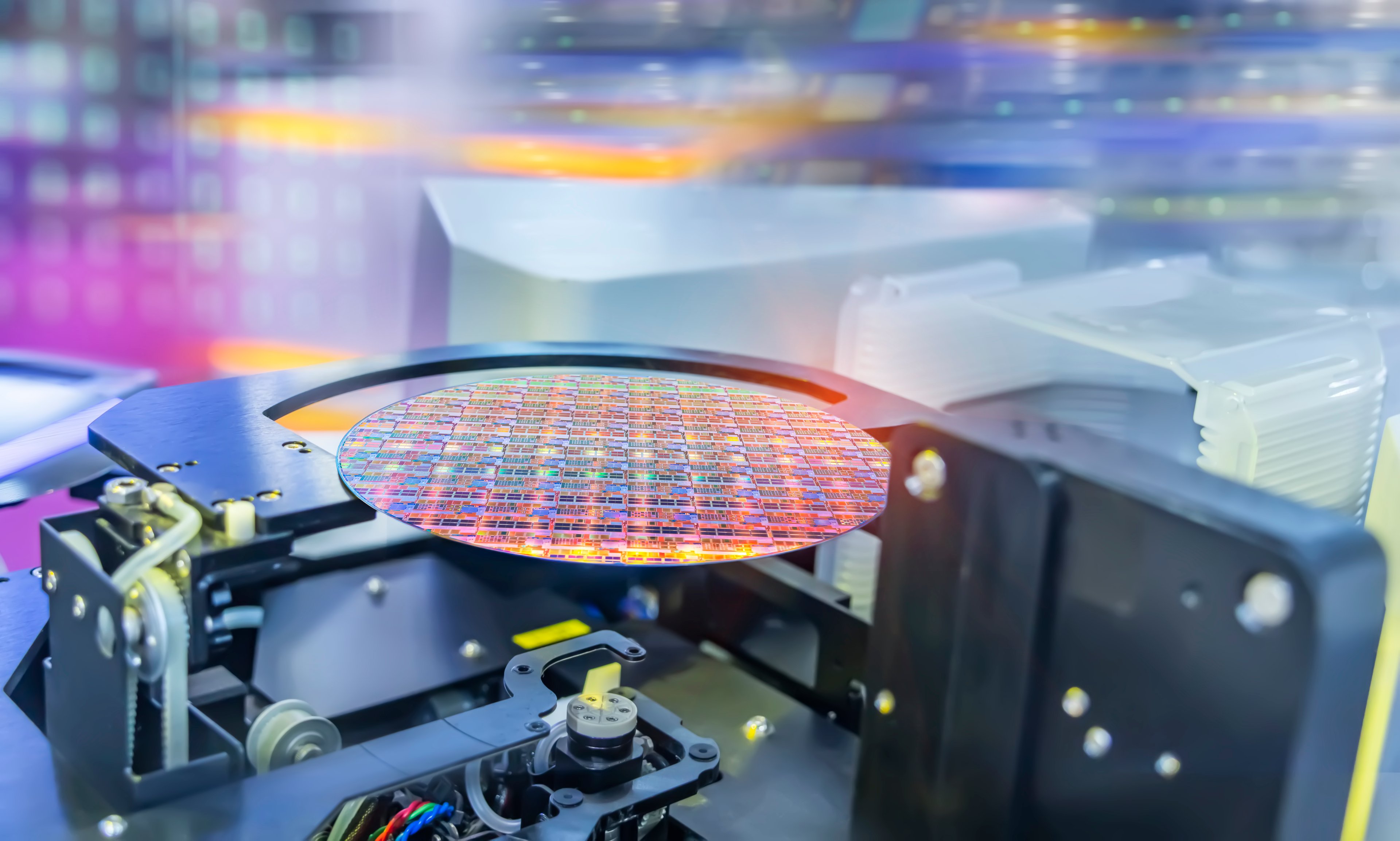
At CES 2026, Intel (INTC +2.01%) officially launched its Panther Lake family of PC CPUs under the Intel Core Ultra Series 3 branding. There are more than 200 PC designs in the works from partners, and Intel is also positioning Panther Lake for embedded and industrial use cases, including robotics and automation.
This is not a run-of-the-mill product launch from Intel. With the company still working on a multi-year turnaround effort, Panther Lake's success is absolutely critical to Intel's future. Here's why.
Image source: Intel.
Staging a comeback in the PC market
Intel has been losing market share in the PC CPU market to AMD for years. In the laptop CPU market, Intel's share declined from over 90% in 2018 to 78% by mid-2025, according to Mercury Research. Intel remains dominant, but the steady erosion of market share has pressured the company's PC business.
Until recently, Intel had been relying on its own older semiconductor manufacturing processes. The popular Raptor Lake family of chips used a version of Intel's 10 nm process, which is far less advanced than the most recent process nodes from TSMC. For Lunar Lake and Arrow Lake, Intel almost entirely outsourced manufacturing to TSMC in an effort to keep pace with AMD.
Lunar Lake was focused on battery life, while Arrow Lake was focused on performance. Panther Lake essentially represents the best of both worlds. Intel is claiming up to 27 hours of battery life, 60% better multi-threaded performance compared to Lunar Lake, and 77% better gaming performance. The new Intel 18A process is a key factor behind the performance and efficiency improvements.
Dell brought back its premium XPS line of laptops at CES, and its choice of components bodes well for Panther Lake. The company is using the high-end variants of Panther Lake, which feature Intel's most powerful integrated graphics. Notably, the new XPS line doesn't appear to include options with discrete graphics, apparently because Panther Lake provides enough graphics performance on its own. Dell is also touting a 27-hour battery life, or 40 hours for local video playback.
While benchmarks and reviews of Panther Lake devices haven't yet arrived, so far, it's looking like Intel has a winner on its hands.
A proof-of-concept for the foundry business
Intel has struggled to sign major external customers for its foundry business. Yields were initially a problem, but the company has now confirmed that yields are improving by about 7% per month, which is in line with industry norms. Intel 18A introduces two key technologies, gate-all-around transistors and backside power delivery, the latter of which is currently unique to Intel.
Panther Lake is the first high-volume chip to use the Intel 18A process. Because it's launching in the early days of volume production, the chip's profitability may be limited due to lower yields. However, the value of Panther Lake goes beyond boosting the PC business.
Any chip designer toying with the idea of using Intel for manufacturing is likely closely watching the Panther Lake launch. If Panther Lake can deliver on both the performance and efficiency fronts, it will provide some critical validation of the Intel 18A process, as well as more confidence in the next-generation Intel 14A process.
Rumors have circulated that Apple is considering using Intel 18A-P, a performance-optimized variant of the process, for some of its M-series chips in 2027. The likelihood of Intel winning Apple's business increases dramatically if Panther Lake is a home run. For Intel's foundry business to be sustainable, the company must start securing major customers. Panther Lake represents a proof-of-concept that could kick off a winning streak for the foundry business in 2026 and beyond.

NASDAQ: INTC
Key Data Points
The most important product in years
Panther Lake still needs to prove itself as devices begin shipping later this month, but given what Intel and its partners have said about performance and battery life, Panther Lake-powered laptops are looking like compelling options for consumers and businesses.
Intel stock soared 84% in 2025, and the company can sustain the rally by demonstrating meaningful progress in the foundry business. If Panther Lake is a success story, the Intel 18A process and the Intel 14A process become more compelling options for chip designers, especially given the capacity constraints at .
For Intel's foundry business to succeed, the company needs hard commitments from customers. A successful Panther Lake launch could help deliver those commitments and prove to investors that Intel's strategy is paying off.