Shares of Duolingo(DUOL 5.75%) fell hard in 2025, according to data from S&P Global Market Intelligence. The online and mobile language-learning expert started the year in fine form, as share prices reached a 66.8% year-to-date gain as of May 14. But that was a short-lived peak, and Duolingo ended 2025 at a 45.9% loss.
What's up with this roller coaster?
Image source: Getty Images.
Duolingo's rise was no accident
Duolingo's rise to the mid-May summit is easy to understand. The language-learning app with the green owl mascot is growing like the dollarweeds in my backyard.
The company had 50.5 million daily active users in the latest earnings report, up from 24.2 million two years earlier and 9.8 million daily users in the fall of 2021. Over the same 4-year period, the number of paid subscribers rose from 2.2 million to 11.5 million. Trailing revenues more than quadrupled from $226 million to $964 million while bottom-line net income swung from a loss to a 40% profit margin:
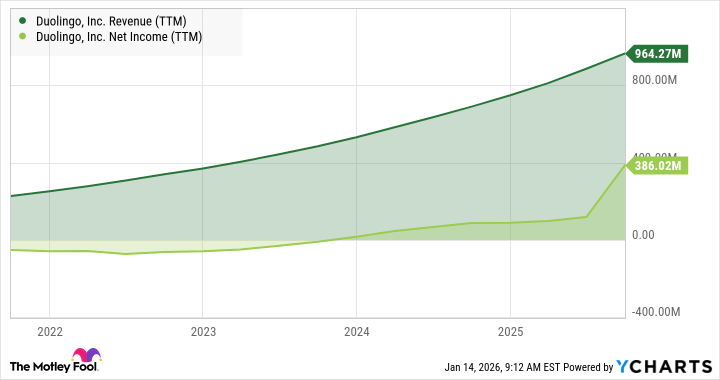
DUOL Revenue (TTM) data by YCharts
That's how Duolingo earned a price-to-earnings (P/E) multiple of 270 for a few hours.
Duolingo isn't just a language-learning system, but a platform for teaching anything that fits its focus on repeating facts in a game-like experience. That includes simple math, music, and chess at this point. In the long run, co-founder Luis von Ahn wants to run a general learning platform that makes the world a better place.
"We're looking for things that have hundreds of millions of people or billions of people," he told the Stanford Graduate School of Business in an interview last summer. "It turns out a lot of people want to learn Pokémon cards. We're not going to do that. We want it to be good for the world."
And of course, not every subject is suitable for gamified learning in a mobile app. Duolingo probably won't train surgeons or chefs any time soon, since hands-on experience is a non-negotiable part of their education.

NASDAQ: DUOL
Key Data Points
What went wrong after May
The downtrend from May 14 is not so clear-cut. Since last May, earnings continued to soar while the stock price plunged. Together, these trends brought Duolingo's P/E ratio all the way down to 22.3 as of this writing on Jan. 14, 2026.
The financial results are booming and von Ahn has outlined an ambitious long-term business plan. Some investors see a threat in artificial intelligence (AI) tools like ChatGPT, and the company recently refocused its day-to-day operations from operating profit to user acquisition. Margins are likely to shrink in the next few quarters as Duolingo seeks user growth via discounted subscriptions and free trials.
Duolingo's stock took a lesson of its own in 2025: what goes up unreasonably high must come down. But with a P/E ratio that's finally speaking in modest tones and a high-octane growth engine, patient investors should find this owl worth a nibble.
I'm tempted to double down on my own position, which is up by 55% across three purchases in 2021 and 2022. But first, it's time to extend my 3,489-day streak of daily Duolingo lessons. Chess, Japanese, or Dutch? Ah, let's do all three. The gamification seems to work on people like me, anyway.