Although it was nothing short of a roller-coaster ride in 2025 for the stock market's benchmark index, the S&P 500 (^GSPC +0.26%), the third year of the bull market didn't disappoint. Following a short-lived period of historic turbulence tied to President Donald Trump's unveiling of his tariff and trade policy, the S&P 500 rallied to close out the year up 16%.
Big gains for the stock market with President Trump in the White House are nothing new. During Trump's first term (Jan. 20, 2017 – Jan. 20, 2021), the Dow Jones Industrial Average (^DJI +0.60%), S&P 500, and Nasdaq Composite (^IXIC +0.25%), respectively soared by 57%, 70%, and 142%!
For years, the evolution of artificial intelligence (AI) has been the stock market's primary catalyst. Nvidia's (NVDA +2.06%) graphics processing units (GPUs) are acting as the brains of AI-accelerated data centers and fueling enormous investments in this game-changing technology that's expected to create more than $15 trillion in global economic value by 2030, according to analysts at PwC.
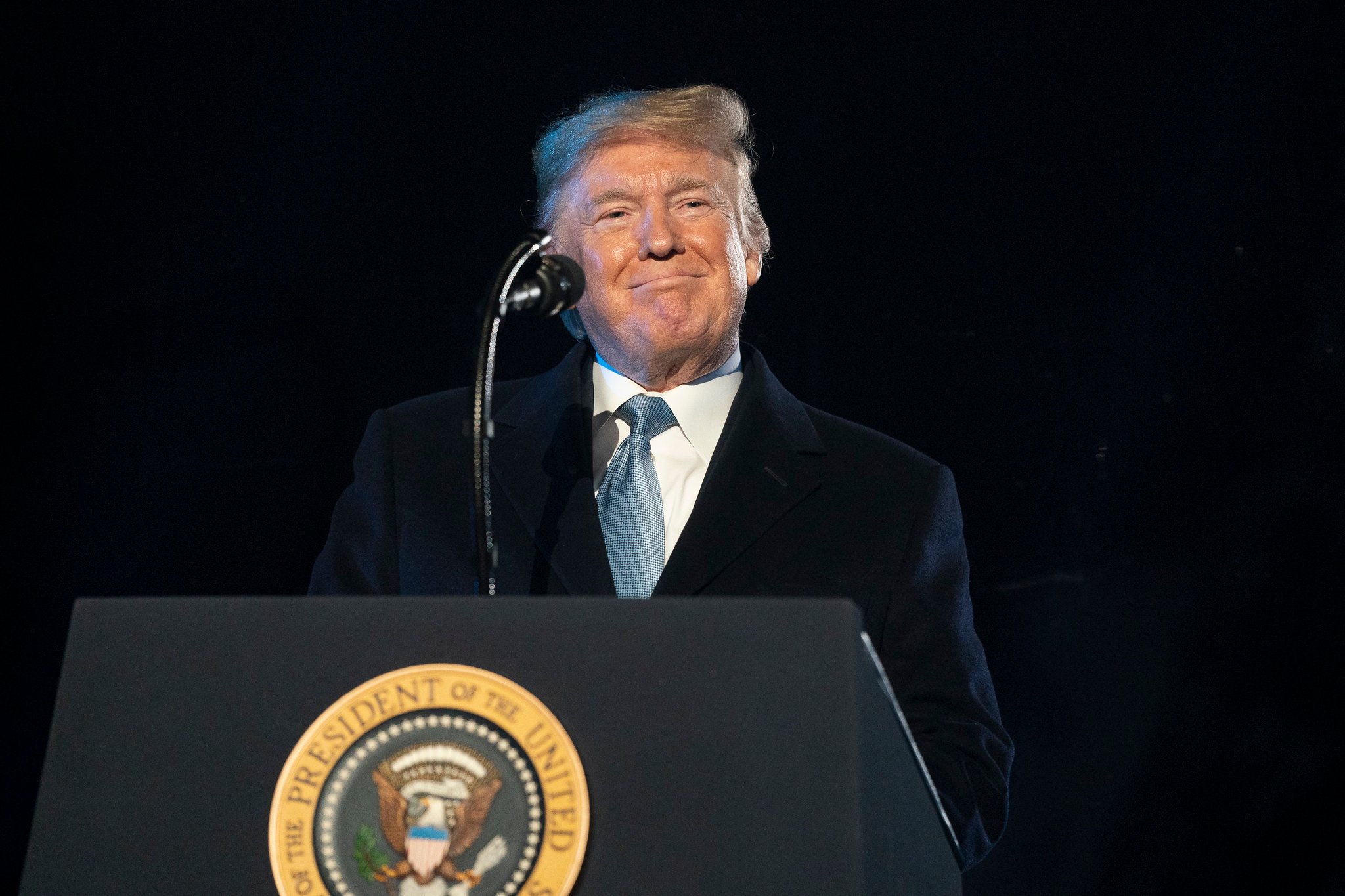
President Trump delivering remarks. Image source: Official White House Photo by Joyce N. Boghosian, courtesy of the National Archives.
However, AI isn't the only trillion-dollar trend that's lit a fire under Wall Street and high-flying stocks like Nvidia. You might be surprised to learn that President Trump's tax policy appears to have played a pivotal role in sparking a now-annual trillion-dollar investment trend on Wall Street.
Donald Trump's policies are leaving an indelible mark on Wall Street
Since every U.S. president and Congress are responsible for shaping our nation's fiscal policy, it's expected that every administration will leave its mark. In Trump's case, he's had an undeniable impact on corporate America during his non-consecutive two-term presidency.
As alluded to earlier, Trump's tariff and trade policy, announced in early April, briefly roiled the stock market. Trump's trade plan involved a sweeping 10% global tariff rate, as well as higher "reciprocal tariffs" on dozens of countries that have had adverse trade imbalances with America. Several trade deals have been announced since early April, resulting in changes following Trump's initial proposals.
Nevertheless, tariffs are threatening to take a bite out of corporate profits and/or forcing businesses to alter their game plans.
According to a December 2024 report ("Do Import Tariffs Protect U.S. Firms?") from four New York Federal Reserve economists writing for Liberty Street Economics, the companies directly impacted by Trump's China tariffs in 2018-2019 saw, on average, their employment levels, labor productivity, sales, and profits decline from 2019 to 2021. In other words, Trump's tariffs had a lasting negative impact on businesses during (and following) his first term.
However, some of the president's policies have had a decisively positive impact on U.S. businesses. The passage of the Tax Cuts and Jobs Act (TCJA) in 2017 is a perfect example.
Although the TCJA temporarily lowered personal tax bracket thresholds (which the recently passed "big, beautiful bill" made permanent), it's the permanent change it made to the peak marginal corporate income tax rate that sent shockwaves through Wall Street.
Prior to the TCJA, the peak marginal corporate income tax was 35%. Following Trump's signing of this flagship tax and spending law, the corporate income tax rate was permanently reduced to 21%, marking its lowest peak rate since 1939.
While the hope was that public companies would use the extra income they get to keep as a result of a lower tax rate to hire, acquire, and innovate, published data from S&P Dow Jones Indices, a division of the more familiar S&P Global, shows it's been used to spark a trillion-dollar annual investment.

Image source: Getty Images.
Stock buyback activity has surged to an all-time high under President Trump
Though we've certainly observed aggressive corporate investments in the metaverse and AI in the wake of the TCJA becoming law, the biggest impact of all looks to be in the share repurchase column for S&P 500 companies.
According to a mid-December press release from S&P Dow Jones Indices, S&P 500 companies bought back $249 billion worth of their own company's stock in the third quarter of 2025. While down from the all-time record of $293.5 billion in buybacks set in the first quarter of 2025, it nonetheless puts the companies that comprise the S&P 500 on pace to record an estimated $1.02 trillion in share repurchases for 2025.
Before the TCJA became law, cumulative quarterly buyback activity for S&P 500 stocks regularly landed between $100 billion and $150 billion. In its wake (excluding a short period of historic uncertainty during the early stages of the COVID-19 pandemic), quarterly repurchasing activity for S&P 500 companies has surged to between $200 billion and $250 billion per quarter.
While we can't say with concrete certainty that Trump's tax policy directly led to S&P 500 companies making cumulative annual trillion-dollar investments in themselves, the data would strongly indicate that this is the case.

NASDAQ: AAPL
Key Data Points
Though hundreds of S&P 500 companies have been taking advantage of a lower peak marginal corporate income tax rate to buy back their stock, Apple (AAPL 0.73%), Alphabet (GOOGL 1.07%)(GOOG 0.94%), and, more recently, Nvidia have stood out.
No public company has a more prolific share-repurchase program than tech stock Apple. The maker of the ultra-popular iPhone has bought back more than $816 billion worth of its own stock since initiating a buyback program in 2013 and reduced its outstanding share count by approximately 44%. This has had a decisively positive impact on its earnings per share and made Apple stock more fundamentally attractive to value-focused investors. Apple spent $90.7 billion on buybacks in fiscal 2025 (ended Sept. 27, 2025).
Among S&P 500 companies, Google parent Alphabet ranks No. 2 in share buybacks over the trailing decade (through Sept. 30, 2025). S&P Dow Jones Indices lists Alphabet as having purchased $342.4 billion worth of its shares over the trailing 10-year period.
Alphabet's Google is a virtual monopoly responsible for approximately 90% of global internet search share. Between its sustainable moat in advertising and its burgeoning cloud infrastructure service platform, Google Cloud, Alphabet has every incentive to use its abundant operating cash flow to repurchase its stock.

NASDAQ: NVDA
Key Data Points
While Nvidia has "only" bought back $115.1 billion worth of its common shares over the last decade, its trailing 12-month buyback total is approaching $52 billion. The insatiable demand for Nvidia's GPUs has afforded the company astronomical pricing power, sending its gross margin into orbit. With more operating cash flow than it knows what to do with, Nvidia has turned to share buybacks.
With no imminent threat of corporate income tax policy changes, Apple, Alphabet, Nvidia, and most members of the S&P 500 are incentivized to reward their shareholders with buybacks that can potentially boost their own earnings per share. Though AI may be the talk of Wall Street, Donald Trump appears to be fueling the trillion-dollar share buyback revolution.