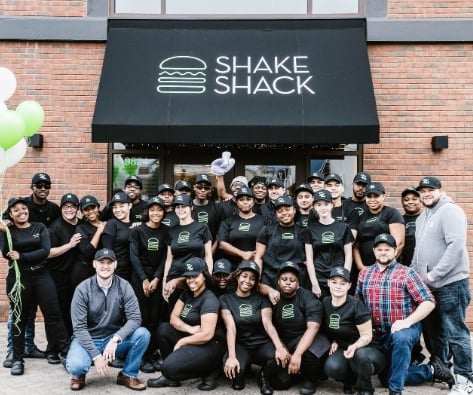
Fast-casual dining chain Shake Shack (SHAK 1.64%) had a big year in 2025. The company announced a massive expansion plan that would more than triple its store count to 1,500 company-owned and licensed locations. The one-time hot dog stand opened 30 new stores as of its third-quarter 2025 earnings report, with plans to ramp that up to 55 to 60 new stores in 2026.
Perhaps most impressively, it delivered same-store-sales growth of 4.9% year over year, at a time when fast-food traffic declined 1.1% nationwide, according to the data company Revenue Management Solutions. To pull off mid-single-digit same-store sales growth in 2025 strikes me as a huge achievement, considering how fast-food executives are lamenting challenging macroeconomic conditions and pinched consumers in seemingly every earnings call.
For context, Chipotle Mexican Grill just saw its first same-store sales decline in 20 years, while Wendy's shares are down 43% in a year in which the company announced a 4.7% slump in same-store sales and plans to close hundreds of U.S. stores. Arby's closed dozens of stores across America in 2025, while McDonald's CEO Christopher Kempczinski announced a 10% slump in lower-income customer visits in Q3 amid a "challenging" pricing environment.
You can see the sector's pain in the performance of AdvisorShares Restaurant ETF (EATZ 0.68%), an exchange-traded fund that allocates at least 80% of net assets to companies dealing primarily in the restaurant business. Over the last 12 months, as the S&P 500 returned 18.5%, the fund eked out a 2% gain.

NYSEMKT: EATZ
Key Data Points
But by every measure except one, Shake Shack has been a rare bright spot in the industry. Apart from its growing same-store sales and robust store openings, it also grew its restaurant-level profit by 180 basis points, bringing its restaurant-level profitability to 22.8% as of the third quarter. For context, the average restaurant-level profit margin typically ranges from 3% to 6%.
Most strikingly to me, it posted its 19th consecutive quarter of sales growth in Q3. That means that, even as inflation hit 9.2% in mid-2022, Shake Shack was able to grow sales that quarter, while much larger competitors like McDonald's saw a 3% slump.
A lesson in pricing power
Over the last 19 quarters, Shake Shack has repeatedly raised prices, yet customers just keep coming back. In 2024, same-store sales rose 4.3% despite price hikes, and at the end of that year it was named the most overpriced fast-food chain in a survey by Preply. Yet, it regularly gets away with passing along higher costs to consumers, even as its restaurant-level margins keep climbing.

Image source: Getty Images.
That's called pricing power, and Warren Buffett explained it well when he told students at the University of Florida about one of his all-time favorite investments, his $25 million purchase of See's Candies. At the time of his purchase, See's sold candy for $1.97 per pound. Yet it was able to raise prices every year for a decade by 11.4% a year, on average, while selling more volume each year. Pricing power was, Buffett asserted, one reason he knew that this eventual 8,000% winner was a great business.
Like See's Candies, Shake Shack has shown it can raise prices with impunity. That indicates a special business -- yet shares slumped in 2025. And unlike See's Candies, I don't think buying Shake Shack today will result in an 8,000% gain, or necessarily any gain at all. Here's why.

NYSE: SHAK
Key Data Points
Severe overvaluation tilts the odds against investors
Shake Shack's price-to-earnings ratio of 98 is more than triple that of the average S&P 500 company. It's over twice as expensive by the numbers as Nvidia, the artificial intelligence (AI) darling with a P/E ratio of 45, that at least is growing earnings by 65% year over year.
To put this in perspective, Shake Shack could post 100% earnings growth overnight and still be more expensive than the hottest stock of the $15.7 trillion AI revolution. When a stock is this overvalued, it tilts the odds against investors, because a company that's "priced for perfection" oftentimes can do nothing but disappoint.
Shake Shack is an intriguing and impressive enough company that I might buy shares of at a modest premium, but this nosebleed valuation is too much. Investors would be well advised to wait for a more favorable entry point before buying shares.