At the end of 2024, I predicted that Nvidia (NVDA 4.42%) would be a $5 trillion company in 2025. The reasons for this prediction were rather simple: The AI hyperscalers would continue spending at a rapid pace, and I was right on that account.
However, I was wrong about Nvidia's valuation multiples. Nvidia breached the $5 trillion market cap level, and although it's below that threshold right now, I think it will return in 2026.
Image source: Nvidia.
Nvidia was a $5 trillion company, but only briefly
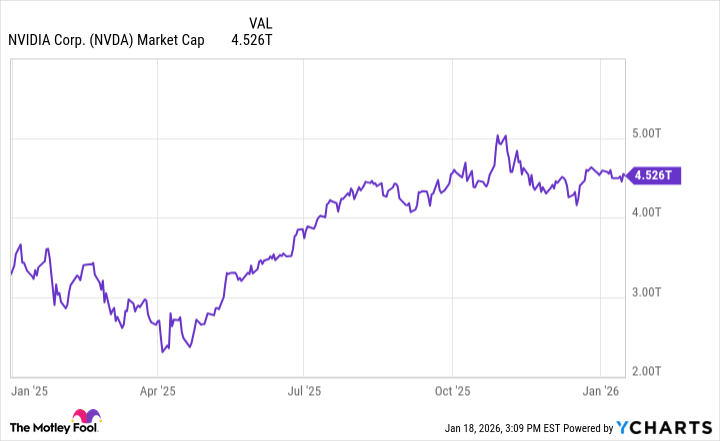
Nvidia entered 2025 valued at just over $3 trillion, so it would take a significant gain for it to breach the $5 trillion mark. Following President Trump's tariff announcements in April, this prediction was in even worse shape as Nvidia was nearly a $2 trillion company.
NVDA Market Cap data by YCharts
However, as the market rallied throughout the year, Nvidia became the first $5 trillion company in October, although it is no longer at that level.
What drove it there was the insatiable demand for its graphics processing units (GPUs), and AI hyperscalers willing to spend a near-unlimited amount of money on computing equipment. That trend didn't shift throughout 2025, and there are no indications it will change in 2026. As a result, I think Nvidia will end the year solidly in the $5 trillion club.

NASDAQ: NVDA
Key Data Points
However, one part of my projection was wrong.
Nvidia's valuation is cheaper than I expected
At the end of 2024 (when I made the initial prediction), Nvidia had a price-to-forward earnings ratio of 45. I called that a bit expensive, but it's slightly cheaper now at 40 times forward earnings.
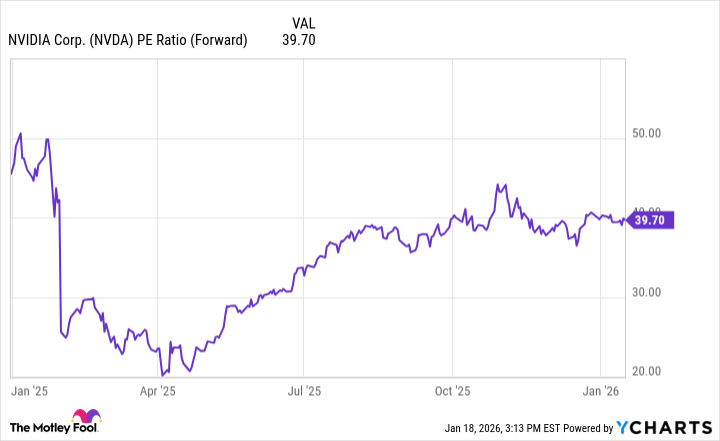
NVDA PE Ratio (Forward) data by YCharts
Make no mistake; Nvidia's stock still isn't cheap. However, the other big tech stocks' valuation levels have climbed to around the 30 times forward earnings level. That gives Nvidia a slight premium over its peers, but I still think that it's a much better buy. After all, which big tech company will be able to match Nvidia's growth this year? Wall Street analysts are projecting 50% revenue growth, driven by Nvidia's platform dominance.
I think 2026 will be the year Nvidia crosses the $5 trillion threshold and doesn't look back. That would require the stock to rise around 10%, which is about market-average returns. I think the actual bull case is far higher than that, and Nvidia should be at the top of investors' purchasing list for 2026.