What do Stanley Druckenmiller, Israel Englander, Ken Griffin, Bill Ackman, and Philippe Laffont all have in common? If you guessed that they are all billionaire investors, you're halfway there.
While some of these investors tend to buy growth stocks, while others flock toward value plays, each of their respective funds hold a common artificial intelligence (AI) position: Alphabet (GOOGL +0.39%) (GOOG +0.42%).
Let's break down why Alphabet is attracting so many billionaire investors, and assess what makes the internet giant such a unique player in the AI landscape.

Image source: Getty Images.
Alphabet is different from its magnificent counterparts
When you think about Alphabet, my hunch is your mind goes straight to Google and YouTube. Alphabet's near-monopoly on internet search is what the company is best known for.
What most investors probably don't appreciate is that Alphabet has a number of subsidiaries spread across several different end markets. Beyond search, Alphabet operates across the following:
- Consumer electronics and smart-home devices through Android
- Autonomous vehicles through Waymo
- Cybersecurity thanks to its acquisition of Wiz and other competing properties
- AI research through DeepMind
- Quantum computing development and custom silicon design
- Sustainable energy infrastructure through its acquisition of Intersect
On the surface, these segments simply drive home the idea that Alphabet is a diversified business. However, the company's underlying operation is far more complex.
Unlike some of its peers, Alphabet is deliberately stitching AI across every major business line. Through the power of its AI model, Gemini, Alphabet is introducing next-generation products and services to consumers and enterprises across both the hardware and software landscapes.

NASDAQ: GOOGL
Key Data Points
Why Alphabet's business model is a competitive advantage
What sets Alphabet's business model apart from the competition is the company's approach to vertical integration. This can be a competitive advantage because it allows a company to control different aspects of its supply chain and tech stack.
In turn, companies can reduce their reliance on external suppliers. In the long run, this can help lower costs and fuel innovation by providing businesses with the financial flexibility to double down on research and development (R&D) and sales and marketing.
What makes vertically integrated businesses so lucrative is that the various product lines support and reinforce one another. This flywheel effect leads to accelerating revenue, and can also strengthen the durability of earnings and cash flow.
Is Alphabet stock a good buy in 2026?
As of this writing (Jan. 22), Alphabet's forward price-to-earnings (P/E) multiple of 29 is near its highest level yet during the AI revolution. While this could imply that Alphabet stock might be overbought, there are some nuances smart investors shouldn't overlook.
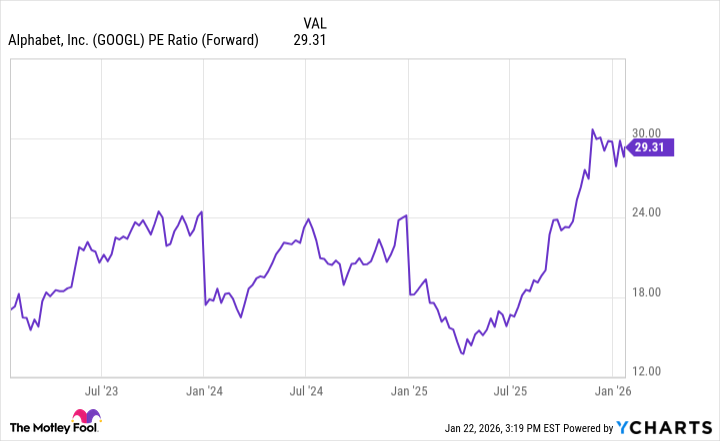
GOOGL PE Ratio (Forward) data by YCharts
Per the trends above, it's clear that Alphabet stock is currently enjoying some momentum. While the stock isn't necessarily a bargain anymore, I think it's telling that so much institutional capital is just now flowing toward the trillion-dollar powerhouse.
Wall Street has only just woken up to Alphabet's role and potential in the broader AI theme. Against this backdrop, I think "smart money" is anticipating further gains on the horizon as Alphabet doubles down on AI infrastructure and services.
Despite meaningful valuation expansion over the last several months, Alphabet's run-up was long overdue. This is another way of saying that Alphabet is only just beginning to grow into its new valuation profile -- supported by continued AI-driven revenue and earnings growth. In my eyes, Alphabet is one of the most compelling buy-and-hold AI stocks of the decade.