After years of lagging the market, Intel (INTC 5.68%) has suddenly found new life.
The stock has more than doubled over the last six months, even after its sharp pullback following disappointing guidance in its fourth-quarter earnings report.
Intel has rebounded with the help of the U.S. government, which took a 9.9% stake in the stock last August, which was followed by Nvidia investing $5 billion in the chip-maker in September.
Both moves gave Intel much-needed capital to continue investing in its foundry business and to develop new AI products. It also showed confidence in the company's turnaround prospects under new CEO Lip-Bu Tan, who has cut costs, streamlined the business, scaled back on capital expenditures, and is aiming to overhaul the culture, making it less bureaucratic and more like a start-up.
However, the recent pullback on its earnings report shows that the stock may be overbought and that expectations seem to have outrun the current reality of the business. Intel is still struggling to grow and turn a profit. Revenue fell 4% in the fourth quarter to $13.7 billion, and it reported a generally accepted accounting principles (GAAP) loss of $591 million, though it was profitable on an adjusted basis.
For the first quarter, it expects revenue of $11.7 billion-$12.7 billion, which is a sharp sequential decline, and sees adjusted earnings per share of just break-even.
For investors looking to capitalize on the AI infrastructure boom, there's a more reliable stock to buy here. In fact, it's a chief rival of Intel. I'm talking about Taiwan Semiconductor Manufacturing Corporation (TSM 4.96%), the world's leading contract manufacturer of semiconductors.
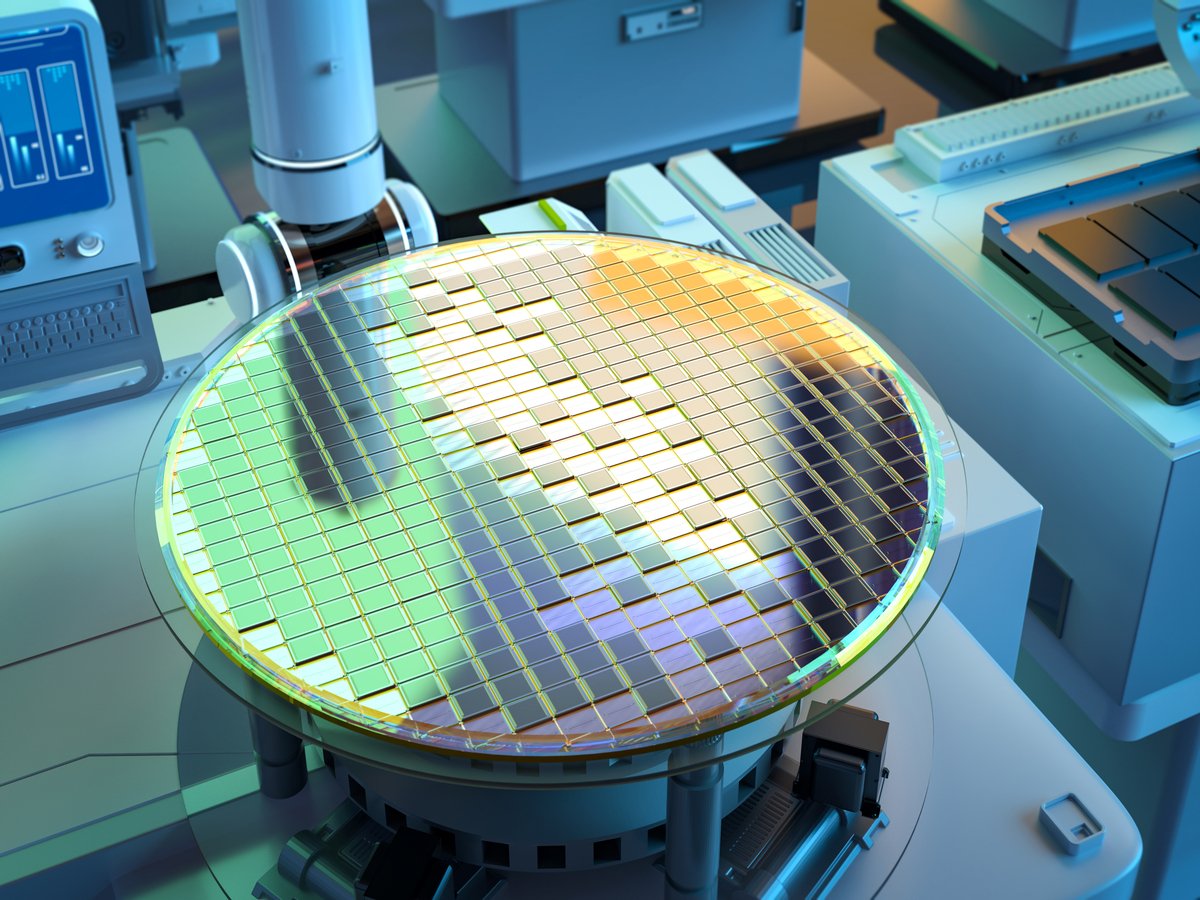
Image source: Getty Images.
A track record of excellence
TSMC, as the company is often known, isn't a household name like Intel. It doesn't make branded products, and it's based in Taiwan rather than the U.S.
However, the company is one of the most valuable in the world at a market cap of $1.8 trillion, and it's a linchpin in the global economy as it's the primary chip manufacturer for tech titans like Apple, Nvidia, AMD, Broadcom, and others. It manufactures more than half of the contract chips in the world and is estimated to account for 90% of the advanced contract chips.
That gives it a strong competitive advantage, and its results back that up as it's turned in phenomenal growth and profit margins during the AI boom.
In its fourth quarter, revenue rose 25.5% to $33.7 billion, and it reported an operating margin of 54%, or $18.2 billion in operating income.
TSMC now makes 77% of its revenue from advanced chips, which it defines as those that are 7 nanometers (nm) or less. The stock also trades at an attractive valuation at a price-to-earnings ratio of 32, making it only slightly more expensive than the S&P 500. Historically, the stock has traded at a discount because it's based in Taiwan and some investors fear that China could invade the island territory.
TSMC stock has also been a longtime winner on the stock market, up more than 1,000% over the last decade.

NYSE: TSM
Key Data Points
Intel vs. TSMC
Intel operates in two primary segments: its products division, which refers to its chip designs, and its foundry division, which is focused on manufacturing. Historically, the company has manufactured chips solely for itself, but it restructured its business in 2021 to open its foundry to outside customers and has signed up some new customers, including Amazon.
Intel has staked the future of the foundry business on advanced processes like 18A (18 angstroms or 1.8nm), which it recently launched. 18A and the upcoming 14A, which is expected to enter production in 2028, have the potential to make Intel a real competitor to TSMC. However, a meaningful challenge from Intel is likely years away, and Intel has been losing billions of dollars a year on the foundry business as it builds out advanced processes in an attempt to establish a third-party manufacturing business.
At this point, Intel stock is more expensive than TSMC, even though its revenue is basically flat and it's losing money on a GAAP basis. TSMC, on the other hand, expects to grow revenue by a compound annual rate of around 25% through 2029, and it's currently keeping more than half of its revenue as operating income.
While Intel's turnaround may be appealing as a story, TSMC is the much safer bet here and should continue to beat the market as long as the AI boom continues.