At over 6%, UPS (UPS +1.63%) has one of the highest dividend yields in the S&P 500, where the average is below 2%. A high-yielding payout is often a warning sign of potential sustainability issues.
While UPS is experiencing some headwinds, the logistics giant expects to continue delivering its high-yielding dividend to shareholders. Here's a look at what drives its view.

Image source: Getty Images.
Ending on a high note
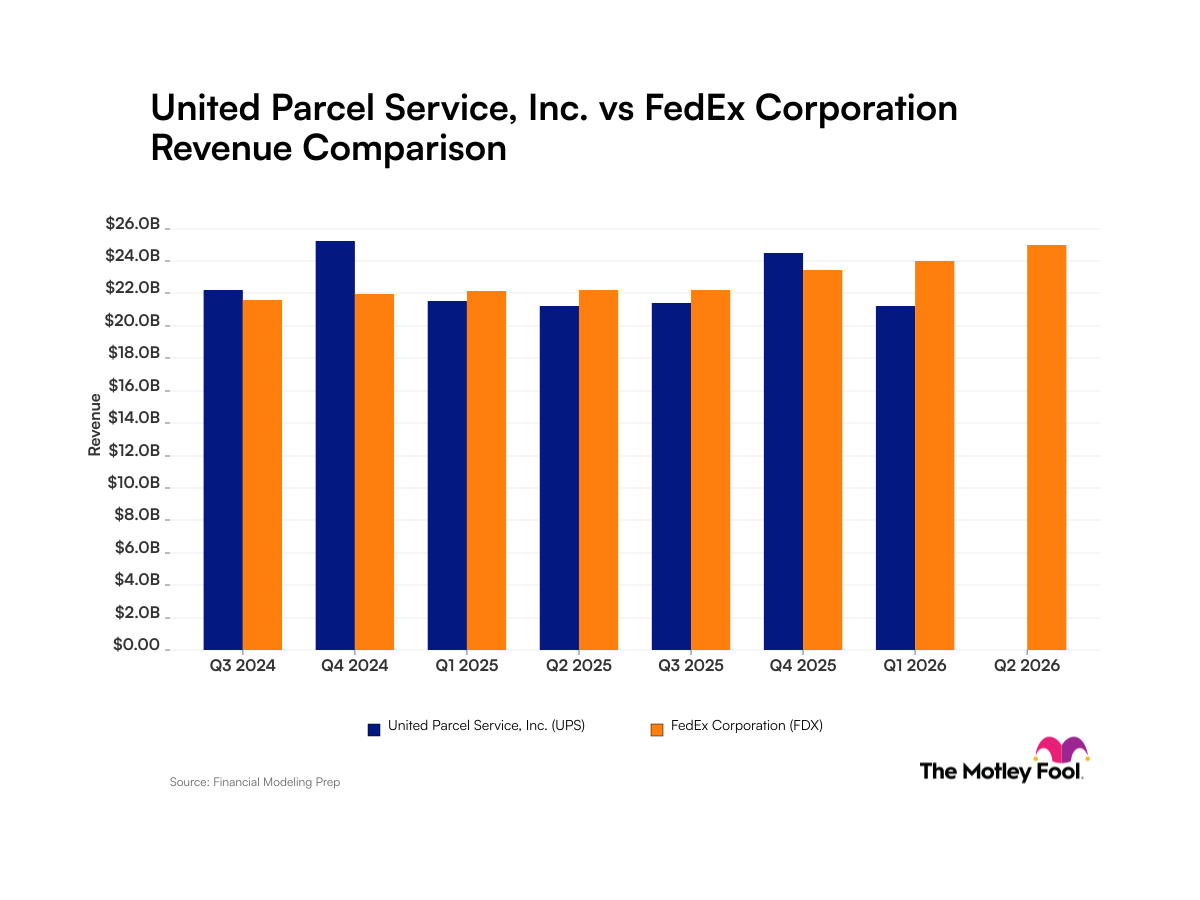
UPS recently reported its fourth-quarter and full-year financial results. The company generated $24.5 billion in revenue in the fourth quarter, just ahead of analysts' expectations. Meanwhile, its adjusted earnings of $2.38 per share beat the consensus estimate of $2.20 per share. Those results pushed the company's full-year revenue to $88.7 billion, while its adjusted earnings per share were $7.16. However, UPS' revenue is still well below the $100 billion it reported in 2022.
The company's financial results have been under pressure in recent years due to global trade issues and its decision to reduce its reliance on its top customer, Amazon. These issues led the company to focus on reducing costs and growing revenue from higher-margin sources. It made significant progress last year by closing facilities, reducing its workforce, and expanding its healthcare logistics capabilities.

NYSE: UPS
Key Data Points
That enabled the company to steadily improve its free cash flow. It generated $8.5 billion in cash from operations last year and $5.5 billion in adjusted free cash flow. It paid $5.4 billion in dividends and completed $1 billion in share repurchases. UPS used its strong balance sheet to cover the shortfall.
Hitting an inflection point
UPS anticipates "2026 will be an inflection point in the execution of our strategy to deliver growth and sustained margin expansion," commented CEO Carol Tome in the fourth-quarter earnings press release. The company expects to complete its strategy of reducing its low-margin Amazon volumes by 50% this year. That should boost its margins as it replaces those volumes with higher margin revenue.
Despite lower Amazon revenue, UPS anticipates its sales will rise to $89.7 billion this year. Meanwhile, the company expects to incur about $3 billion in capital expenditures, which is down from $3.7 billion last year. Additionally, it plans to pay another $5.4 billion in dividends this year. It should be able to cover its shareholder payout with free cash flow again in 2026. It also has a hefty cash balance (nearly $5.9 billion at the end of 2025), which provides it with some cushion.
The dividend is growing more sustainable
UPS has either maintained or increased its dividend every year since going public in 1999. The company's commitment to this payment is one of its core principles and a key indicator of its financial strength. While sustainability questions have surrounded the shareholder payout in recent years, it appears to be heading back toward solid ground. That makes UPS an intriguing option for investors seeking a potentially lucrative stream of dividend income.