While Joby Aviation (JOBY 5.16%) and Archer Aviation (ACHR 2.96%) are attracting a huge amount of immediate attention in the electric vertical takeoff and landing (eVTOL) space, there's another company that's playing a longer, but arguably more revolutionary game in the eVTOL space. While Boeing's (BA 0.14%) eVTOL investment via its subsidiary, Wisk, may not be high-profile yet, it poses a major threat to both companies.

Image source: Getty Images.
Boeing and Wisk
Not all eVTOL companies have the same business models, and differences in these models are directly affecting their Federal Aviation Administration (FAA) certification process, capital requirements, and potential upside and downside risks. Archer's focus is on becoming an original equipment manufacturer (OEM) selling its aircraft to third-party users. It operates an asset-light business model that involves relying on partners' technology and components.

NYSE: BA
Key Data Points
Joby is aiming to become a vertical transportation services company, using its own eVTOL aircraft and partnerships with Delta Air Lines and Uber Technologies to offer air taxi services.
Wisk is similar to Joby in that it aims to be a transportation services company, but differs from both because it's fully committed to developing an autonomous eVTOL with its Generation 6 aircraft. This is a serious threat to Joby in particular because it could be direct competition to its air taxi business, and the lack of a pilot is highly likely to make it much more cost-effective.
Wisk risk
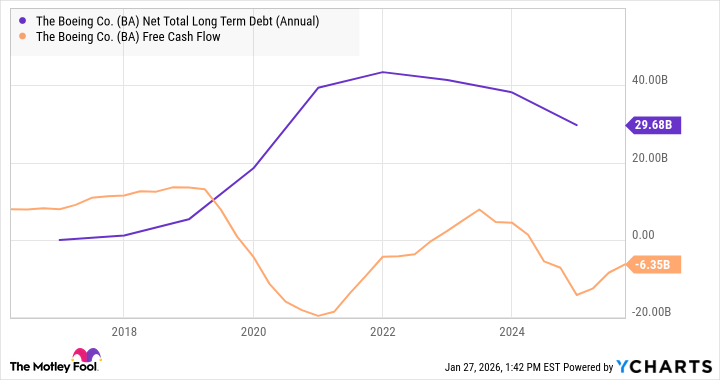
That said, autonomous eVTOLs require significantly more certification hurdles, and that's why Wisk isn't expected to be in commercial service until at least 2030. That timeline gives Joby and Archer a first-mover advantage and could put financial pressure on Boeing -- a company with significant debt that needs to fund a new narrow-body plane for the next generation of aircraft.
Data by YCharts.
In fact, the certification process is so complex that Boeing is proposing a new "Concept of Operations for Automated Flight Rules (AFR)."
In a nutshell, Boeing is proposing a new set of rules (AFR). At the heart of it lies the aim to "promote system automation, including digitized communication and information exchange, across the entire industry: airspace, aircraft, and aerodromes." This implies moving beyond visual flight rules (VFR) and instrumental flight rules (IFR), thus enabling automated flight (in this case, with the Generation 6), eliminating the need for human eye detection and collision avoidance.
That said, AFR isn't analogous to, say, Tesla's full self-driving (FSD), which, in theory at least, will be able to drive anywhere and intuit its environment. Instead, Boeing's proposal involves substantive ground operations to monitor and manage aircraft digitally, as well as the use of digital twin technology to model each eVTOL in flight.
What does it mean for Boeing investors?
It's an exciting technology, but one that requires massive capital investment (not least in ground operations), convincing the FAA to adopt AFR, and building scale to make it profitable.
That might be difficult to support if Boeing doesn't generate meaningful cash flow and reduce debt in the coming years. Moreover, given the choice between funding Wisk or developing a new narrow-body, management is likely to favor the latter. There are plenty of hurdles to overcome here, and there's a long way to go before Boeing can start thinking about eating its rivals' lunch.