In some ways, AbbVie (ABBV +0.33%) isn't the same company it was five years ago. Sure, it's still in the biopharmaceuticals business. However, AbbVie has a new CEO. More importantly, it no longer depends on Humira for roughly 37% of total revenue.
Today, AbbVie can see its Humira patent cliff in the rearview mirror. But what does the view look like through the front windshield? Where will AbbVie be in five years?
Image source: Getty Images.
A $32 billion (or more) power couple
Although predicting the future is usually fraught with uncertainty, I think we can safely say that Skyrizi and Rinvoq will be the most important products for AbbVie in 2031. These two autoimmune disease drugs are already the most important members of the company's lineup.
During the first nine months of 2025, Skyrizi and Rinvoq generated combined sales of roughly $15 billion. This amount is nearly 45% of AbbVie's total revenue during the period. And sales for both drugs continue to soar. The big biotech company reported an impressive 47% year-over-year sales increase for Skyrizi in Q3, with Rinvoq's sales rising 35%.
Skyrizi is approaching the sales levels Humira achieved in its heyday. AbbVie's latest guidance projects full-year 2025 sales for the drug of $17.3 billion.
The future should be even brighter. Analysts expect Skyrizi and Rinvoq will rake in at least $32 billion by 2030. This immunology power couple should anchor AbbVie financially even more five years from now than today.

NYSE: ABBV
Key Data Points
More potential blockbusters and rising stars
Skyrizi and Rinvoq aren't the only big winners in AbbVie's lineup, though. Sales for migraine therapies Qulipta and Ubrelvy continue to grow robustly. The company's Botox franchise remains a therapeutic juggernaut.
I predict that AbbVie will add to its list of blockbuster drugs within the next five years. Cancer therapy Elahere appears to be almost a slam dunk to join the club. Parkinson's disease drug Vyalev could be knocking on the door of $1 billion in annual sales if not exceeding the threshold by 2031.
AbbVie could soon win regulatory approvals for other promising therapies. The company awaits approval decisions for tavapadon for the treatment of Parkinson's disease, PVEK for the treatment of the aggressive blood cancer blastic plasmacytoid dendritic cell neoplasm (BPDCN), and the aesthetic product TrenibotE to help reduce glabellar lines (frown lines).
Look for AbbVie's pipeline to product several rising stars by early in the next decade. The company has around 60 programs in Phase 2 and Phase 3 clinical trials. Late-stage candidates to especially watch include the autoimmune disease drug lutikizumab, the blood cancer therapy etentamig (ABBV-383), and the cancer therapy temab-A (ABBV-400).
Bigger and kinglier
AbbVie currently ranks as the third-largest healthcare company in the world, with its market cap at around $392 billion. I don't expect it to leapfrog past Eli Lilly (LLY 0.24%) and Johnson & Johnson (JNJ +2.21%) to claim the No. 1 spot. However, I do predict that AbbVie will be a much bigger company in five years.
What is a reasonable guess about just how much AbbVie can grow by 2031? I think the stock could realistically achieve average annual gains of nearly 10%. If we assume an average 9% growth rate, AbbVie could be worth around $600 billion five years from now.
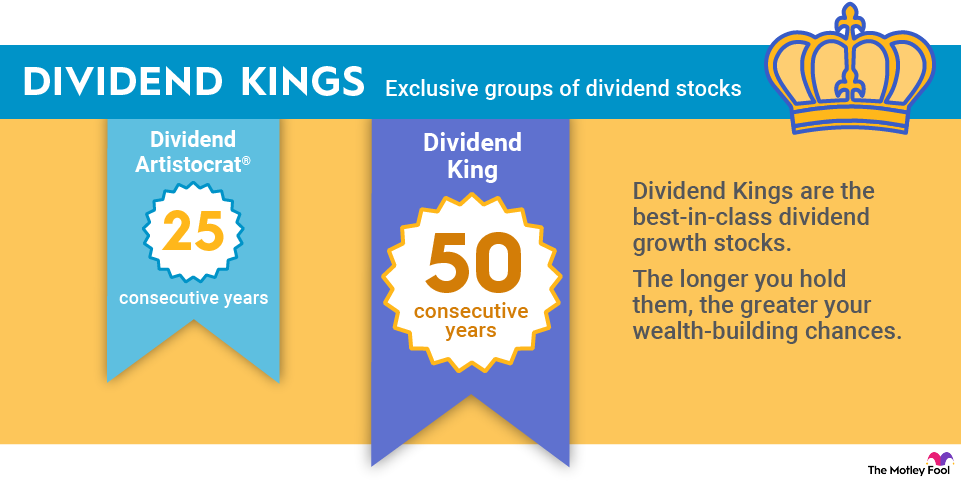
However, investors are likely to be rewarded in other ways by AbbVie during this period. The drugmaker is a member of the Dividend Kings, an exclusive group of stocks that have increased their dividends for at least 50 consecutive years. AbbVie's streak of consecutive dividend hikes stands at 54 years. I'm confident that the company will continue raising its dividend, making AbbVie kinglier than ever in five years.