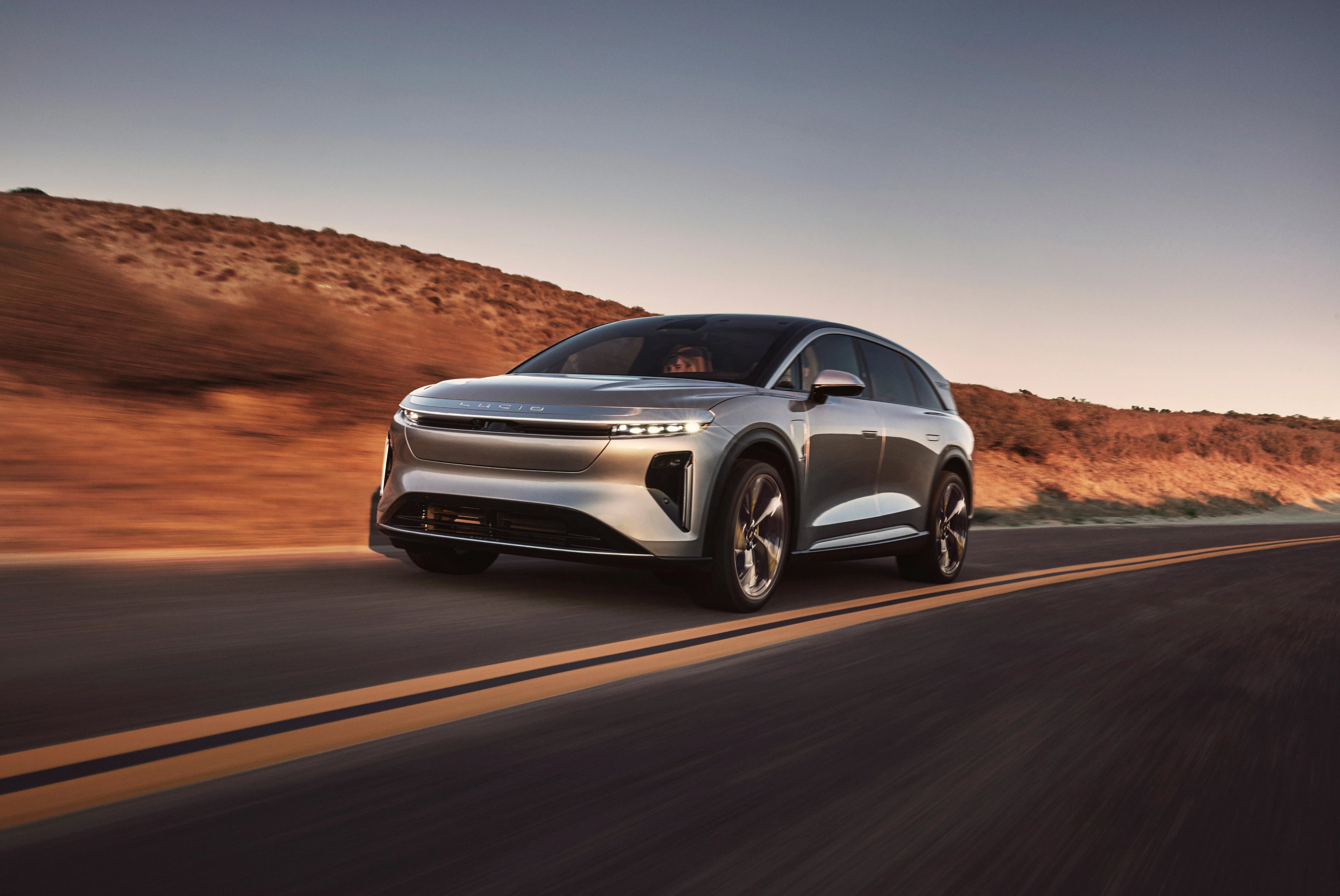
When Lucid Group (LCID +2.04%) first came on the scene with its Air electric sports sedan in 2021, it looked for a moment as if Tesla (TSLA +0.04%) had met its match.
The Air was priced competitively with Tesla's flagship, the Model S, and it topped the Model S and Bugatti Chiron in a quarter-mile drag race with a time of 9.1 seconds (the Tesla and Bugatti tied with 9.3-second times.)

Image source: Getty Images.
Then the reviews came out, and the Air seemed to be the better car by quite a margin. It was cheaper, faster, and had a longer range than the Tesla Model S, along with more cargo space and better build quality and features.
But despite all that, Lucid has not only failed to unseat the American electric vehicle (EV) market king, but it's also on the ropes financially. And even with the release of its Gravity SUV and a celebrity ad campaign featuring Timothée Chalamet and directed by James Mangold, Lucid and its admittedly impressive cars haven't moved the needle enough for me to consider buying shares.
There's simply still too much risk here.

NASDAQ: LCID
Key Data Points
More like a lucid nightmare
First, the good news, because there isn't much. In the company's latest reported quarter, the third quarter of 2025, it recorded revenue of $337 million, up 68.5% over Q3 2024 on the back of a 47% year-over-year increase in new vehicle deliveries.
It's all downhill from there.
Over the course of 2025, Lucid burned through almost half of its cash reserves. It started the year with over $5 billion, and as of Sept. 30, it has $2.9 billion remaining. Couple that with the company's $2.8 billion in total debt (up 2% year over year), and the financial picture isn't looking particularly dreamy.
It gets worse, though. Despite Lucid's $136 million increase in revenue, costs rose $257.7 million, which swallowed the entirety of the increase. Still, with declines in other costs, Lucid reduced its net losses from $992.5 million in Q3 2024 to $978.4 million in Q3 2025. So, even despite the slight decrease, it's still hemorrhaging money.
Speaking of, the company's free cash flow (FCF) losses deepened from -$622.5 million for Q3 2024 to -$955.5 million for Q3 2025. Lucid is not only unprofitable, but it's also operating with a gross margin of -99.12%.
Even though Tesla had a rough 2025, too, it's still plenty profitable.
All American EV manufacturers were hurt by the end of the EV tax credit last November, but whereas it's a drag on Tesla's revenue and bottom line, it might just be lethal to Lucid.
The company is simply spending too much money that it doesn't have, and prospective customers in the United States now have less incentive to buy its cars.
See, while the Air is priced lower than its Tesla equivalent, the Model S, the Gravity is significantly more expensive than the Model Y it competes with. And Lucid has no competitor to the $36,990 Model 3.
So, there's little incentive for a price-conscious consumer to consider Lucid, even after Tesla discontinues the Model S -- something CEO Elon Musk said would likely happen this year. Paired with the company's rapidly depleting cash and growing costs to generate revenue, Lucid isn't shaping up to be a dream for your portfolio.