After Microsoft (MSFT +0.65%) reported its fiscal 2026 second-quarter results on Jan. 28, its stock crashed by 10%. That was a significant tumble for the world's fourth-largest company. However, the question investors must ask now is whether that pullback was warranted or not.
As of Monday afternoon, Microsoft's stock sits almost 22% below its all-time high. That discount may look enticing, but is it a trap?

Image source: Getty Images.
Microsoft's results weren't that bad
This tech giant has products ranging from business software and gaming stations to social media sites and cloud computing infrastructure. Its cloud computing segment is what most investors have had their eyes on lately because that unit's results offer investors an indication of the overall demand for artificial intelligence (AI) computing.
Many companies that are training and running AI models choose to do so on server clusters rented from cloud infrastructure providers, as this spares AI developers from having to build their own expensive data centers. Microsoft is one of the three largest hyperscalers, and it's happy to foot the up-front bills in exchange for the chance to rent out the resulting computing power.
Azure, Microsoft's cloud computing division, has become a top reason to own the stock, and it didn't disappoint in fiscal Q2. For the period, which ended Dec. 31, Azure revenue was up 39% year over year. Furthermore, its remaining performance obligations -- in other words, how much money is left to be earned on the various contracts it has already signed -- rose by 11% to $625 billion. That indicates that there are still tons of AI workloads to churn through, and Azure is far from done growing.
Still, Wall Street analysts were looking for slightly faster growth, and Microsoft's mild underperformance resulted in the stock plummeting. However, management noted that if the company had made more of the computing capacity that it brought online during the past two fiscal quarters available for external customers rather than using it for its internal needs, its growth rate could have been even higher. This shows that demand for AI computing capacity is still outpacing supply, which suggests that Microsoft stock should be fine over the long term.
After the pullback, Microsoft stock now trades for around 25 times forward earnings, its lowest valuation by that metric in the past three years.
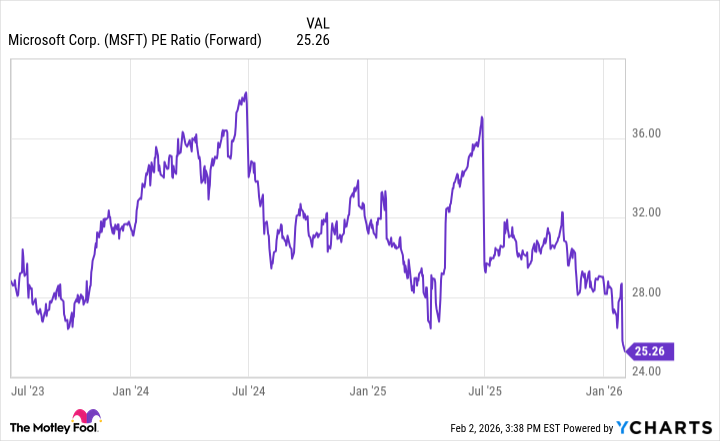
MSFT PE Ratio (Forward) data by YCharts.
Microsoft stock rarely goes on sale, and it has a history of being a top-notch performer. I think this is an excellent buying opportunity, and investors should scoop up shares while the stock is still cheap, as its rebound may occur fairly quickly.