Last November, I called out the State Street Consumer Staples Select Sector SPDR ETF (XLP 0.40%) as my top high-yield exchange-traded fund (ETF) to buy for passive income. My investment thesis centered around the fund's quality value-stock holdings and reliable passive income.
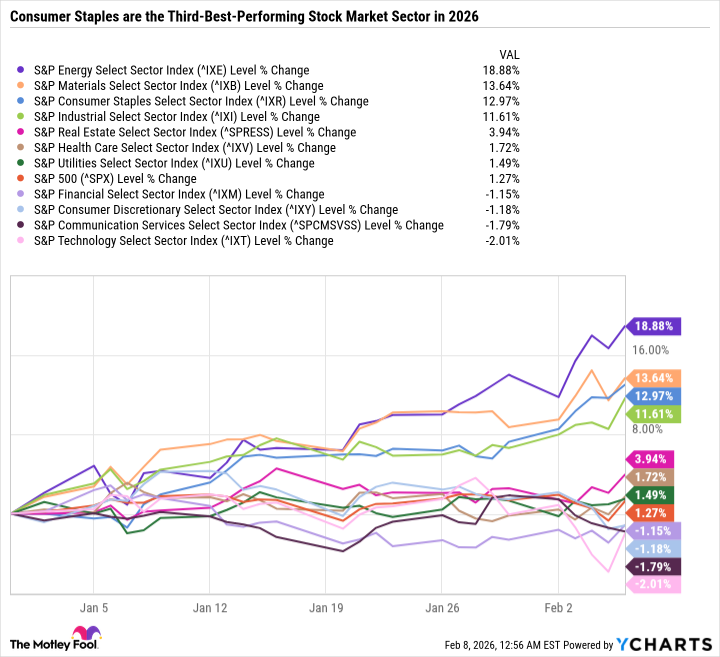
I did not expect the ETF to already be up 13.2% in 2026 compared to a mere 1.3% gain in the S&P 500. Here's why the seemingly boring consumer staples sector is scorching hot, and why the Consumer Staples SPDR ETF remains a buy for broad-based exposure to it.

Image source: Getty Images.
Generating passive income from companies you can trust
Top holdings in the Consumer Staples Select Sector SPDR ETF include Walmart, Costco Wholesale, Procter & Gamble, and Coca-Cola. These aren't the kind of stocks that investors expect to achieve breakneck growth or make pioneering strides in artificial intelligence (AI). But they can be relied on to produce strong results no matter what the economy is doing, and many such companies pay stable and growing dividends.
You may have heard the term Dividend King, which refers to companies that have paid and raised their dividends annually for at least 50 consecutive years -- names like P&G, Coke, PepsiCo, and Colgate-Palmolive. Consumer staples dominate the group, making up 15 of the 57 Dividend Kings.
But the consumer staples sector has been under pressure due to pullbacks in customer spending, and many companies are struggling to pass along higher costs through price increases. In fact, consumer staples was the worst-performing stock market sector in 2025. This year, it is the third-best-performing sector.
Understanding sector rotations
Years of underperformance relative to the S&P 500 and a discounted valuation aren't even the primary reasons the consumer staples sector is exploding higher in 2026. Rather, it has more to do with shifting sentiment in growth-focused sectors like tech, communications, and consumer discretionary. As such, the best-performing sectors in 2026 have been value- and income-focused ones like energy, materials, consumer staples, and industrials.
As an example, Amazon and Microsoft sold off after their latest earnings reports and are down big year to date.
Amazon Web Services and Microsoft Azure are the two biggest cloud infrastructure service providers in the world. Amazon announced $200 billion in 2026 capital expenditures (capex) -- a lot of which is going toward AI and cloud infrastructure.
Similarly, Microsoft is now devoting more toward quarterly capex than its annual amount from less than four years ago. There are concerns that these companies are overspending on AI.
And there's real risk that the spending will eventually outpace cash flows, meaning some of the spending may be funded with debt. Investors who don't like the risk and potential reward of these investments, the threat AI poses to software companies, or the expensive valuations of many semiconductor companies, may be loading up on value stocks instead.
These broader market dynamics -- rather than the performance of the top consumer staples companies -- are largely why the sector has done so well. In fact, earnings continue to grow relatively slowly for many top consumer staples companies.
In sum, the sectorwide rebound is mechanical, not fundamental.
Buying consumer staples stocks for the right reasons
Sector rotations and whether growth or value stocks are in or out of favor shouldn't matter too much for long-term investors. But I still think it's important to be aware of these factors, especially when they overly punish good companies or result in somewhat unjustified rapid run-ups.
The Consumer Staples Select Sector SPDR ETF could keep running higher if investors continue fleeing from growth-focused stocks to value stocks. However, the best reason to buy the fund isn't to make a quick buck, but rather, if you're looking to power your passive income portfolio with a variety of industry leaders.
The fund remains a decent value, with a 24.1 price-to-earnings ratio. Its yield is still solid at 2.6%. And the expense ratio is just 0.08%, or $8 for every $10,000 invested.
All told, the fund isn't as cheap as it was at the end of 2025, but it's still a good foundational holding for risk-averse investors, especially those whose financial goals include generating reliable passive income.