By now you've heard the news: The U.S. military is buying drones. A lot of drones. In fact, $1.1 billion worth of drones.
On Feb. 6, the U.S. Department of War (formerly the U.S. Department of Defense, or DOD) announced it has chosen 25 vendors to compete in a Phase 1 "Gauntlet" of the new Drone Dominance Program (DDP). Starting Wednesday, Feb. 18, these two dozen-odd military contractors will demonstrate their wares at Fort Benning, Georgia. After two weeks of testing, the Pentagon will place $150 million worth of orders for military drones, with delivery due in five months.
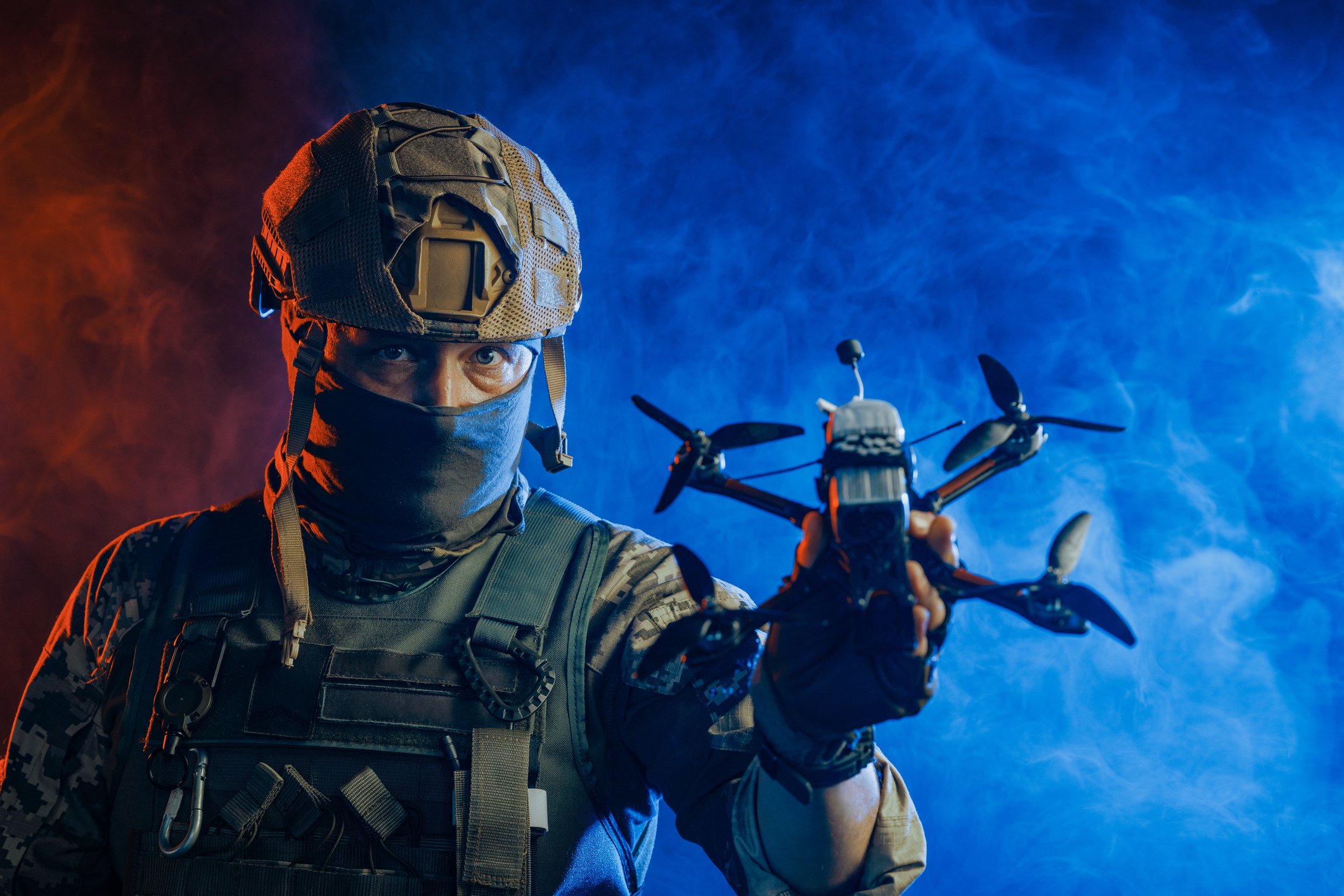
Image source: Getty Images.
Who gets to compete in the Phase 1 Gauntlet?
The list of competitors in Phase 1 reads as follows:
- Anno.ai
- Ascent Aerosystems
- Auterion Government Solutions
- Dzyne Technologies
- Ewing Aerospace
- Farage Precision
- Firestorm Labs
- General Cherry (based in Ukraine)
- Greensight
- Griffon Aerospace
- Halo Aeronautics
- Kratos SRE, a division of Kratos Defense & Security (KTOS -0.42%)
- ModalAI
- Napatree Technology
- Neros
- Nokturnal AI
- Paladin Defense Services
- Performance Drone Works
- Responsibly
- Swarm Defense Technologies
- Teal Drones, a subsidiary of Red Cat Holdings (RCAT -4.86%), according to data from S&P Global Market Intelligence
- Ukrainian Defense Drones Tech (based in Ukraine)
- Vector Defense
- WS Darley & Co.
- Xtend Reality
Who passed, who didn't
So what do you notice from this list?
What jumps out at me right away is the dearth of publicly traded defense companies on it. Not a single one of the large defense prime contractors -- the Boeings, General Dynamics, and Lockheed Martins of the world -- made its way onto the list. The only public U.S. companies are Kratos and Red Cat.

NASDAQ: KTOS
Key Data Points
Not even AeroVironment -- arguably the best-known American drone company -- or Redwire, which made a $1 billion bet on drones when it bought Edge Autonomy last year, made it into the Gauntlet.

NYSE: RDW
Key Data Points
As for the lucky 25 who did make the list, it remains to be seen which ones will make the cut and survive Phase 1. Only at the end of the first gauntlet will vendors "be scored on the systems, and up to 12 of the 25 vendors will be invited to produce their drones, at scale, for the department," says DOD. It is these 12 winners who will be awarded contracts to build "a total of 30,000 units, at an average price of $5,000 for each, and deliver by July."
Put down your pencils. That means $150 million will be awarded, divided 12 ways, giving each winner a $12.5 million contract. It means $12.5 million for Kratos if it wins and $12.5 million more for Red Cat.

NASDAQ: RCAT
Key Data Points
What comes next?
Thus will end the DDP's first Gauntlet -- but three more remain. Over the course of three succeeding Gauntlets, running through 2027, the Pentagon plans to further whittle down the field from 12 to five ultimate winners. After the final round, the Pentagon plans to award these five companies a combined order for 150,000 drones priced at $2,300 each ($345 million total).
That's $69 million per winner, on top of the initial $12.5 million and whatever awards are won after Gauntlets two and three. Assuming a geometric progression in the size of each phase's awards, by the time DDP concludes, the five final winners will presumably have amassed $12.5 million plus $22 million plus $39 million plus $69 million, for a total of roughly $142.5 million each .
And the U.S. Pentagon will be the proud owner of approximately 340,000 small first-person-view one-way attack drones, each costing about $2,300 to produce, and with five proven suppliers to maintain price competition and keep prices low.
What does it mean for investors?
At present, it would appear the best way for investors to profit from DDP is to invest in the two publicly traded stocks involved -- Kratos and Red Cat.
Further down the line, the Pentagon could admit other companies to the competition, however. That might not sound fair to the other companies that had to survive more "Gauntlets," but there's nothing in the DOD's announcement that promises not to add more competitors down the road.
Additionally, companies that win contracts will presumably become increasingly financially viable as their winnings increase. Potentially, one or more of the 23 companies that are not yet publicly traded might become strong enough to hold initial public offerings of their own and go public.
Keep a close eye on this space. The drone industry is growing fast, and you don't want to miss an opportunity if it emerges.