Microsoft (MSFT +1.14%) has been a long-term winner for its shareholders. The stock has risen about 680% over the past decade, turning a $10,000 investment back then into $78,010 now. While you could find other stocks that have had a better decade-long run, this run handily outperforms the S&P 500's comparable performance of 260%.
Still, measuring Microsoft's return just a few months ago would have shown an even more impressive gain. The stock has sold off recently, and it now sits about 26% down from its all-time high. Sell-offs of this depth rarely happen to Microsoft's stock, especially during its current business iteration.
Following Microsoft through these ups and downs, there's one clear signal I see about Microsoft stock right now, and I think it might be time for investors to load up on shares.

Image source: Getty Images.
Microsoft has earned its premium
A stock's valuation is a market's vote of confidence in its performance. Stocks that trade at a discount to the market tend to have issues, causing shareholders to doubt the stock's ability to outgrow the market over time. If a stock trades at a premium, then investors tend to feel confident the stock will deliver outsized gains over the long haul. Microsoft recently lost its premium status and now trades at essentially a market-matching valuation.

NASDAQ: MSFT
Key Data Points
There are several ways to value a company. It can be done using sales, earnings, or any of several other financial metrics. One common measure is the price-to-earnings (P/E) ratio, which is a good measure, but can be skewed by various factors out of a company's control. A big issue with P/E ratios is that unrealized gains on investments factor into how it's calculated. This is a big deal for a company like Microsoft, which happens to be a large investor in privately owned OpenAI. Microsoft has a 27% stake in the company. With OpenAI's valuation skyrocketing each quarter, Microsoft must report the increase in valuation of its investment in its net income metric.
This has altered Microsoft's valuation and made it harder to determine the stock's real value. This is why I prefer valuing Microsoft based on its operating income, as this metric is unaffected by its investments. Microsoft's operating P/E ratio is at one of the lowest points it has been in the past decade.
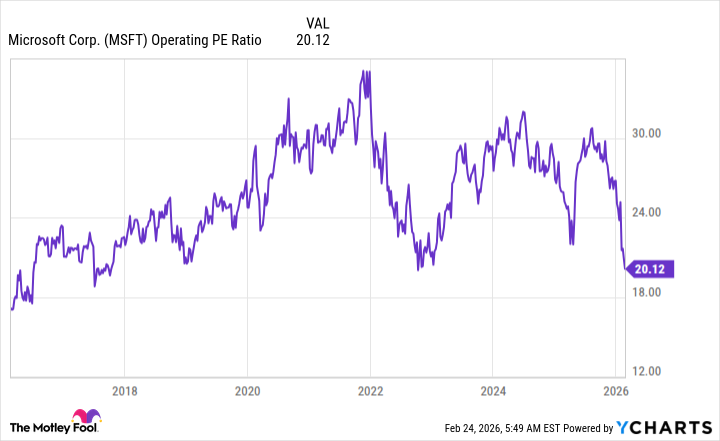
Data by YCharts.
A decade ago, Microsoft was refining itself as a cloud-first company -- something that it has achieved and excelled at. Now that the cloud-first mindset places Microsoft at the top of the generative AI race, Microsoft is becoming a top option to build AI models and applications. Azure, its cloud computing segment, grew its revenue at a 39% year-over-year pace during its latest quarter and has a $625 billion backlog it's churning through.
This is a high-margin and recurring-revenue model business, giving Microsoft a lucrative business model that investors love to see. However, the stock has sold off dramatically, and I think right now could be a great buying opportunity.
Sell-offs like this rarely occur
With Microsoft's near-decade low valuations, I don't think investors need any clearer sign to take a position. However, they should be sure that there aren't dark clouds on the horizon. With Wall Street analysts projecting 16% revenue growth during this fiscal year and 15% in the next, I think investors are in the clear.
Microsoft is a critical company in the AI build-out due to its vast cloud computing infrastructure. Microsoft isn't seeing any weaknesses in this area, so the sell-off is really unwarranted. I would be loading up on Microsoft stock at these prices, as it's a best-in-class business that's set to profit from AI proliferation.