The S&P 500 is an index of 500 U.S.-listed stocks from 11 different sectors of the economy. It has strict entry criteria so it typically only hosts the largest and highest-quality companies the market has to offer, from investment banks like JPMorgan Chase to artificial intelligence (AI) powerhouses like Nvidia.
Then there is the Russell 2000, which hosts 2,000 of the smallest companies listed on American stock exchanges. Many of them are benefiting from favorable domestic economic and political conditions right now, which is why the Russell is up 4.3% in 2026 already. The S&P 500, on the other hand, is modestly in the red.
The Vanguard Russell 2000 ETF (VTWO 2.20%) is an exchange-traded fund (ETF) that directly tracks the performance of the index by holding the same stocks and maintaining similar weightings. Here's why its hot start to 2026 could be a sign of things to come.

Image source: Getty Images.
Small companies with big potential
The S&P 500 is weighted by market capitalization, so the largest companies in the index have a much greater influence over its performance than the smallest. The information technology sector is home to several multi-trillion-dollar giants including Nvidia, Apple, and Microsoft, so it's the largest sector in the S&P by far, with a weighting of 32.8%.
The Russell 2000 is also weighted by market cap, but there is a much narrower gap between the most valuable and the least valuable companies in the index. As a result, sector weightings are more evenly distributed. Of the 11 sectors represented in the Vanguard Russell 2000 ETF, the industrial sector is the largest with a weighting of 19.3%, followed by healthcare at 17.8%, and financials at 16.9%.
Plus, the top 10 holdings in the Vanguard ETF account for just 5.6% of the total value of its portfolio, so the fate of its performance doesn't rest with just a handful of stocks.
|
Stock |
Vanguard ETF Portfolio Weighting |
|---|---|
|
1. Bloom Energy |
1.06% |
|
2. Credo Technology |
0.62% |
|
3. Fabrinet |
0.57% |
|
4. Kratos Defense |
0.55% |
|
5. Nextpower |
0.55% |
|
6. EchoStar |
0.49% |
|
7. Hecla Mining |
0.46% |
|
8. Guardant Health |
0.45% |
|
9. IonQ |
0.43% |
|
10. Coeur Mining |
0.42% |
Data source: Vanguard. Portfolio weightings are accurate as of Jan. 31, 2026, and are subject to change.
These might be small-cap stocks, but they pack some big potential. Bloom Energy stock, for instance, is up by an eye-popping 563% over the last 12 months alone. Demand for the company's on-site clean energy solutions is soaring, particularly from data center operators seeking alternative sources of power to feed their AI infrastructure.
Credo Technology stock, on the other hand, soared by 145% over the past year on the back of growing demand for the company's data center networking equipment, which facilitates the rapid flow of information between chips and devices.
There have also been huge gains outside the data center space. Shares of domestic gold and silver mining companies Hecla Mining and Coeur Mining have more than tripled over the past year, as investors pile into precious metals to hedge against rising political and economic uncertainty.

NASDAQ: VTWO
Key Data Points
Many of the companies in the Russell 2000 conduct their business inside the U.S., where they have benefited from a series of favorable economic policies introduced by the Trump administration. For example, President Trump has imposed tariffs on imported goods to make American producers more competitive. The administration has also cut the corporate tax rate, and slashed red tape to reduce the cost of doing business domestically.
Can the Russell continue outpacing the S&P 500?
Investors who bought the Vanguard Russell 2000 ETF a decade ago would have earned a solid return of 141% had they held until now, but they would have done far better in an S&P 500 or a Nasdaq-100 index fund instead:
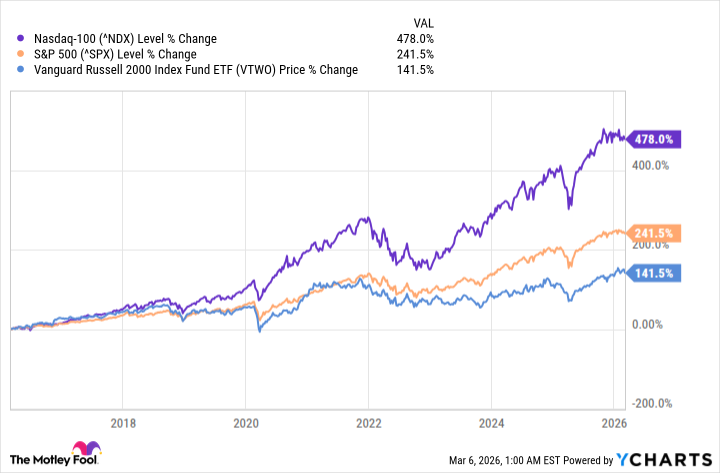
The Russell 2000 has underperformed large-cap indexes like the S&P 500 and the Nasdaq-100 over the last 10 years because it lacks exposure to America's tech giants, which have generated more earnings and delivered faster growth than the rest of the market.
However, the Russell is on track for a very strong year in 2026. In addition to the policy tailwinds I mentioned earlier, small-cap companies are also benefiting from lower interest rates. The U.S. Federal Reserve has executed six rate cuts since September 2024, and the CME Group's FedWatch tool suggests there could be one more in 2026.
According to Goldman Sachs, around 32% of small-cap companies have floating-rate debt, compared to just 6% of the companies in the S&P 500, so lower rates are boosting the profitability of almost one-third of the Russell's constituents. As a result, I think the Russell can convert its hot start to 2026 into a very strong year.