If you were hoping Friday would bring some relief to your portfolio after a volatile week, well, the market had other plans.
Rising oil prices and concerns about potential fuel supply disruptions are pushing equities lower across the board. At the heart of it all, of course, is the continuing conflict in Iran.
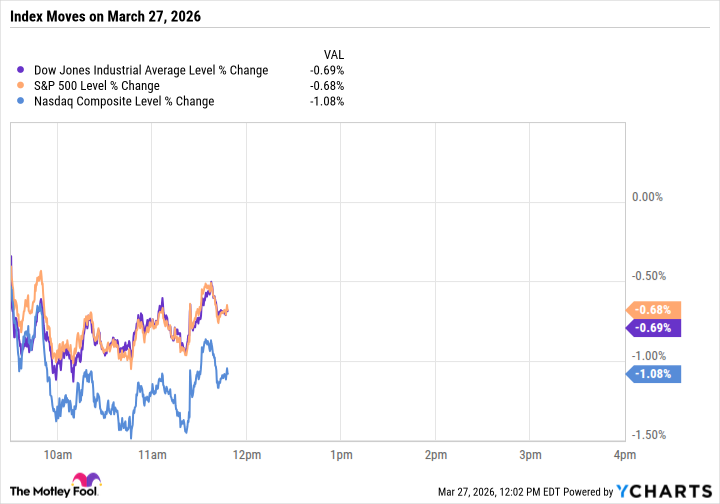
Shortly before midday ET, the S&P 500 (^GSPC +1.18%) and Dow Jones Industrial Average (^DJI +0.59%) indexes were down by 0.7%. The Nasdaq Composite (^IXIC +2.07%) took a deeper dive of 1.1%.
The Dow is back where it was a week ago, while the Nasdaq and S&P 500 indexes fell by 2.2% and 1.1%, respectively, over the last five days. Nearing the end of March, all three market trackers are down by approximately 7% for the month.

Image source: Getty Images.
The usual catalysts: Iran tensions and oil prices
At the moment, investors aren't buying President Trump's latest attempts at Middle East dealmaking.
Oil prices have been on a tear; the United States Oil Fund (USO +1.52%) jumped nearly 4% Friday and is up a staggering 48% over the past month. When oil spikes, it acts like a tax on everything, and the market knows it. This fund tracks crude oil prices closely, making it a quick dipstick for checking current trends in the energy market.
Tech stocks are taking it on the chin. All of the Magnificent 7 stocks are down today, led by dips of at least 3% for Meta Platforms (META +2.27%) and Amazon (AMZN +3.23%). With trillion-dollar market caps, these moves make a significant difference to the woes of cap-weighted indexes, including the Nasdaq Composite and S&P 500.
Energy and utility stocks generally rose on Friday, alongside upticks in the basic materials and consumer defensive sectors. The Nasdaq is underperforming since it has less exposure to the stock categories that are on the upswing.

NASDAQINDEX: ^IXIC
Key Data Points
What's at stake beyond today's sell-off
The market appears to be pricing in prolonged uncertainty regarding the Iran situation. The implications of this conflict for energy costs and global supply chains are already massive, with spiking energy prices suggesting broadly higher consumer prices in the coming months. Until the Strait of Hormuz is unlocked, the global market will have limited access to oil and natural gas producers far beyond Iran. There are some pipelines in the region, but oil tankers remain the most effective way to ship fossil fuels out of this key region.
The names include Iraq, Kuwait, Saudi Arabia, Qatar, Bahrain, and the United Arab Emirates. At the other end of the shipping lines, countries like South Korea, Japan, and China rely heavily on Middle Eastern oil.
For long-term investors, moments like these can feel uncomfortable, but they're also when opportunities tend to emerge. Volatility isn't fun, but it's also not unusual. It's anyone's guess how long the war with Iran will last. Stay patient, stay diversified, and remember that the headlines driving today's sell-off won't last forever.