It is easy to feel the weight of fear when news headlines scream of conflict. After the United States began Operation Epic Fury against Iran in late February, the S&P 500 (^GSPC +1.18%) dropped by as much as 9%. Wartime sell-offs are abrupt reminders that the stock market hates uncertainty.
Yet history shows us that volatility is not a bug in capital markets. It's actually the system's heartbeat. Investors who allow emotions to drive buying and selling decisions during these types of episodes consistently miss out on the powerful rebounds that always follow. And in this case, the rebound is apparently underway -- the S&P 500 is already back to setting new highs.
Staying invested through geopolitical storms, economic cycles, and policy shocks delivers superior long-term wealth generation. Why is that? Because markets do not simply survive chaos. They price it in, adapt, and then compound gains.
Below, I've examined why these patterns hold, how smart investors should position their portfolios to weather turbulence, and why the S&P 500 index is engineered to thrive precisely because of -- not in spite of -- volatility.

Image source: Getty Images.
Fear is temporary, adaptation is permanent
During times of extreme geopolitical tensions, most investors flock toward "safer" asset classes like commodities or real estate. While defense budgets swell, supply chains develop kinks, and energy prices spike, it's not uncommon for investors to sell first and ask questions later.
As a result, the initial plummet in the stock market is both real and painful. Interestingly, history reveals a consistent pattern: Once the fog of uncertainty lifts, stocks do not just recover -- they surge.
The reason is simple: While it may feel like the world is coming to an end in these types of situations, companies plan for them. Operators act to reroute logistics, governments and central banks intervene with the goal of stabilizing currencies, consumers adjust their spending patterns, and smart capital reallocates toward the sectors and companies that are positioned to solve the new problems.
While the broader market is quick to discount the worst-case scenario, wars tend to fuel innovation in important industries such as logistics, materials science, and energy efficiency. Investors who remain fully invested through periods of conflict wind up capturing not only the recovery phases but also the subsequent expansions as economies rebuild and productivity climbs.
Another way of looking at this is to recognize that selling at the bottom in an effort to "wait for clarity" works out to be an expensive mistake because that clarity will arrive only after stock prices have rerated higher.
The lesson is simple: Volatility from geopolitical uncertainty is loud, but the underlying tailwinds of corporate earnings and reinvested capital are louder.
Building a fortress designed to withstand volatility
The best defensive strategy against temporary chaos is not trying to time the market. Instead, constructing a diversified portfolio of high-quality blue-chip companies can insulate you from heavy losses.
Start with the core:
- Select between 20 and 30 companies, making sure that number includes names from each major sector. Ensure that no single industry's share of your portfolio exceeds 20% of its total value.
- When choosing your holdings, prioritize companies with decades of free-cash-flow generation, investment-grade credit ratings, and a history of raising dividends or employing stock buybacks across all economic conditions.
- Gain exposure to consumer staples and healthcare businesses that supply things that people will always need, regardless of headline narratives. Complement these positions with industrials and technology leaders whose products become even more essential during periods of uncertainty. Lastly, sprinkle in some financial firms that benefit from higher rates and energy companies designed to thrive when oil price volatility spikes.
The magic lies in asymmetry: When geopolitical or macroeconomic indicators shift, defensive sectors cushion the portfolio while cyclicals are positioned for the inevitable rebound. Blue chip stocks tend to fare well because they have already developed the qualities that have allowed them to endure every flavor of crisis the world has previously thrown in their direction.
By owning durable businesses, investors transform volatility from a threat into a feature that will provide them with the financial flexibility to rebalance when appropriate and buy high-quality names at discounted prices.
The S&P 500 is a machine designed to outmaneuver volatility
The S&P 500 is not a static basket of stocks. It is a living economic algorithm that mirrors American capitalism. Successful companies grow their way into it. Large caps that can't keep up are gradually pruned from it. This adaptability explains why the index has absorbed every headwind from world wars and stock market bubbles bursting to inflation spikes and unemployment swings. In the chart below, such market-turning events are illustrated by the grey columns.
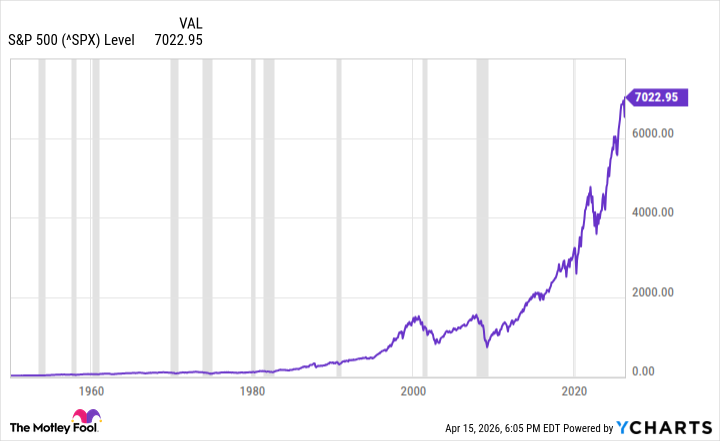
The trends above underscore the idea that volatility is the S&P's native language. Fluid macro indicators create the very conditions under which nimble, well-capitalized businesses are best equipped to gain market share.
The S&P 500's sector diversity and market-cap weighting also help ensure that no single event can permanently derail the index's upward momentum. When one part of the economy stumbles, another will step forward.
Over a 50-year period, the S&P 500 has delivered roughly 10% annualized returns on average. This isn't because volatility vanishes. It's because volatility is the mechanism that clears dead weight and rewards the most innovative enterprises. Staying invested through harsh cycles is not an act of blind faith in the slightest. It is a signal of alignment with the index's fundamental design.
The dip during the first month of the Iran conflict was merely another data point in a long series of temporary interruptions. The machine is proven to keep running -- reinvesting profits, innovating, and compounding -- long after the doomsday headlines fade.
Investors who remain grounded for the entire ride will capture this compounding effect, while those who give into fear at the first sign of turbulence may struggle to find their way back on the train at the "right time."
In the end, the case for staying invested through periods of uncertainty is not about being oblivious to risk. Savvy investors recognize that the greatest risk of all is shunning the most reliable wealth-creation vehicle ever built at the exact moments that it is cheapest to buy.