Just when investors were ready to put the Iran war behind them, Iran closed the Strait of Hormuz again, and uncertainty continues to surround the conflict in the Middle East, especially as President Trump has said that the two-week ceasefire is unlikely to be extended.
Finding stocks that can weather this kind of storm isn't easy. Energy stocks soared in March as oil prices spiked, but have since come down, while cyclical stocks fell in the initial stages of the war, but have climbed in response to signs of a detente.
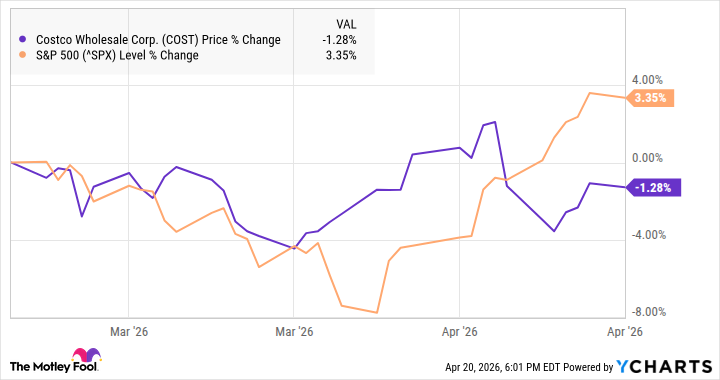
However, one stock has been nearly unflappable over the last two months, trading as if the Iran conflict wasn't even happening. That's Costco (COST 0.63%), the retail giant known for its recession-resistant qualities. As you can see from the chart below, Costco only fell as much as 4% in March, just half the maximum drop on the S&P 500, though the S&P 500 surged past it in April.
Why Costco can win no matter what happens in the Middle East
Costco has long earned a premium from investors because it has a number of qualities that make it well-positioned to grow in any kind of environment.
Its membership model, for example, means retail sales are less important than they are for most retailers. In fact, Costco makes most of its profit from membership fees. That allows it to charge rock-bottom prices for its members, which keeps retention high -- around 90% -- and keeps them returning frequently to the store to shop.
Like other retailers, Costco has some exposure to high oil prices, as they tend to make products more expensive by increasing shipping costs. However, Costco also sells gasoline, which again gives it a buffer when oil prices spike. Because of its reputation for low prices, Costco tends to see higher traffic for gasoline when prices are high, which both leads to profit from its fuel division and drives traffic to its stores.
Because of its membership model, Costco also has a higher-income customer base than the typical retailer, meaning its customers are less sensitive to the general economy. That means they're more likely to keep visiting Costco and continue being members.
Finally, most of Costco's sales come from staples like groceries, rather than discretionary items, so most of Costco's customers are coming to buy products that they need and are cheaper than they are at competitors.

Image source: Getty Images.
Is Costco a buy?
Consumer staples stocks like Costco tend to trade at a premium because of their recession-resistant qualities and ability to withstand shocks like the Iran war.
Costco now trades at a price-to-earnings ratio of 52, which is nearly double that of the S&P 500. That's a level typically reserved for promising growth stocks.
While Costco might not be thought of as a growth stock, it continues to deliver strong results, with comparable sales adjusted for gas prices and foreign exchange up 6.4% for the first 31 weeks of the fiscal year, outpacing nearly every other retailer.
For investors looking for a safe stock to ride out the storm in the Middle East, Costco looks like an excellent choice.