The S&P 500 is the stock market's most popular index, and it's the primary benchmark that investors typically use to assess whether an investment has been "good."
That's why, when looking at the Vanguard Total International Stock ETF's (VXUS -1.17%) performance over the past decade, many people would say VXUS has been a bad investment. It's up around 77% in that time, compared to the S&P 500's 238% gain (as of April 20).
Of course, outperforming the S&P 500 would be ideal, but VXUS is doing what it's intended to do well: providing broad exposure to companies outside the U.S. It's worth considering if you want your portfolio to be more well-rounded.
Image source: Getty Images.
You only need one ETF to cover a lot of international ground
VXUS contains nearly 8,800 companies from around the world. Investing in international stocks can sometimes carry more geopolitical and currency risks than U.S. stocks, so being able to invest in thousands at once helps reduce some of those risks. Here is how the ETF is divided by regions and the most represented countries in those regions:
- Europe (37.5%): United Kingdom, France, Switzerland
- Pacific (26.9%): Japan, Australia, South Korea
- Emerging Markets (26.4%): China, Taiwan, India
- North America (8.3%): Canada
- Middle East (0.9%): Saudi Arabia, Israel, United Arab Emirates
Each region, country, and market comes with its own pros and cons, but having both developed and emerging markets lets you take advantage of both relative stability and high-growth opportunities.

NASDAQ: VXUS
Key Data Points
Why not just go with the S&P 500 instead?
VXUS isn't meant to be an S&P 500 replacement. Investing in international stocks should be a way to ensure your portfolio isn't overly reliant on the U.S. market. Most of your portfolio should be in American stocks. However, VXUS can be a safety net when the U.S. economy is down or U.S. stocks are in a rough patch.
A good example is this year, when VXUS has outperformed the S&P 500 by more than 5% through April 20. But to see why VXUS has underperformed the S&P 500 so much over the past decade, you just need to see the difference in makeup between them.
| Sector | Percentage of VXUS | Percentage of S&P 500 |
|---|---|---|
| Financials | 22.48% | 12.6% |
| Industrials | 15.9% | 9.0% |
| Technology | 15.8% | 32.9% |
| Consumer discretionary | 8.8% | 9.9% |
| Basic materials | 7.9% | 2.1% |
| Healthcare | 7.7% | 9.5% |
| Energy | 5.4% | 4.0% |
| Consumer staples | 5.3% | 5.3% |
| Communication services | 4.7% | 10.3% |
| Utilities | 3.3% | 2.5% |
| Real estate | 2.6% | 1.9% |
Data source: Vanguard and Yahoo! Finance.
Tech has driven much of the S&P 500's gains over the past decade. Eight of the world's most valuable public companies are now American tech companies. That's a level of growth that the international market couldn't have reasonably kept up with over that time.
I would definitely keep the bulk of my portfolio in the S&P 500 to take advantage of the long-term reliability and growth of the U.S. economy, but allocating up to 10% to international stocks is a good complement to that core holding.
An underrated income source
Along with being cheap (its 0.05% expense ratio is one of the lowest you'll find), VXUS has an attractive dividend that makes it worthwhile. Its current dividend yield is around 2.8%, only slightly below its 2.9% average for the past decade.
At 2.8%, VXUS's dividend yield is higher than popular dividend ETFs like the Vanguard High Dividend Yield ETF and Vanguard Dividend Appreciation ETF. It's also well over double what you'd get from an S&P 500 ETF.
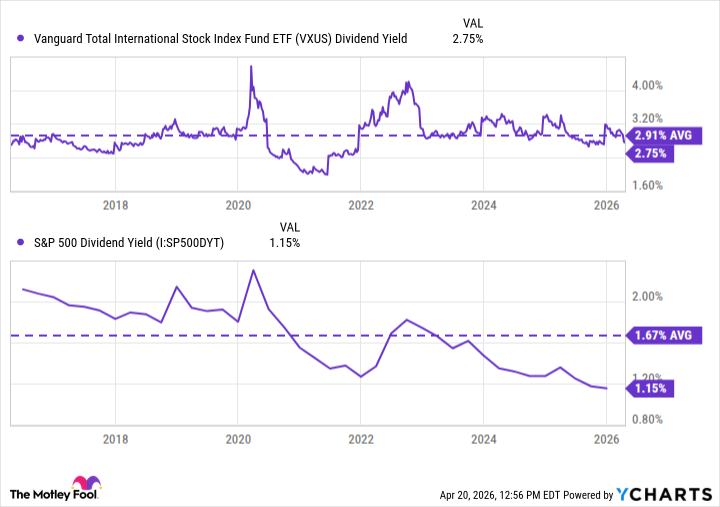
VXUS Dividend Yield data by YCharts
We can't predict how the U.S. or international markets will perform going forward, but in either case, having a diversified portfolio that includes companies from around the world is a good idea. Their influence on your portfolio won't (and shouldn't) be the same, but having some skin in the game is worthwhile.
VXUS may not be a routine market-beater, but it does its job well.