Although artificial intelligence (AI) is Wall Street's largest addressable opportunity, it's not the only technological leap forward capturing the attention and capital of Wall Street and investors. The advent of quantum computing is also turning heads.
Over seven trading days (from the closing bell on April 9 through the close on April 20), shares of pure-play quantum computing stocks IonQ (IONQ -4.57%), Rigetti Computing (RGTI -3.08%), and D-Wave Systems (QBTS -4.07%) soared by 72%, 37%, and 56%, respectively.

Image source: Getty Images.
Quantum computing stocks have given investors several reasons to be excited, including a sky-high addressable market of up to $850 billion by 2040, according to Boston Consulting Group, as well as several early stage partnerships. For instance, Amazon has given its Braket quantum cloud service customers access to quantum computers from IonQ, Rigetti, and D-Wave. Landing a member of the "Magnificent Seven" as a client is a big deal.
But whether this short-term rally in pure-play quantum computing stocks has legs is a different story. Though growth stocks have exhibited exceptional strength in recent weeks, investors wagering on a continuation of this rally will likely be disappointed.
Three reasons the quantum computing bubble appears destined to burst
The biggest enemy for quantum computing stocks is history. Although several next-big-thing trends since the mid-1990s have been highly successful for investors over long periods, early stage bubbles have been a given.
For decades, investors have been overestimating the adoption and/or optimization of game-changing technologies. Quantum computing faces issues on both fronts: quantum computers are still very early in their commercialization, and businesses are nowhere close to optimizing this technology to boost sales and profits. History suggests a quantum computing bubble-bursting event is inevitable.
History also points to quantum computing stock valuations as unsustainable.
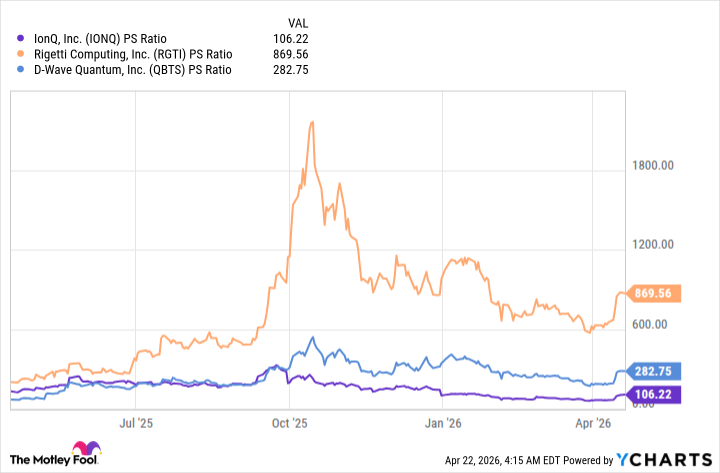
IONQ PS Ratio data by YCharts. PS Ratio = price-to-sales ratio.
Prior to the dot-com bubble bursting, companies at the leading edge of the internet-driven expansion, such as Cisco Systems and Microsoft, topped out at price-to-sales (P/S) ratios of 30 to 45. This arbitrary range has commonly served as a ceiling for next-big-thing stocks and alerted investors to bubbles in the making.
As of April 20, IonQ, Rigetti Computing, and D-Wave Systems were sporting trailing 12-month P/S ratios of 106, 870, and 283, respectively. Even with high double-digit or triple-digit sales growth, these three stocks are the textbook example of bubble territory.
But history isn't the only issue for IonQ, Rigetti, and D-Wave. The barrier to entry for pure-play quantum computing stocks may be considerably smaller than investors realize.

NYSE: IONQ
Key Data Points
This trio is currently losing money hand over fist and is reliant on dilutive share issuances to effectively keep the lights on. Meanwhile, most members of the Magnificent Seven have foundational operating segments, are highly profitable, and possess fortress-type balance sheets that allow them to make aggressive investments in game-changing technologies.
For example, Microsoft and Alphabet have already debuted quantum processing units since late 2024. The point being that first-mover advantages in this space may be tenuous, at best.
If you chase this rally in IonQ, Rigetti Computing, and D-Wave Systems, you'll likely regret it.