The ceasefire in Iran right now is fragile, the talks in Islamabad are uncertain, and Iran's parliament speaker is already signaling "new cards on the battlefield." Yet none of that changes the core prediction: the AI (artificial intelligence) supercycle is intact and still unfolding.
What is changing is the illusion that the supply chain feeding it is immune to geopolitical shock. That assumption died somewhere between the first Iranian strikes on Qatar's Ras Laffan facility and the moment helium spot prices doubled. For investors paying attention, all these current events are a great buying opportunity.

Image source: Getty Images.
Why the supercycle survives
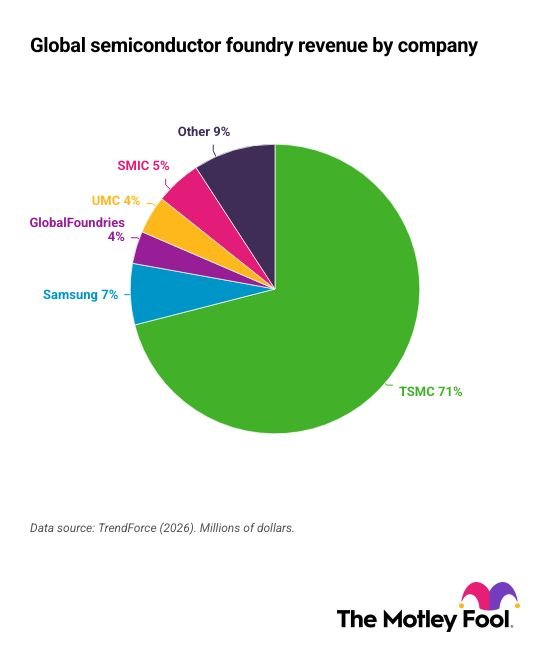
The AI trade held up with a resilience that surprised even its biggest bulls. Since hitting a low on March 30, the iShares Semiconductor ETF surged more than 30%. The Magnificent Seven posted double-digit gains despite ongoing conflict, and Taiwan Semiconductor Manufacturing (TSM -1.98%) said on its earnings call that it does not anticipate immediate operational disruption, citing prepared safety stock and government energy agreements. J.P. Morgan, in a March note, concluded that the Iran war represents "a manageable risk, for now" because semiconductor allocations for helium are being prioritized, and the industry has several months of inventory buffer.
The deeper reason the supercycle persists is simpler: Demand for AI compute is no longer optional. Hyperscalers like Microsoft, Alphabet, and Amazon have already committed hundreds of billions to data center build-outs that cannot be paused for a commodity shock. The war creates friction, not cancellation. It raises costs and compresses timelines at the margin, but the fundamental pull of generative AI adoption is stronger than any single supply disruption.
What it does do is change who benefits. And that is where the investment story gets interesting.

NYSE: TSM
Key Data Points
The new winners: Industrial gas and domestic foundry
If helium is now a strategic asset rather than an afterthought, then the companies that produce, store, and distribute it have a different kind of pricing power than they did six months ago. Linde (LIN +0.75%), the world's largest industrial gas company, has emerged as the most prominent beneficiary. Linde holds significant helium storage capacity and a well-established supply network that gives it disproportionate leverage when supply is constrained, and buyers are desperate.
Semiconductor manufacturing already accounts for roughly a quarter of global helium usage -- and that share was growing even before the war, alongside the AI chip build-out. Linde also has a $10 billion project backlog, with two-thirds tied to clean energy contracts, meaning the helium windfall is a cyclical bonus on top of a business with long-term structural growth.
To me, Linde is one of the cleaner ways to express the thesis that the AI build-out will continue, but the supply chain around it is permanently more expensive. When chips cost more to make and helium is in short supply, Linde collects the difference.
Air Products and Chemicals (APD +0.93%) is worth watching alongside it. Air Products is one of the few other companies with meaningful industrial helium distribution infrastructure and the scale to redirect supply when regional shortages create pricing premiums. It's less discussed than Linde in most Iran war coverage, which is sometimes the best sign.

NYSE: APD
Key Data Points
The reshoring trade has a new urgency
The other structural winner of a permanently more complex global chip supply chain is domestic semiconductor manufacturing. GlobalFoundries (GFS +0.21%) spent 2025 laying the groundwork for what now looks prescient: a multibillion-dollar U.S. manufacturing expansion anchored at its Fab 8 campus in Malta, New York, and its Vermont facility, supported by CHIPS Act funding and backed by partnerships with major financial players.
In February 2026, GlobalFoundries also announced a multibillion-dollar expanded strategic collaboration with Renesas, explicitly framed around "secure, resilient supply chains" and alignment with "U.S. priorities to strengthen domestic semiconductor production for economic and national security."
That language was written before Operation Epic Fury, but it reads like something written after it. A U.S. fab in upstate New York does not have a helium problem sourced from Qatari LNG. It does not have a shipping route problem in the Strait of Hormuz. In short, it does not have a seven-day liquified natural gas (LNG) reserve problem.
These are decisive structural advantages that are impossible to ignore after Feb. 28, and are now visible to every supply chain manager in the tech industry.

NASDAQ: GFS
Key Data Points
The Iran war will be felt for years
Even if the ceasefire holds and negotiations in Islamabad produce something real, the Iran war has permanently altered how the technology industry thinks about supply chain concentration.
A third of the world's helium supply came from one facility, in one country, with one shipping route to the world. That is not a vulnerability that disappears because a peace deal gets signed.
The AI supercycle is intact. The supply chain that feeds it just got a permanent redesign. The investors who recognize that shift early -- before it fully appears in consensus estimates -- are the ones who will look back on this moment as the setup for the next leg of the trade.