President Donald Trump caused quite a stir last month when he floated a 2027 defense budget of $1.5 trillion. That's almost double the $892.6 billion he asked for last year.
If he gets the full amount from Congress, it would be the largest year-over-year increase in defense spending since World War II.
Whatever you think of that amount, the U.S. isn't the only country looking to bolster its defense spending in light of the chaos ramping up around the world.
And, while the U.S. is talking about its greatest rearmament since the end of the Cold War, Germany is actually doing it. And Rheinmetall (RNMBY +3.01%) is already gathering up large chunks of the country's rapidly growing defense budget.
A sleeping giant is waking up
Germany is the third-largest economy in the world, behind only the U.S. and China. Yet, until recently, it wasn't a big spender on its military, in relative terms at least.
In 2020, Germany was the seventh-largest spender on defense, behind Saudi Arabia, the United Kingdom, and India, among others. But over the past few years, it has been growing its military spending rapidly.
As of 2026, it's the fourth-largest defense spender in the world. With a budget of $114 billion for 2026, it's ahead of India and behind the U.S., China, and Russia.
Germany grew its defense budget 24% from 2025 to 2026 alone, and it's not stopping anytime soon. The country plans to develop its military into the European continent's largest by the end of the decade. And Rheinmetall will provide the armed forces with much of the hardware it needs to do that.
Image source: Getty Images.
Superior firepower
Rheinmetall, one of Germany's oldest companies, began as an artillery manufacturer in Düsseldorf in 1889.
These days, besides artillery and ammunition, it produces vehicles, drones, lasers, and antiaircraft weapons. After its acquisition of Naval Vessels Lürssen, the company has also become one of Germany's premier warship builders.
The only area it lags in is aircraft. Companies like Airbus manufacture the Eurofighter Typhoon and other combat aircraft for Germany and other European militaries.
However, Rheinmetall does provide repair and maintenance services to Germany's helicopter fleet and produces fuselage parts for the F-35. The company has also partnered with Boeing to integrate the MQ-28 Ghost Bat drone support aircraft into Germany's air force.
So, aside from a fighter jet or some small arms, if you need military hardware, Rheinmetall has a world-leading or world-beating product to meet your needs. And the company clearly has a commitment to remaining a leader in defense technology, if its tank program is anything to go on.
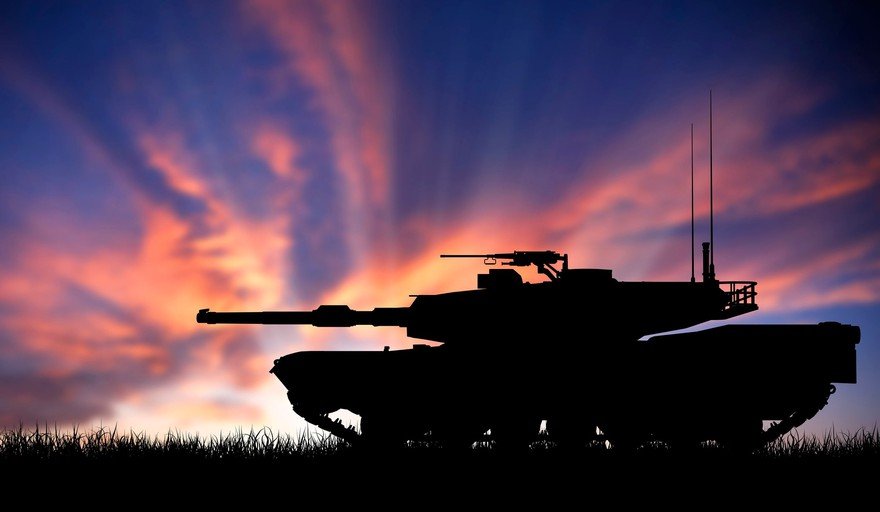
One of its most famous products (which it makes with several smaller defense contractors in Germany) is the Leopard 2 tank, which is considered a rival to both America's M1 Abrams and Russia's T-90. Dozens of Leopard 2 tanks were sent to Ukraine when the war there broke out in 2022.

OTC: RNMBY
Key Data Points
The tanks have encountered problems. For instance, they are complicated to repair, and drones have changed the game for tanks across the board. They were also designed with air support in mind, and Ukraine lacks the air superiority to cover them from Russian airstrikes.
But Rheinmetall has distilled lessons learned in Ukraine into the next-gen Panther Kf51 tank, which has an autonomous anti-drone machine gun mounted to the back of the turret. It can carry up to four drones to bring some of its own limited drone-based air support with it.
So, how has Germany's rearmament been treating Rheinmetall? Pretty well so far.
Hitting its target
I'll start with the bad news: Rheinmetall missed its earnings estimates for the second, third, and fourth quarters of 2025, and its fourth-quarter loss was pretty severe. However, per its 2026 first-quarter results, it was right on target and beat earnings expectations.
The rest of the first quarter was solid, with sales up 8% year over year. Operating profit grew 17%, and it raised its backlog 31% to 72.9 billion euros ($85.5 billion).
The company grew its net profit margin from 9.19% at the end of 2025 to 11.84% at the end of the 2026 first quarter. The company maintains a remarkably low debt-to-equity ratio of 0.47 despite operating a huge number of factories around the world.
After a fairly rough 2025 for its share price, Rheinmetall is looking good going into the second half of 2026. And with Germany's rearmament continuing apace, I anticipate the stock will benefit enormously from Berlin's goal of having the largest army on the Continent.