Cerebras Systems (CBRS +1.58%) took the market by storm last week when it surged 68% on its first day of trading. The reason behind the excitement is clear. Cerebras offers something in great need right now: a high-performance AI chip to power workloads. In fact, the company even says its chip has surpassed the performance of graphics processing unit (GPU)-based systems -- here, we might think of AI chip market leader, Nvidia (NVDA +0.27%), which is known for its GPUs.
Thanks to this market dominance, Nvidia has delivered multiple wins for investors in recent years -- in fact, over the past five, the stock has climbed 1,400%. Propelling this performance has been solid earnings growth. AI companies have rushed to Nvidia for compute, and this has helped revenue reach records well into the billions of dollars. The AI giant finished the latest full year with revenue of more than $215 billion, representing a 65% increase.
Now, as Cerebras takes its first steps as a publicly traded company, it's reasonable to ask the following: Could this young AI company be the next Nvidia? Let's find out.

Image source: Getty Images.
Cerebras' big chip
So, first, let's consider the point that makes Cerebras look very promising right now. The company has built a chip that's 58 times the size of Nvidia's B200 chip, and this size allows it to deliver great speed. Cerebras says that its Wafer-Scale Engine (WSE) has delivered up to 15 times faster inference -- this is the large language model's "thinking" process -- than systems powered by GPUs. And in certain situations, Cerebras says its chips have been 1,000 times faster. Cerebras' WSE 3 includes 4 trillion transistors to fuel a given job -- the company compares this to an Nvidia package of two GPUs that hold 208 billion transistors.
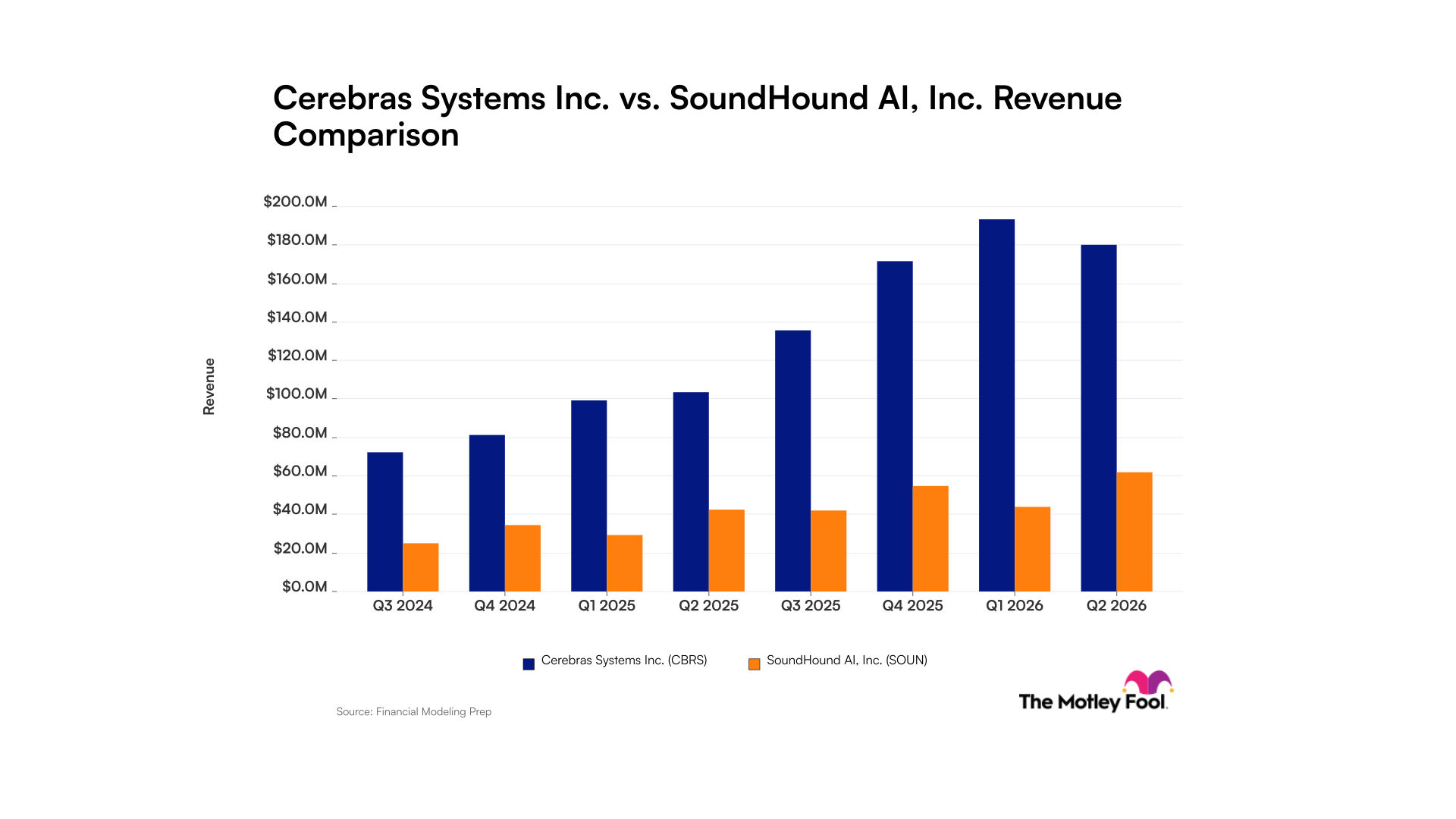
Customers may access the WSE either by ordering platforms for their data centers or by using them through the Cerebras Cloud or a third-party cloud. And Cerebras has seen gains in revenue as customers flock to this exciting solution. Revenue has soared about 2,000% from 2022 to last year, when it came in at $510 million.
Investors clearly liked Cerebras' progress in the AI market as the stock surged on its first day of trading -- May 14 -- and the company raised $5.5 billion for the biggest IPO this year. In the following trading session, however, the stock gave back some of the gains.

NASDAQ: CBRS
Key Data Points
Cerebras vs Nvidia
Now, let's compare Cerebras to Nvidia. It works in the same space as the market leader, and they share the goal of making AI tasks faster and more efficient for customers. But it's important to note that their stories are much different. Nvidia was founded more than 30 years ago and has been building GPU expertise and market presence over that time. The GPU initially served the video gaming market, but as Nvidia recognized the chip's broad potential, the company built a parallel computing platform -- CUDA -- to pave the way to this expansion.
Nvidia then saw the AI opportunity ahead and decided to design GPUs specifically for this market. Meanwhile, the young Cerebras, founded in 2015, set its sights on offering compute to handle the massive needs that AI would surely bring.
Nvidia today continues to serve the gaming market and has expanded into AI, offering solutions tailored to specific industries -- from robotics to healthcare. Nvidia's biggest customers are tech giants such as Microsoft and Amazon, but the company serves smaller players too.
What could create vulnerability
Cerebras has seen revenue climb, but one problem is that revenue comes from a limited number of customers -- that creates vulnerability because if one of these customers reduces spending, Cerebras may feel the impact. Last year, contracts with Mohamed bin Zayed University of Artificial Intelligence in the United Arab Emirates made up 62% of revenue. And Cerebras said in its prospectus that its dependence on this customer, as well as on Group 42 Holding Ltd and OpenAI, "subjects us to a number of risks."
To become the next Nvidia, Cerebras must greatly grow its number of customers to include U.S. tech giants as well as others internationally. The company also must truly prove its strengths in AI over time -- and we should see this reflected in earnings reports, with revenue growth and eventually profitability.
While profitability may come, it might be difficult for a newcomer like Cerebras to build an empire -- after all, Nvidia's ascent came after decades of research and growth.
As for stock price, history shows that new IPO companies don't necessarily outperform in their early years. Excluding first-day returns, IPO stocks have underperformed other companies of similar size by 3.6% per year in the five years following their operations, according to Jay Ritter, a finance professor at the University of Florida. So, if history is right, Cerebras may not be on track for an Nvidia-style run.
Is Cerebras the next Nvidia? From a product, earnings, and stock performance perspective, I don't see this happening in the near term. But, as mentioned, Nvidia became the Nvidia we know today after decades of work. So, over the long run, if Cerebras builds on its strengths and expands across customers and industries, it could potentially become the new Nvidia.