Running artificial intelligence (AI) software requires an astronomical amount of computing capacity, which is typically delivered via large, centralized data centers. This infrastructure is powered by thousands of specialized chips and networking components, which are supplied by semiconductor companies like Micron Technology, Advanced Micro Devices, Broadcom, Nvidia, and Intel.
Nvidia CEO Jensen Huang believes that data center operators could spend up to $4 trillion on AI infrastructure per year by 2030, so this is the biggest financial opportunity in the semiconductor industry's history.
The iShares Semiconductor ETF (SOXX -0.17%) is an exchange-traded fund (ETF) that exclusively invests in suppliers of chips and computing components. It has delivered a blistering return of 330% since the AI boom started gathering momentum in early 2023, thanks to its large positions in Micron, AMD, Broadcom, Nvidia, Intel, and a host of other semiconductor giants.
Here's why more upside might be ahead for this ETF over the long term.
Image source: Getty Images.
The world's best semiconductor stocks packed into one ETF
ETFs can hold hundreds, or even thousands, of different stocks, but the iShares Semiconductor ETF holds just 30. It only invests in U.S. companies that design, manufacture, and distribute chips and components, particularly those that stand to benefit from megatrends like AI. Below are its top five holdings, which represent 40% of the value of its portfolio.
|
Stock |
iShares ETF Portfolio Weighting |
|---|---|
|
1. Micron Technology |
9.97% |
|
2. Advanced Micro Devices (AMD) |
8.88% |
|
3. Broadcom |
7.29% |
|
4. Nvidia |
7.05% |
|
5. Intel |
6.73% |
Data source: iShares. Portfolio weightings are accurate as of May 14, 2026, and are subject to change.
Graphics processing units (GPUs) are the main data center chips used to develop and deploy AI models, and Nvidia's Blackwell series currently dominates the industry. The company will up the ante later this year when it starts shipping its Vera Rubin systems, which the company says will be so powerful that developers can train AI models using 75% fewer GPUs (compared to Blackwell).
However, Nvidia faces growing competition from AMD and Broadcom. AMD has released a portfolio of data center GPUs for AI workloads, but it's going in a slightly different direction with its upcoming MI450 AI accelerators, because they can be customized to suit the needs of specific customers. When configured in the company's Helios data center rack, MI450 accelerators can deliver a staggering 36 times more performance than its last generation of GPUs.
Broadcom is one of the biggest players in the AI accelerator space. It's helping five major customers, including OpenAI, Meta Platforms, and Alphabet, design and fabricate custom data center chips. However, Broadcom is also one of the semiconductor industry's top suppliers of networking equipment.
GPUs and accelerators can't operate at their full potential without high-bandwidth memory (HBM) or central processors (CPUs). Micron supplies some of the best HBM, and Intel supplies some of the best CPUs, so both these companies are also benefiting from the AI boom.
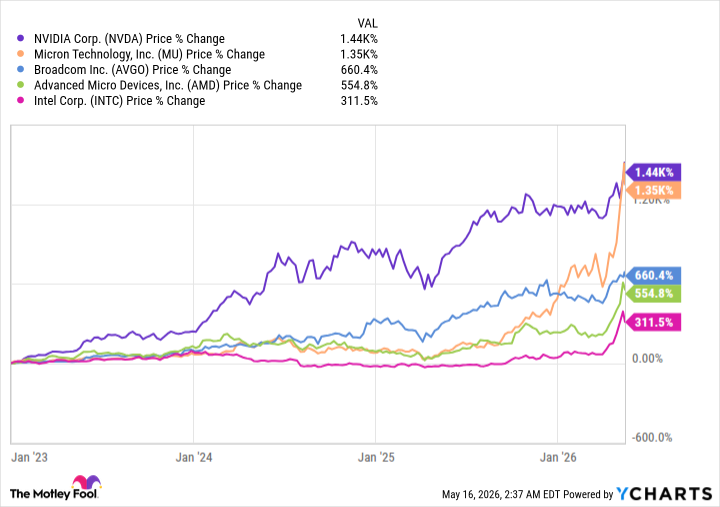
Micron, AMD, Broadcom, Nvidia, and Intel have produced an average return of 860% since the start of 2023, so they have been a massive source of upside for this iShares ETF.
The iShares ETF has a stellar long-term track record
Investors who bought the iShares Semiconductor ETF when it launched in 2001 would have earned a compound annual return of 14% to date. They would be crushing the broader market, because the S&P 500 has returned just 8.4% per year over the same period.
AI is just one of many technological revolutions that spurred demand for computing hardware over the last 25 years. The dawn of the internet, personal computers, smartphones, enterprise software, and cloud computing fostered sales growth across the entire semiconductor industry.

NASDAQ: SOXX
Key Data Points
But there's no doubt that AI is the industry's biggest opportunity so far, which is why the iShares Semiconductor ETF has delivered an above-average compound annual return of 50% over the last three years. Amazon, Microsoft, Alphabet, and Meta Platforms are three of the largest buyers of data center chips and components right now. Based on their most recent forecasts, they will spend a combined $710 billion on AI infrastructure during 2026 alone.
As a result, Huang's prediction that industrywide spending could reach $4 trillion by 2030 sounds plausible, as long as companies can effectively monetize their AI software to fund further investments in infrastructure. If spending does grow to that level, the iShares Semiconductor ETF is likely to deliver more upside over the next few years.