How hot are semiconductor stocks this year? In a word, scorching. Exchange-traded funds (ETFs) make it easy to quantify the sizzling temperatures associated with chip stocks in 2026.
There are more than 5,200 exchange-traded products (ETPs), including ETFs, trading in the U.S., but just 120 are trading up at least 50% year to date. Of that group, 10 are "plain vanilla" semiconductor ETFs, meaning they're not leveraged funds. Ten doesn't sound like a lot, but it is when noting that the universe of ordinary chip ETFs isn't densely populated.

This chip ETF is soaring without much help from Nvidia. Image source: Getty Images.
One of the 2026 leaders in the chip ETF clubhouse is the State Street SPDR S&P Semiconductor ETF (XSD -0.05%), though that status is arguably overlooked. That's surprising, because this is a $3 billion tech ETF that turned 20 in January, meaning it's neither small nor young. Those are superficial statistics, so it's worth examining its other metrics to see whether this ETF has real meat on the bone.
The usual suspect isn't important in this ETF
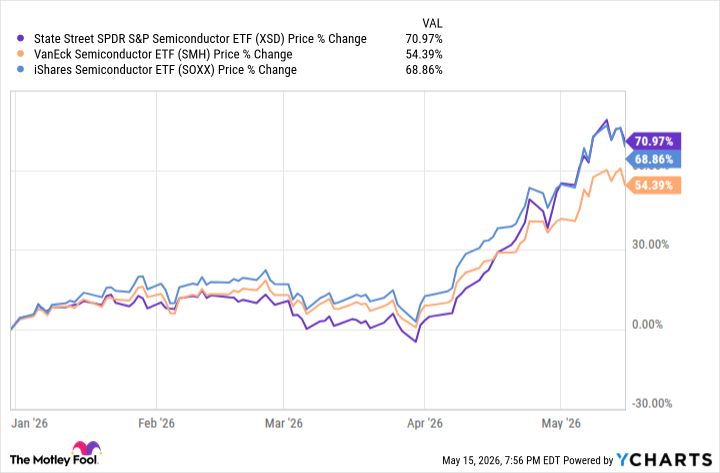
To little fanfare, this SPDR ETF is outperforming the biggest funds in the category year to date. Alone, that's impressive, but wait until you hear the following.
Data by YCharts.
This semiconductor ETF is topping its larger rivals, with a rather diminutive 2% weight to Nvidia (NVDA -0.52%). That's saying something, because of the 25 ETFs with the largest weights to that stock, three are dedicated chip funds. In fact, the largest semiconductor ETF allocates 17.6% of its portfolio to Nvidia.
In the case of the SPDR S&P Semiconductor ETF, 27 of its 44 holdings command larger weights than Nvidia. That may sound like a violation of the semiconductor ETF "code," but it's easily explainable. Most run-of-the-mill ETFs focused on chip stocks weight holdings by market capitalization, so it stands to reason that Nvidia will be the largest holding in those funds. But this SPDR ETF tracks the S&P Semiconductor Select Industry Index, which is equally weighted.

NYSEMKT: XSD
Key Data Points
One of the purported advantages (and critiques) of equally weighting stocks is that the methodology leans into the size factor, placing more emphasis on smaller stocks. To be sure, the SPDR S&P Semiconductor ETF is not littered with small-cap stocks. The weighted average market value of its holdings is $270.7 billion. That's mega-cap territory, but it's also well below the weighted-average market cap of $1.4 trillion for the holdings in the largest chip ETF.
Kicking the Nvidia habit
Let's be clear. Nvidia isn't being dogged here, but not all investors want ETFs that serve as proxies for just one or two stocks, as many semiconductor ETFs do.
The SPDR S&P Semiconductor ETF solves that quagmire by providing a more diverse approach to chip investing. Its advantages don't stop there. Equal-weight ETFs do offer the potential for long-term outperformance due to the aforementioned emphasis on smaller stocks. Additionally, rebalancing equal-weight ETFs can reduce the weights of some overvalued holdings. Said another way, equal-weight ETFs can potentially sell high, unburdening investors of that task.
The SPDR S&P Semiconductor ETF charges 0.35% in fees per year, or $35 on a $10,000 stake.