As earnings season comes to a close, artificial intelligence (AI) investors eagerly awaited Nvidia (NVDA -0.74%) to report its first-quarter results last Wednesday. I wasn't too surprised to learn that the company once again blew past Wall Street's expectations and also beat its own internal guidance.
After all, the rest of big tech -- many of which are Nvidia's largest customers -- already reported earnings. The main theme from those reports was that investment in AI infrastructure is accelerating. That's a good sign for Nvidia's core data center business.
What I most certainly did not expect was the company's announcement of an additional $80 billion stock repurchase authorization. Let's explore what a stock buyback signals about management's views regarding the current AI capex supercycle.
Image source: Nvidia.
Why do companies buy back stock?
If management believes its company's stock is trading below its intrinsic value, it may choose to deploy excess capital to buy back shares. Moreover, buybacks often reflect management's confidence in the company's ability to sustain robust growth. Rather than hoard cash or pursue questionable acquisitions, companies can return capital to shareholders when they are optimistic about the revenue and profit expansion ahead.
In Nvidia's case, with massive free cash flow amid unrelenting chip demand from hyperscalers, such shareholder rewards programs underscore management's belief that the company's trajectory outpaces current market pricing.

NASDAQ: NVDA
Key Data Points
What does Nvidia's share repurchase history look like?
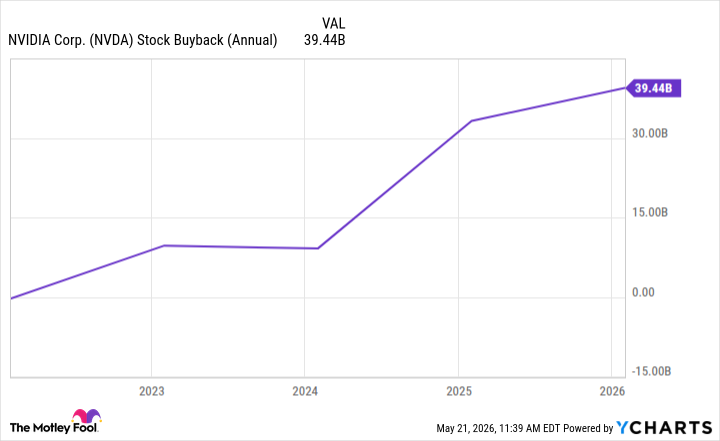
In August 2023, the company authorized a $25 billion buyback without expiration. Of note, this was an increase to a prior buyback program. Exactly one year later, Nvidia approved a subsequent $50 billion stock repurchase program. This was followed by the announcement of an additional $60 billion in buybacks in August 2025.
Data by YCharts.
During fiscal 2026 (period ended Jan. 25), Nvidia returned over $41.1 billion to shareholders through a combination of buybacks and dividends. Entering the latest quarter with $38.5 billion remaining under the prior buyback program, Nvidia's board of directors approved another $80 billion share repurchase without expiration.
Nvidia stock looks dirt cheap right now
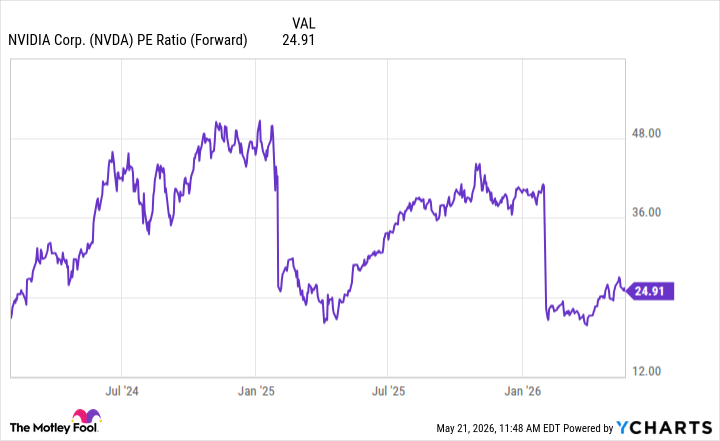
A forward price-to-earnings (P/E) analysis further illustrates why Nvidia's latest buyback may reflect astute timing. With Nvidia currently trading at 25 times next year's expected earnings, Nvidia's multiple appears quite modest relative to the premiums it commanded during similar expansion phases throughout the AI revolution.
Data by YCharts.
I think this discount stems from a number of overlooked catalysts beyond the core data center GPU business. Inference workloads are exploding as enterprises deploy AI at scale -- demanding more compute resources alongside Nvidia's GPUs.
In addition, agentic AI represents a new frontier. Autonomous agents require enormous inference cycles and CPU horsepower, thereby creating layered demand that complements Nvidia's training GPUs. As hyperscalers shift to include CPUs -- such as Nvidia's Vera architecture -- alongside existing GPU clusters, the company stands to become a key supplier in hybrid GPU-CPU systems.
At the end of the day, Nvidia's latest buyback isn't just a simple capital return program. It's a strong vote of confidence that the stock's growth trajectory is poised to kick into a new gear as the AI infrastructure era takes off.