The conventional wisdom holds that a stock that trades up more than 50% in less than six months is overvalued. But sometimes the best stocks are recent winners that Wall Street is only beginning to uncover, with fundamental business improvements that remain undervalued relative to their long-term growth trajectories.
This is an apt description for healthcare disruptor Oscar Health (OSCR 1.14%). Oscar Health is a health insurer stealing market share with its technology-focused offering and is beginning to show a profit inflection. Here's why shares -- up 53% so far this year -- are still too cheap to ignore.

Image source: Getty Images.
Market share gains and rapid growth
When considering basic health insurance, one might argue that it is a commodity. All the insurer is doing is providing blanket coverage across various health providers in the local area, subject to stringent regulations such as Medicare and the Affordable Care Act (ACA) marketplace.
Where Oscar Health has made inroads, from a standing start a decade ago, is through a better customer experience across everything outside traditional health services. It has built a cloud-based software solution from the ground up, complimentary telehealth for all users, and transparent pricing compared to the competition. It may take years for Oscar to catch up to legacy competitors like UnitedHealth in terms of doctor and care coverage across the United States, but it is already light-years ahead in the rest of the customer experience.
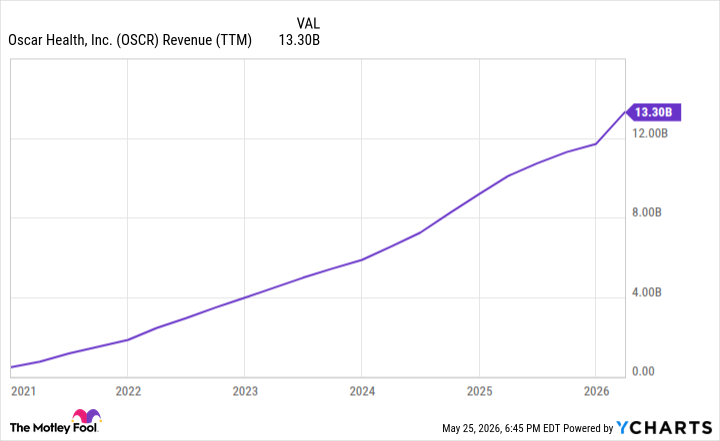
This is why Oscar Health's total number of members paying for insurance has grown rapidly in recent years, hitting 3.2 million at the end of Q1 2026. Right now, the company focuses only on the ACA marketplace, making this growth even more impressive. In Q1 2021, Oscar had just over 500,000 paying insurance members.

NYSE: OSCR
Key Data Points
The path to operating leverage is clear
What kept Oscar Health's stock in the gutter last year was rising healthcare utilization among its members, which exceeded analyst projections. This was an issue for all health insurers in 2025, leading to a decline in profitability. In 2025, Oscar Health had a $400 million operating loss due to these rising costs.
At the same time, the United States government debated last year whether to eliminate extended tax subsidies for ACA marketplace payors, which increased the pool of citizens who could afford individual health insurance, a boost for Oscar Health. As the government let these subsidies expire amid a tough year for Oscar, the stock began to fall.
It turns out that Oscar Health's nimble management had already prepared health insurance plan pricing for subsidy experimentation while also being conservative in projecting healthcare utilization among members to ensure 2025 did not repeat in 2026.
Q1 2026 results proved the strategy's intelligence. Oscar Health generated $700 million in operating income in the first quarter, gaining market share while also achieving operating leverage. It expects typical seasonality in health insurance to lower its 2026 annual operating earnings to $250 million-$450 million, but that would still be a record high for the business. If the company can keep adding new members, it will gain greater nationwide scale, enabling stronger earnings growth in the years ahead.
Data by YCharts.
Why Oscar Health stock is too cheap to ignore
After jumping up 53% this year, Oscar Health trades at a market cap of $6.63 billion. This is still cheap compared to what the business can earn in a few years. At the high end of its 2026 guidance, the company expects revenue of $19 billion and operating income of $450 million, resulting in a profit margin of just 2.3%.
More scale in the years ahead should enable greater expansion of profit margins. Remember that $30 billion in premium revenue and just a 3% profit margin is $900 million in annual operating income, or less than 10x its current market cap. Given the size of the healthcare industry in the United States, premium revenue could grow well beyond $30 billion over the long term.
This makes Oscar Health stock still cheap despite its 50% year-to-date gain.