The quantum computing industry is soaring after the Department of Commerce announced plans to provide $2 billion in federal incentives to nine quantum companies. IonQ (IONQ +0.74%) wasn't on the list, but it was the first publicly traded pure-play quantum computing company and has seen its share price increase 56% on the year (through May 28).
IonQ is arguably the most successful pure-play quantum company, too, as it was the first to surpass $100 million in annual revenue. Even though it's already up big, there's another major catalyst that could lift the entire industry higher this year.
Image source: The Motley Fool.
Quantum advantage in 2026
In a first-quarter earnings call, IBM CEO Arvind Krishna said he believes the company's partners will achieve the first examples of quantum advantage this year. The computing giant has also launched an open community quantum advantage tracker, where researchers can collect, validate, and compare results.
While there's no strict definition of quantum advantage, it generally refers to a demonstration that a quantum computer can solve a commercially relevant problem faster than a classical computer. This would essentially serve as validation for the entire quantum computing industry, as at the moment, there are still questions about its commercial applications.
IonQ would benefit the most if it were the company to demonstrate quantum advantage. Even if it weren't, this development would still likely boost all quantum computing stocks. If one company demonstrates quantum advantage, competitors will likely be able to do the same in time.

NYSE: IONQ
Key Data Points
However, there's no guarantee quantum advantage will happen in 2026 or at all. Commercial uses for quantum systems are still largely theoretical. That's one of a few notable risks of investing in IonQ.
Why IonQ is a high-risk investment
Like other quantum computing pure plays, IonQ hasn't reached profitability yet. Its adjusted earnings before interest, taxes, depreciation, and amortization (EBIDTA) was a loss of $186.8 million in 2025 and $96.8 million in the first quarter of 2026. On a positive note, it had $3.1 billion in cash, cash equivalents, and investments as of March 31, enough to cover several years of operating expenses.
IonQ also has an extremely expensive valuation, trading at 120 times trailing sales. In fairness, its main competitors are even more expensive. Quantum Computing, Inc. trades at over 500 times trailing sales, while D-Wave Quantum and Rigetti Computing both trade at over 800 times trailing sales. IonQ is the better deal by this metric because of its higher revenue.
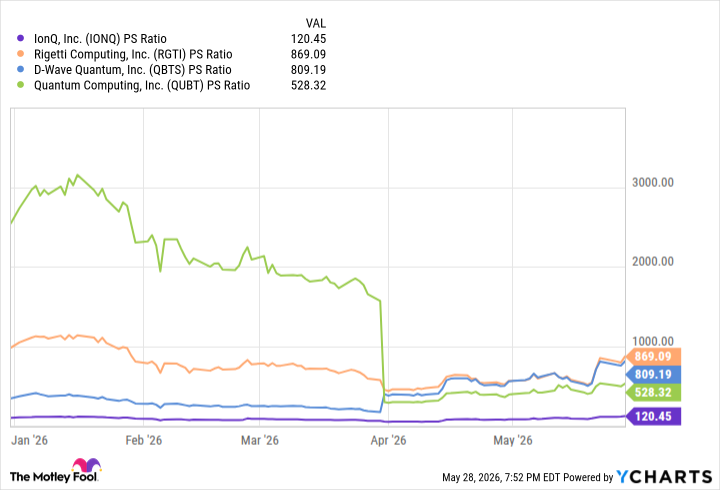
IONQ PS Ratio data by YCharts
But compared to other tech stocks, these quantum computing companies have stretched valuations. Nvidia trades at 21 times trailing sales.
IonQ is also betting on a specific approach to quantum systems based on a trapped-ion architecture. This has led to a notable advantage in accuracy over other quantum systems so far, including a 99.99% 2-qubit gate fidelity score -- meaning its system was 99.99% accurate. The downside is that trapped-ion quantum systems are much slower than systems using competing approaches, such as superconducting and photonics.
Accuracy is what matters most in quantum systems, so IonQ is in a good position. However, if other companies catch up, then processing speed could become more important, putting IonQ at a disadvantage.
Should you invest in IonQ?
IonQ is moving in the right direction financially. Revenue in Q1 2026 was $64.7 million, a 755% year-over-year increase and 30% higher than the midpoint of the expected range. Management also raised full-year revenue expectations to between $260 million and $270 million.
The analyst community rates IonQ highly, with most considering it a strong buy. However, the 12-month price target is $67.64, below the company's share price at the time of this writing, suggesting the price may have outrun analyst expectations.
Although I believe IonQ is the most interesting pure-play quantum company, I'm hesitant to invest right now, given its price appreciation and volatility. If you want to add IonQ to your portfolio, consider starting with a small position and gradually adding to it over time. It could continue to outperform, especially if quantum advantage becomes a reality this year, but there's also a good chance of a pullback that results in a better buying opportunity.