Costco Wholesale (COST -0.10%) just reported an outstanding earnings report with its highest quarterly growth in years. Walmart (WMT +0.71%) reported phenomenal results as well just two weeks ago, and since these two companies are the largest physical supermarket companies in the U.S., that says a lot about the resilience of the U.S. consumer right now.
However, despite the brilliant results, both Costco and Walmart fell after earnings. Is this a warning for investors?

Image source: Getty Images.
Shoppers keep shopping
Costco's revenue increased 11.6% year over year in the 2026 fiscal third quarter (ended May 10), its highest rate since 2022. Comparable sales (comps) were up 9.8%, and earnings per share were $4.28, up from $4.93 the year before. The last five weeks of the quarter were the company's highest-volume five-week period ever.
Although higher fuel costs have been negatively impacting many companies, Costco is using the volatility to its advantage, providing lower-cost gas and attracting members who don't usually fill up at its stations. Members who fuel up at Costco also tend to spend more overall.

NASDAQ: COST
Key Data Points
As usual, there was strong growth across metrics, with membership fee income up 10.7% and executive membership up 9.6%.
Walmart's performance tells a similar story. In the 2027 fiscal first quarter (ended April 30), sales were up 7.3% over last year, with a 4.1% increase in U.S. comps. Earnings per share (EPS) were up from $0.61 to $0.66. Global membership fee revenue was up 17.4%, and the company continues to leverage its 10,000+ global store base to fulfill orders quickly, a key advantage over other supermarkets.
All of its businesses are performing well, including the high-margin advertising business, which was up 37% year over year.
But that might end soon
Despite fabulous results, both Costco and Walmart stock fell after the releases.
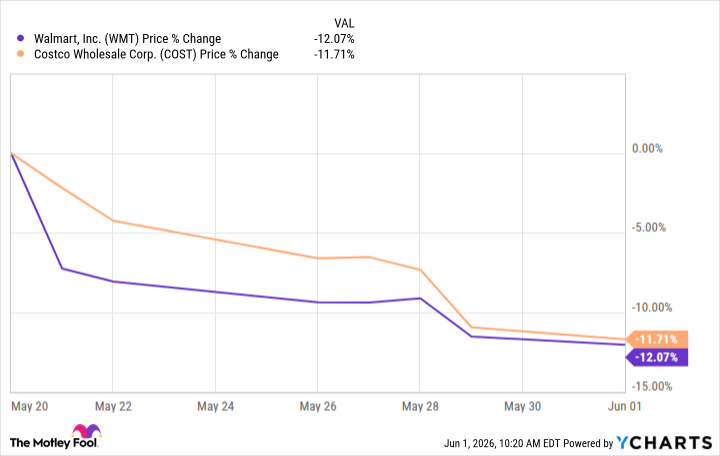
Costco stock had already been falling after Walmart's report, as seen in the chart above. The macro picture is worrisome, as Walmart CFO John Rainey noted: "We see with our customers that the high-income customer is spending with confidence in many categories, while the lower-income consumer is more budget-conscious and perhaps navigating financial distress."
That's a warning about the continued resilience of the U.S. consumer. As inflation remains relentless and fuel prices increase, the economy, which has been strong, might start feeling the pinch.
But there's more to the story.
Warning to Wall Street?
Despite worries about the economy, the market continues to zoom higher. The S&P 500 keeps hitting new highs, and it's up nearly 11% year to date as of this writing. As it climbs, it's becoming more expensive. The cyclically adjusted P/E, or CAPE ratio, is nearly 40, its second-highest level in more than a century of tracking. The previous high of 44 was reached right before the dot-com bubble burst in 2000, ushering in three consecutive years of S&P 500 losses.
How does that play into what's happening at Costco and Walmart? Both stocks have become quite expensive; Costco trades at 49 times trailing-12-month earnings, while Walmart trades at 41 times trailing-12-month earnings. Those are premium valuations, which means that neither company can afford any missteps.

NASDAQ: WMT
Key Data Points
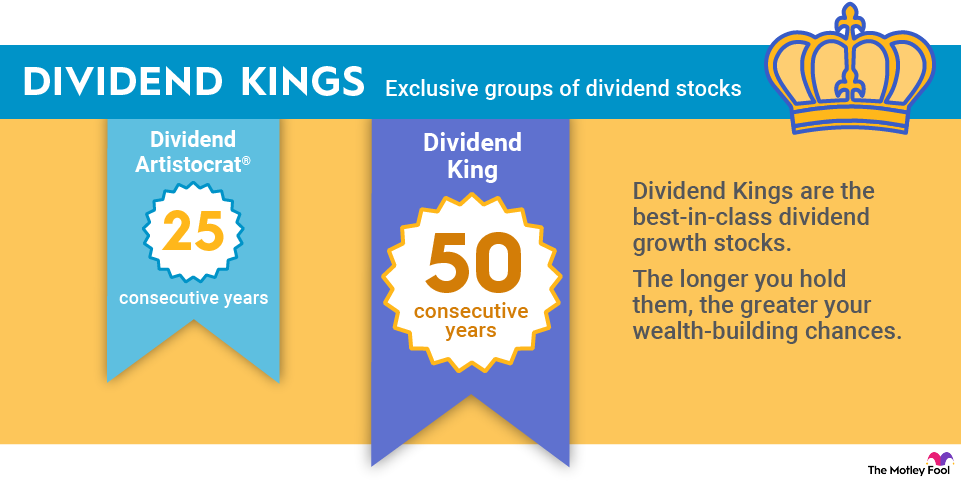
In other words, at these prices, any negativity, even only in sentiment, can send the stock down. And that goes for the entire market. Warren Buffett is famous for noting that he gets fearful when the market is greedy. Bull markets don't have to imply greed, but unreasonable valuations do. Today, even safe dividend stocks like Walmart and Costco are trading at valuations well above multi-year averages.
In this situation, investors should make sure that they're well diversified with anchor stocks that can protect their funds in the case of a downturn, and be choosy about new stock purchases.