AI chip company Nvidia (NVDA -3.16%) became the first company ever worth $5 trillion in late 2025. As of this writing, it sits just below this after a recent pullback. But it's still the most valuable company in the world by a comfortable margin.
What's striking is how few companies are even in the conversation to pass it. But I personally think this is a conversation worth having, because I don't think Nvidia will hold its crown forever.
Of the handful that have crossed into multitrillion-dollar territory, three arguably look like plausible challengers over time: Alphabet (GOOG -1.68%)(GOOGL -1.74%), Apple (AAPL +0.49%), and Microsoft (MSFT -1.80%). Each has market capitalizations measured in the trillions, yet each still trails Nvidia -- and closing that gap would require specific things to go right. But I think passing Nvidia's value is possible for all three -- especially for one of them.
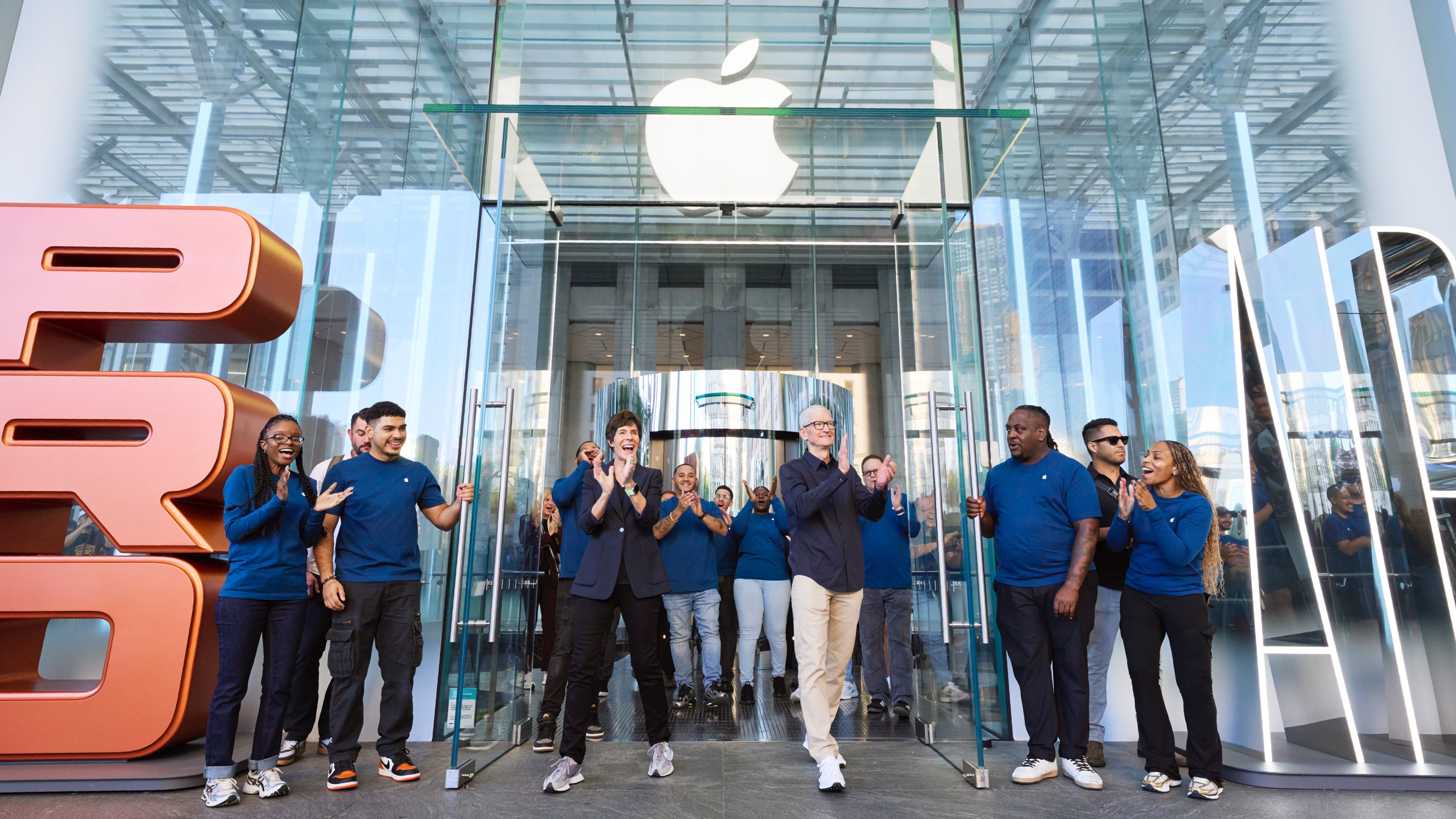
Apple CEO Tim Cook an at an Apple store. Image source: Apple.
Alphabet
Of the three, Google parent Alphabet had closed the most ground until recently. Its stock has climbed sharply over the past year, lifting its market value to about $4.9 trillion -- a little more than half a trillion dollars short of Nvidia. But after a recent pullback, the stock's market capitalization is now $4.45 trillion -- still within striking distance but behind Apple, which has a market capitalization of $4.51 trillion as of this writing.
So, how does Alphabet become bigger than Nvidia?
The bull case rests on Alphabet controlling every layer of the AI business. From the chips up, Alphabet has its hands in virtually every part of the technology stack that builds AI and delivers it to end users.
Capturing its incredible AI momentum, Alphabet's first-quarter Google Cloud revenue grew 63% year over year to $20 billion, accelerating from 48% growth in the fourth quarter of 2025, and its order backlog nearly doubled in three months to more than $460 billion.
And "Google search and other advertising revenue," which many investors feared AI would erode, instead grew 19%.
"And the fact that we own frontier models, own the silicon, really helps us stay ahead of the curve," said Alphabet CEO Sundar Pichai during the company's first-quarter earnings call.
That silicon -- Google's in-house Tensor Processing Units -- may be the part that matters most, because Alphabet has started selling that hardware to outside customers and will begin delivering it to select customers later this year, putting it in more direct competition with Nvidia.
Reported earnings per share jumped 82% in the quarter, though most of that came from a one-time $36.9 billion gain on some of Alphabet's investments. But operating income -- the figure that better reflects the underlying business -- still rose 30% year over year.
Microsoft
Microsoft has the steepest climb. At around $3.1 trillion, the software giant trades well below its highs of the past year and meaningfully trails Nvidia.
That's not for lack of underlying business growth, however. In its fiscal third quarter (the period ended March 31, 2026), Microsoft's revenue rose 18% to $82.9 billion, Azure and other cloud services grew 40%, and Microsoft said its AI business passed a $37 billion annual revenue run rate -- up 123% from a year earlier. Additionally, paid seats for its Microsoft 365 Copilot assistant climbed past 20 million, up from 15 million three months earlier.
But to catch Nvidia, Microsoft would need both years of that torrid cloud growth and a higher valuation from investors -- and it's spending heavily to get there, with capital expenditures set to reach roughly $190 billion this year. That spending has weighed on margins and, so far, on the stock.
Still, given enough time, I think Microsoft's more diversified growth drivers and its software model, which is less dependent on business cycles, will help the company have a shot at eventually passing Nvidia in market value.
Apple
Apple sits next, worth more than $4.5 trillion -- not too far behind Nvidia.
The iPhone maker's edge is its installed base of more than 2.5 billion active devices and its loyal customer base. And iPhone in particular has been booming recently. In its fiscal second quarter (the period ended March 28, 2026), Apple's revenue rose 17% year over year to $111.2 billion, with iPhone revenue up 22% on demand for the iPhone 17 lineup and services revenue up 16% to about $31 billion.
The bigger question is artificial intelligence, where Apple has lagged. But it's aiming to remedy this. Earlier this year, the tech giant struck a deal with Alphabet's Google to use its Gemini models to power a rebuilt Siri, expected to make its debut this year -- and Apple's developer conference next week could offer the first real look. If AI finally gives that enormous installed base a reason to upgrade at an even faster clip, Apple's earnings -- and its valuation -- could move sharply higher. But that's not guaranteed, and rising memory costs may pressure margins in the meantime. Apple is also notably changing leaders, with CEO Tim Cook handing off to company veteran John Ternus on Sept. 1. This leadership change can be seen as a potential catalyst and a risk, depending on how you look at it.

NASDAQ: AAPL
Key Data Points
Can anyone catch Nvidia?
For now, I believe the most plausible path to passing Nvidia in market value is Apple's. It's the closest in size, its iPhone business is surging even before its Siri overhaul, the company is reportedly planning to launch a major new iPhone model later this year, and Apple's high-margin services business could help expand the tech giant's total company gross profit margin over the long haul.
Still, the target keeps moving. Nvidia's earnings rose triple digits last quarter, and the stock trades at a price-to-earnings ratio of about 31 -- not a bad valuation for a company growing as fast as Nvidia is, even if its business is cyclical.
Ultimately, the leaderboard may well reorder in the years ahead. But for any of these companies to pass Nvidia, a lot would have to go right -- and Nvidia would have to slow down.