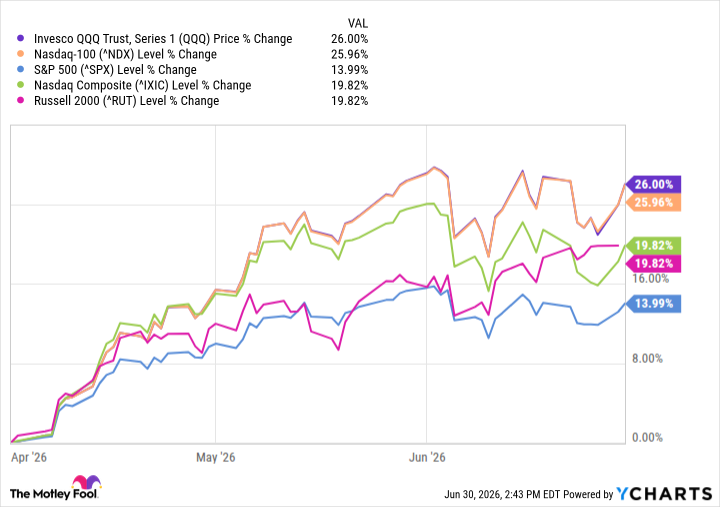
The stock market continues to roll in 2026, with major indexes again posting solid gains. The S&P 500 (^GSPC -0.06%) rose 14% in the second quarter, and the Nasdaq Composite (^IXIC -0.44%) and Russell 2000 both jumped nearly 20%, challenging all-time highs.
It's an impressive run for the market considering the economic climate. Rising inflation, higher interest rates, and conflict in the Middle East continue to dominate the headlines. But the market seems oblivious to those issues while investors reap the benefits.
Conditions like this are why I think it's so important to include index funds in your portfolio. They capture broad segments of the market, allowing you to benefit from the overall market's strength while avoiding overexposure to any single stock. But I also believe that even with an index fund, you can be very targeted in how you set yourself up for success.
That's why the Invesco QQQ Trust (QQQ -0.70%) continues to be my index fund of choice. The QQQ tracks the Nasdaq-100, which comprises the 100 largest nonfinancial companies listed on the Nasdaq. With its heavy emphasis on technology and high-growth stocks, the QQQ has outperformed the broader indexes, gaining 26% over the last three months.
Here's why the QQQ will remain a core holding in my portfolio in 2026.
About the QQQ ETF
While there are thousands of exchange-traded funds, the QQQ has long been my favorite. It's one of the oldest ETFs, with a 25-year track record, and the second-most-traded ETF in the U.S. by average daily trading volume.
The QQQ has nearly $500 billion in assets under management and has been an overachiever for years. In the last decade, the QQQ has jumped more than 615% as major tech stocks and artificial intelligence have become predominant themes in the market.
Image source: Getty Images.
That's important for the QQQ's better-than-the-market performance. Tech stocks comprise 66.9% of the fund, followed by consumer discretionary stocks at 17.6%. No other sector has more than a 4% weighting in the ETF.
The top 10 holdings are a who's who among major tech companies. The QQQ is a modified market cap-weighted fund, so companies with the largest market caps typically have a higher weighting. But there are exceptions.
|
Company |
Weighting |
Market Cap |
Year-to-Date Performance |
|---|---|---|---|
|
Nvidia |
7.52% |
$4.82 trillion |
6.79% |
|
Apple |
6.59% |
$4.23 trillion |
6.18% |
|
Micron Technology |
5.68% |
$1.29 trillion |
301.7% |
|
Microsoft |
4.36% |
$2.75 trillion |
(23.26%) |
|
Amazon |
4.12% |
$2.56 trillion |
3.38% |
|
Advanced Micro Devices |
3.87% |
$943.98 billion |
171.1% |
|
Alphabet Class A shares |
3.28% |
$4.32 trillion |
14.05% |
|
Tesla |
3.28% |
$1.57 trillion |
(6.86%) |
|
Alphabet Class C shares |
3.05% |
$4.32 trillion |
12.66% |
|
Intel |
2.91% |
$705.28 billion |
280% |
Data source: Invesco. Holdings as of June 28, 2026. YTD performance as of June 30, 2026
The Nasdaq-100 and QQQ are rebalanced quarterly, but even then, some weightings can become misaligned. Micron, AMD, and Intel have risen so much this year that they're temporarily among the top 10 weightings in QQQ, though that will likely change when the fund gets rebalanced. And the table doesn't take into account Space Exploration Technologies, or SpaceX, which had its IPO on June 12 and will be added to the Nasdaq-100 on July 7.

NASDAQ: QQQ
Key Data Points
The tech sector will continue to play an outsize role in the stock market in 2026, and I believe the QQQ is the best way to invest in the sector. It gives you solid returns, broad exposure to the tech sector, and only charges a small expense ratio of 0.18%, or $18 annually per $10,000 invested. It will be a core holding in my portfolio.