While most of the market's attention right now is on tech and artificial intelligence (AI) stocks, it's worth noting that dividend stocks have a pretty good track record. Sure, they haven't delivered the returns that semiconductor stocks have. But if you go back more than a decade, you'll find plenty of impressive track records.
This is important because looking back 10 to 20 years means you're accounting for the 2022 bear market, the 2020 COVID-19 pandemic, the 2018 mini-bear market, and the 2011 U.S. credit downgrade. Stocks and exchange-traded funds (ETFs) should be judged on long-term performance, not just recent performance. That helps ensure we see how these securities perform across multiple market and economic cycles.

Image source: Getty Images.
What makes a strong long-term dividend ETF
If you're looking for a dividend ETF that can be used as a core portfolio holding, you'd ideally like to see a few things:
- An ultra-low expense ratio
- A strategy that considers more than one factor (e.g., high yield plus quality)
- Meaningful sector diversification
- A screen that helps ensure long-term dividend sustainability
These qualifications aren't necessarily requirements for meeting the definition of a "good" fund. But a well-rounded strategy that considers multiple factors in its selection process generally has a better chance of limiting volatility and achieving long-term success. A strategy that uses selection criteria as a cross-check can do a better job of eliminating the bad apples from consideration.
Four ETFs that have turned $10,000 into $45,000 or more over the past 15 years
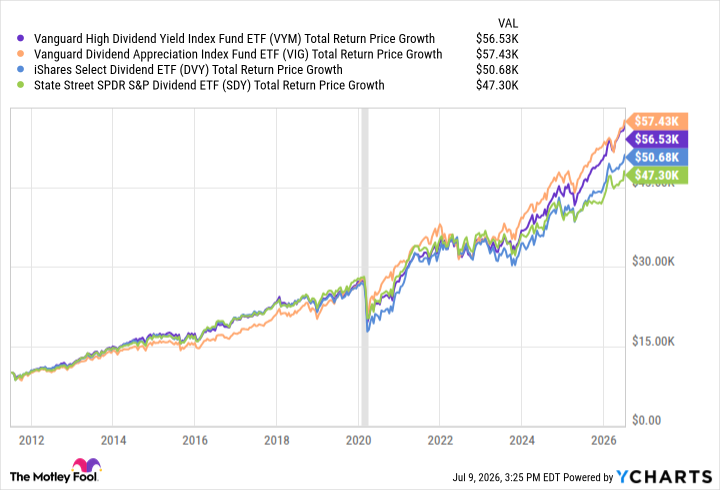
Data by YCharts.
Vanguard High Dividend Yield ETF
The Vanguard High Dividend Yield ETF (VYM +0.71%) is a pure high-yield strategy. It starts with a large U.S. stock universe and simply selects the top 50% of forecast yields from that group, excluding real estate investment trusts and weighting by market cap.

NYSEMKT: VYM
Key Data Points
Its top four sector holdings are financials (20%), tech (19%), industrials (13%), and healthcare (12%). Investors get solid sector diversification from growth, cyclical, and defensive areas of the economy.
Vanguard Dividend Appreciation ETF
The Vanguard Dividend Appreciation ETF (VIG +0.65%) would be the pure dividend growth strategy. It also starts with a large universe of U.S. stocks and selects those with 10 or more consecutive years of annual dividend growth. The top 25% of yields are excluded to avoid any potential yield traps. Holdings are market-cap-weighted.

NYSEMKT: VIG
Key Data Points
Removing high-yielders reduces the portfolio's overall yield to just 1.5%. That's not going to entice many people to use it as an income holding, but it's historically been more growth-oriented, which explains some of its strong performance. Tech currently accounts for 28% of the portfolio, which has been driving recent gains.
iShares Select Dividend ETF
The iShares Select Dividend ETF (DVY +0.22%) is the first combination strategy on the list. It looks at a stock's five-year dividend growth rate and payout ratio to consider both dividend history and quality characteristics. Because it weights the portfolio by dividends paid, it tends to skew toward a higher yield.

NASDAQ: DVY
Key Data Points
There are two caveats with this fund. First, its expense ratio of 0.38% definitely qualifies as above average within the dividend ETF category. Second, almost half the portfolio is dedicated to the financials and utilities sectors. Historical performance has been solid, but it comes up short on these two key criteria.
State Street SPDR S&P Dividend ETF
The State Street SPDR S&P Dividend ETF (SDY +0.05%) is the fund that targets high-yield, long-term dividend growers. It selects companies with 20-plus-year dividend-growth track records and weights them by dividend yield. This gives the fund the durability of more financially stable dividend growth stocks with the income potential of high-yielders.
This portfolio is surprisingly diverse. Industrials, consumer staples, utilities, and financials all receive allocations of between 13% and 19%. This makes it perhaps the most suitable ETF on this list to weather different market environments.
If you need income now, the iShares Select Dividend ETF and the State Street SPDR S&P Dividend ETF make more sense. If you have a longer-term time horizon, the Vanguard Dividend Appreciation ETF's dividend-growth component and tech exposure offer greater long-term growth potential.