Value stocks are companies that the market is pricing at a level below what investors might expect based on the business's fundamentals.
Value investors aim to buy such stocks on the premise that they are temporarily on sale, then sell them after they're returned to more appropriate valuation levels.
Growth stocks rarely fall into value territory, and amid the AI megatrend, most investors would naturally consider Microsoft (MSFT +2.38%) or Nvidia (NVDA -0.52%) to be growth stocks. However, given how the market is valuing them, I'd argue they could also be considered value stocks.
Investors won't want to miss out on the explosive returns that can result from buying undervalued growth stocks, but which one of these two is the better pick to add to your portfolio now?

Image source: Getty Images.
Are they really value stocks?
Some may take issue with calling these two tickers value stocks, but consider the facts. Microsoft trades for 22.9 times trailing earnings and 19.9 times forward earnings. It has only rarely traded this low.
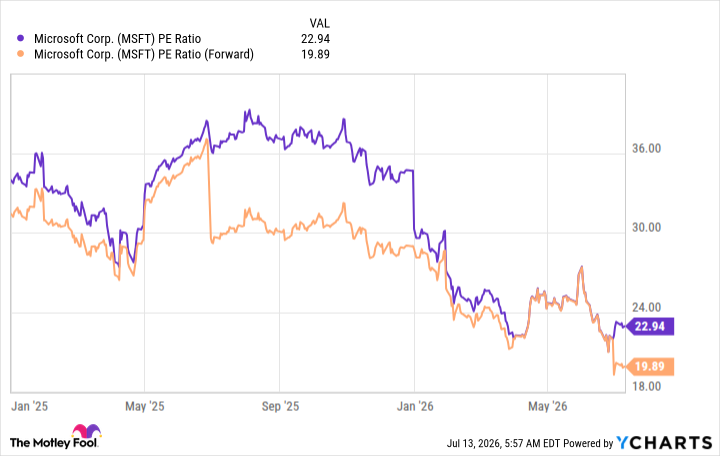
MSFT PE Ratio data by YCharts.
Compared to the broader market, as measured by the S&P 500 (^GSPC +0.59%), Microsoft actually looks cheap. The S&P 500 trades for 25.6 times trailing earnings and 21.7 times forward earnings. That makes Microsoft the textbook definition of a value stock.
Nvidia is a bit more of a stretch, but not by much. It is one of the hardest companies to value on the market due to its size and rapid growth, so looking at three valuation metrics makes sense.
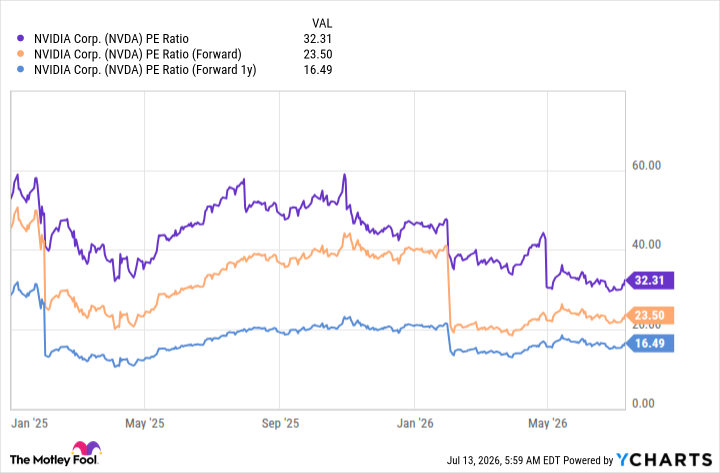
NVDA PE Ratio data by YCharts.
From a trailing earnings standpoint, it's more expensive than the S&P 500, but certainly not overvalued. But its trailing earnings metric fails to factor in its jaw-dropping forecast growth; Wall Street expects Nvidia to grow at a 96% pace next quarter. From a forward earnings standpoint, Nvidia trades at a ratio of 23.5 -- a slight premium to the market's 21.7. But considering that Wall Street expects Nvidia's top line to grow by more than 40% next year, I think measuring that stock relative to next year's earnings estimates makes sense. It's trading now at 16.5 times next year's earnings. By that metric, Nvidia's stock would look pretty cheap by early next year if the share price stayed flat.
So, is Nvidia a value stock? Maybe not by traditional measures, but I think it's close enough that investors could consider it to be one. But is Nvidia a better buy than Microsoft?
Both companies have their merits
Nvidia and Microsoft are both involved in the AI build-out. Nvidia is on the hardware side and provides AI hyperscalers (like Microsoft) with GPUs and other supporting products for their data centers. That's a well-defined business, and it's making huge profits right now. With the AI infrastructure build-out expected to last at least until 2030, that makes Nvidia's future pretty clear and also quite bright. However, there are many questions about what Nvidia's business will look like a decade from now.

NASDAQ: NVDA
Key Data Points
Microsoft is on the opposite end of the spectrum. It's building out data centers right now, and has a pretty solid AI business; its AI-related revenue rose 123% year over year to $37 billion last quarter. Its cloud computing business also saw 40% revenue growth, and is a direct beneficiary of the world's increasing AI workloads. While its business is growing at a strong pace, there are questions surrounding what the long-term payoff will be for the hundreds of billions of dollars it's spending on constructing new data centers. If AI software doesn't deliver the payoff that companies are looking for, then Microsoft's AI data centers may prove a poor long-term investment -- and so could the stock.

NASDAQ: MSFT
Key Data Points
That's part of the bear case for each. The bull case is that if AI pans out, more computing power will be needed to satisfy demand. However, the market is still years away from having clarity about the outcome. All that's known for certain is that the AI community is still in the early innings of its build-out, which bodes well for Nvidia and less so for Microsoft (because it's spending a lot of money to bring data centers online). As a result, I think Nvidia is the better pick to hold over the next five years, because there is still huge revenue growth expected for the chipmaker, and not a ton of it is priced into the stock right now. Microsoft will still be a solid investment, but I think it has less upside potential than Nvidia.