Quantum computing represents a fundamental shift from classical systems, which process data using binary bits that exist as zeros or ones in underlying codebases. Quantum machines use qubits, which possess a property called superposition -- allowing them to evaluate vast numbers of possibilities simultaneously.
This capability holds particular promise for artificial intelligence (AI), where quantum computers could deliver faster answers to complex optimization problems, enhance machine learning, and simulate molecular interactions, among many other uses. According to McKinsey & Company, quantum computing could add up to $2.7 trillion of value to the global economy by 2035, underscoring the scale of the opportunity as this technology matures from laboratory curiosity toward practical utility.

Image source: Getty Images.
What are the most popular quantum computing stocks?
IonQ (IONQ -3.61%), Rigetti Computing (RGTI -4.71%), and D-Wave Quantum (QBTS -5.21%) are the primary publicly traded pure-play companies focused on quantum computing hardware and services.
IonQ employs trapped-ion qubits in its quantum systems, which aim to improve AI models and create better data for research purposes. Meanwhile, Rigetti uses superconducting qubits to build quantum computers that customers can leverage with existing AI-native tools. Both IonQ and Rigetti offer access to their platforms through cloud-based environments, seeking integrations with infrastructure providers like Microsoft Azure, Amazon Web Services, and Google Cloud. D-Wave has primarily focused on a niche technology called quantum annealing that is only useful for solving optimization problems and sampling problems. However, those types of problems include a host of real-world applications in areas like logistics, finance, and drug discovery.
Across these companies, technology remains heavily research-oriented. While commercial systems and cloud access are expanding, they are still years away from delivering enterprise-grade fault-tolerant machines capable of providing a measurable quantum advantage.
Analyzing the financial realities of quantum pure plays
Though they are all generating some revenues and receiving support from government subsidies, each of these quantum pure plays continues to post substantial operating losses. All of them have relied on repeated equity raises to fund their research and development. The result has been ongoing shareholder dilution.
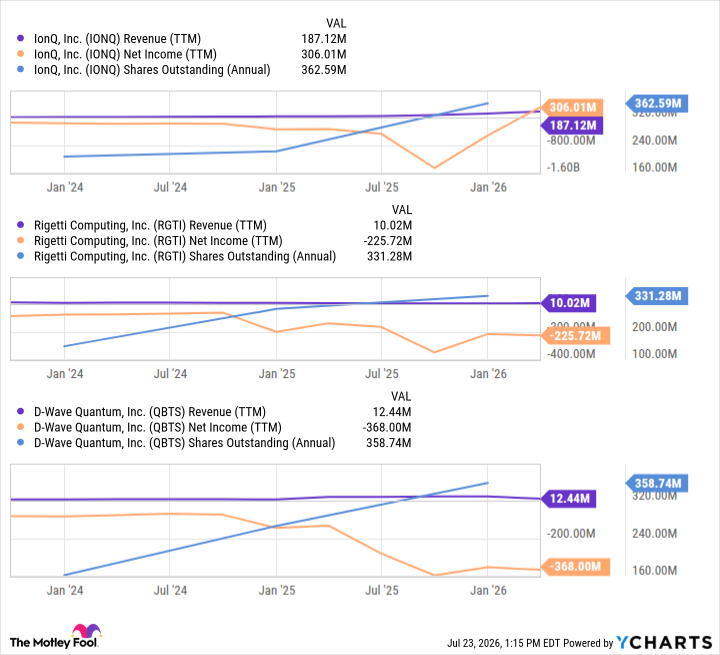
IONQ Revenue (TTM) data by YCharts.
The valuations of the quantum pure plays reflect extreme speculation rather than concrete fundamentals. IonQ has a price-to-sales (P/S) ratio around 58, while Rigetti and D-Wave both sport P/S multiples near 480. For cash-burning operations whose progress has yet to translate into profitability or self-funding growth, these valuation profiles are overextended, to say the least.
What is the best quantum computing stock?
In my view, Nvidia (NVDA -1.01%) is the strongest candidate to consider buying for any investor seeking quantum computing exposure in their portfolio.
Nvidia supplies the classical infrastructure essential to building quantum machines through its CUDA-Q platform, which enables hybrid quantum-classical programming across GPUs, CPUs, and quantum processors. As quantum AI scales up, these systems will increasingly depend on Nvidia's ecosystem for next-generation algorithms that allow the strengths of classical and quantum computing to be efficiently combined.
Meanwhile, Nvidia's price-to-earnings (P/E) ratio of 32 is hovering around its lowest level in nearly seven years. This discount suggests that the potential upsides of quantum computing adoption and continued AI infrastructure expansion are not yet fully reflected in Nvidia's stock price.
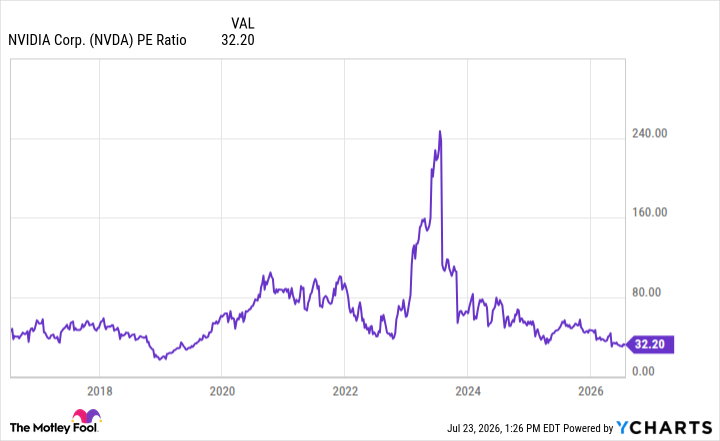
NVDA PE Ratio data by YCharts.
This positions Nvidia stock as a compelling buy to capture the near-term momentum of data center build-outs, while offering leveraged exposure to longer-term advances of quantum computing over the coming decade.