Intel (INTC -3.45%) and Advanced Micro Devices (AMD +0.22%) have outperformed Nvidia (NVDA +0.22%) so far in 2026. However, Nvidia is coming after one of Intel and AMD's most important businesses, which could derail their momentum.
Earlier this year, it emerged that Nvidia will start selling its Vera server central processing units (CPUs) as a stand-alone product to customers. It now appears that the company has already started making a solid dent in this market, according to a report by Tom's Hardware, and that doesn't bode well for Intel and AMD.
Image source: Getty Images.
Nvidia's stand-alone CPU server business seems to have gotten off to a terrific start
Nvidia's vice president of hyperscale and high-performance computing, Ian Buck, told Tom's Hardware that the company has already shipped "hundreds of thousands of Grace stand-alone servers." It is worth noting that the chip giant had shipped more than 2.5 million units of its Grace server CPUs by May this year. It entered into a partnership with Meta Platforms in February to deploy stand-alone Grace CPUs in AI data centers.

NASDAQ: NVDA
Key Data Points
And now, Nvidia is set to double down on the server CPU market with the even more powerful Vera chip. Nvidia claims that the Vera CPU has a 1.5x performance advantage over the Grace CPU. Even better, the company claims it is 50% faster than chips built on the x86 architecture, used by Intel and AMD.
Another important point is that Nvidia has already begun delivering the Vera CPUs to customers, including OpenAI, Anthropic, and Space Exploration Technologies. It won't be surprising to see this chip gaining more popularity. That's because Meta was seeing a 2x jump in performance-per-watt on the Grace platform, and the Vera CPU could help customers enjoy a bigger performance advantage.
As a result, Intel and AMD's dominance of the server CPU market could take a hit.
Why Nvidia's CPU push is bad news for Intel and AMD
According to Mercury Research, server CPUs built on the Arm architecture accounted for 13.2% of the overall server CPU market at the end of 2025. What's worth noting is that Arm server CPU shipments doubled year over year in Q4 last year, primarily driven by the popularity of Nvidia's Grace CPUs.
However, Arm-based CPUs could capture almost 90% of the server CPU market by 2029, according to Counterpoint Research. It won't be surprising to see that happen if Nvidia can indeed deliver the performance gains it claims over x86 processors. Moreover, we have already seen that the company's customer base in server CPUs is indeed expanding, and that doesn't bode well for Intel and AMD.
Intel reported a 59% year-over-year increase in its data center and AI (DCAI) revenue in the second quarter of 2026 to $6.3 billion. The company noted in its earnings call that its Xeon 6 server CPU is "one of the fastest ramping products" in its history. In fact, Intel reiterated that demand for its products continues to outpace supply.
AMD, meanwhile, is yet to release its Q2 report. However, the company's data center segment revenue was up 57% year over year in Q1 to $5.8 billion. AMD's data center revenue includes sales of both graphics cards and CPUs, while Intel's DCAI segment also includes sales of custom processors. So, the combined data center revenue of Intel and AMD in their last reported quarter was just over $12 billion, translating to an annual run rate of nearly $50 billion.
Nvidia is anticipating $20 billion in Vera server CPU revenue in the current fiscal year. That's impressive for a product that just started shipping to customers last month. So, Nvidia is on track to take a significant chunk out of Intel and AMD's addressable opportunity in the data center chip space. What's more, Nvidia sees a $200 billion long-term revenue opportunity in server CPUs. If its Arm-based processors indeed capture a lion's share of the server CPU market over the next three to four years, Nvidia's revenue from this segment will increase substantially.
So, Intel and AMD's growth rates could take a hit as Nvidia's server CPUs gain more influence. This could help Nvidia stock regain its mojo and outperform its competitors, especially given that it trades at a significantly lower valuation.
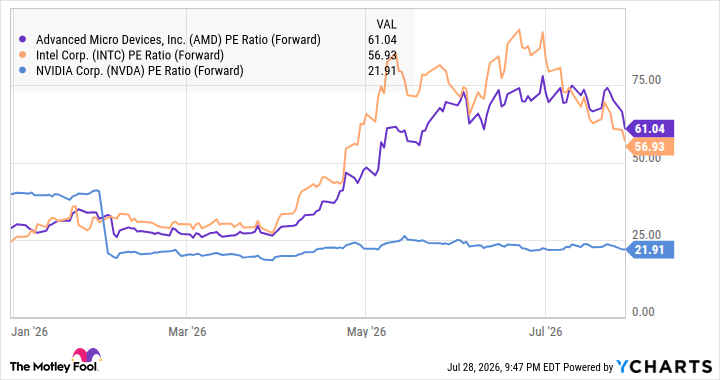
Data by YCharts
All this makes Nvidia the better semiconductor stock to buy right now for investors looking to capitalize on the AI infrastructure boom.