In early August, three of the biggest pure-play quantum computing stocks will report their Q2 results within a day of one another. IonQ (IONQ +8.78%) reports its earnings on Aug. 5, and Rigetti Computing (RGTI +9.68%) and D-Wave Quantum (QBTS +9.24%) report on the next day.
So which of these companies will perform best over the rest of this year?

Image source: Getty Images.
Rigetti has a strong balance sheet
Rigetti Computing has the strongest balance sheet of the group, with $569 million in cash, equivalents, and saleable investments and no debt, though its operations still ran an operating loss of about $26 million in the first quarter. Its balance sheet is thus much healthier than what is standard for quantum computing stocks, where the norm is to survive by selling stock when market conditions are permissive.
Rigetti's top line isn't about to win any awards, though. Its first-quarter revenue was just $4.4 million, mostly from one-off sales of Novera hardware for universities and government labs. The company is a very long way from generating recurring revenue and even further from generating real profits. Neither of those two things may ever happen.

NASDAQ: RGTI
Key Data Points
But it has a decent catalyst that could make its stock a winner in the long run: It's planning to launch a 1,000-plus-qubit machine within the next three or four years.
IonQ is bringing in plenty of revenue
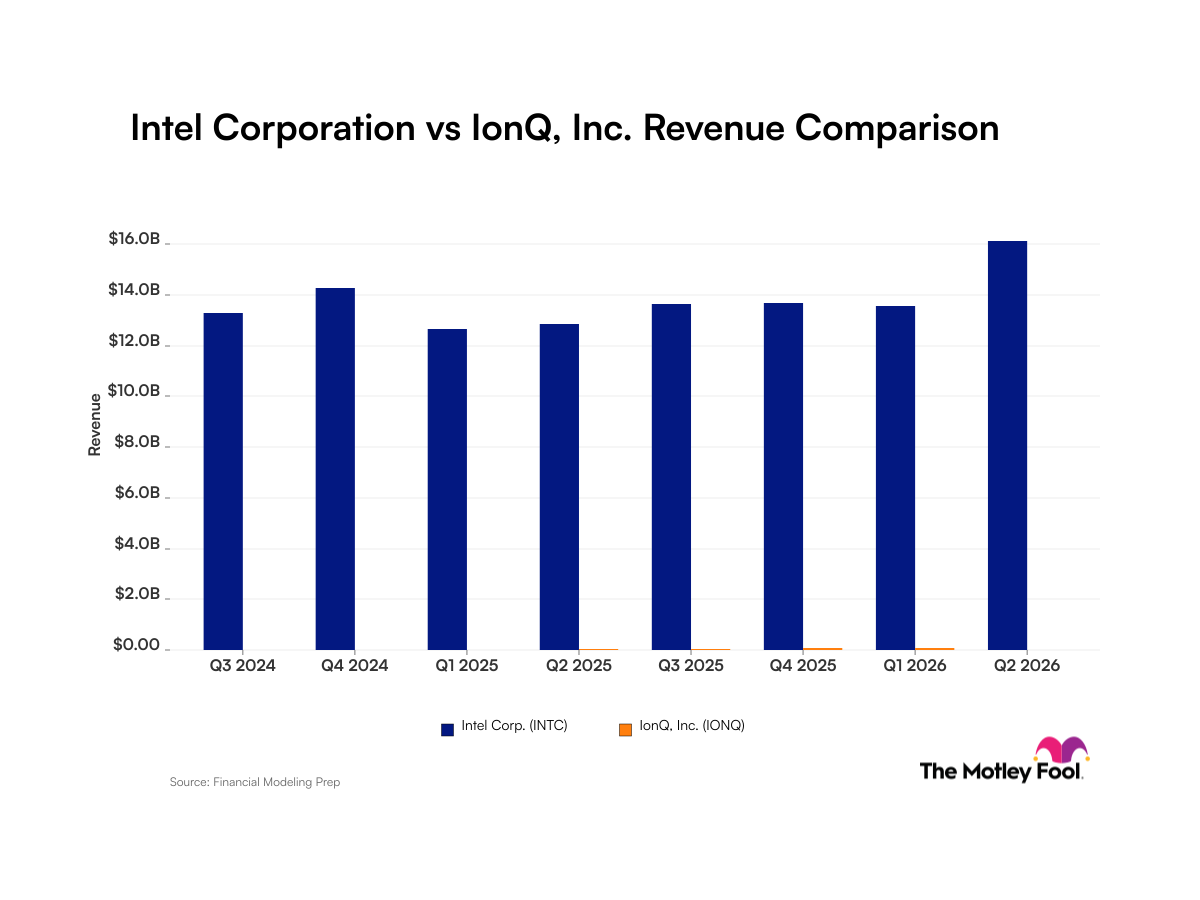
Unlike Rigetti and D-Wave, IonQ is already raking in revenue. Its quarterly revenue jumped 755% year over year to $64.7 million in Q1, and its remaining performance obligations, which account for contracted revenue not yet booked, reached $470 million. With $3.1 billion in cash, equivalents, and short-term investments, IonQ's funding is no worry for the moment.

NYSE: IONQ
Key Data Points
It's also pursuing a run of acquisitions, including a pending $1.8 billion deal for a chip foundry called SkyWater, which will significantly draw down its capital while potentially delivering the capabilities needed to fill the reservoir back up again down the line.
Its commercial revenue, which management indicates is approximately 60% of its total revenue, is quite formidable and may continue to grow. The main catalyst to watch is that $470 million backlog: If it keeps growing, that means new bookings are outpacing the revenue IonQ can recognize. That's a sign demand is running ahead of what the company can deliver, which is bullish.
D-Wave is differentiated, but tiny
D-Wave is the smallest of these three businesses by revenue but the only company selling two kinds of quantum computers. It sells annealers as well as newer general-purpose gate-model systems. Furthermore, it holds $588 million in cash and marketable securities, which should give it a multiyear runway.

NASDAQ: QBTS
Key Data Points
Its Leap cloud service, which is essentially quantum computing-as-a-service, could drive recurring revenue growth. In the first quarter, it booked a $10 million, two-year Leap agreement with a Fortune 100 company, and more than half of its 100-plus customers were commercial enterprises rather than governments or research labs.
D-Wave's total revenue was $2.9 million in Q1. If its Leap service scales and leads to a growing base of real recurring revenue, it'll be a very bullish factor for the stock.
How these names rank
So how do these quantum computing stocks stack up going into 2027?
IonQ is the first choice, with the most revenue, deepest cash hoard, and fullest slate of catalysts. Second place goes to D-Wave, as it's the only one already earning (some) recurring, nongovernment income, and it's held back only by how little of that recurring revenue exists at the moment. In third place is Rigetti, as it has the safest balance sheet but the most government-dependent core business.
Still, ranking the sturdiest of these risky plays does not make the winner a good bet for everyone. None of these companies will be able to fund themselves from revenue for years, so there is no sense owning any of their shares unless you can hold for five-plus years and stomach some volatility along the way.