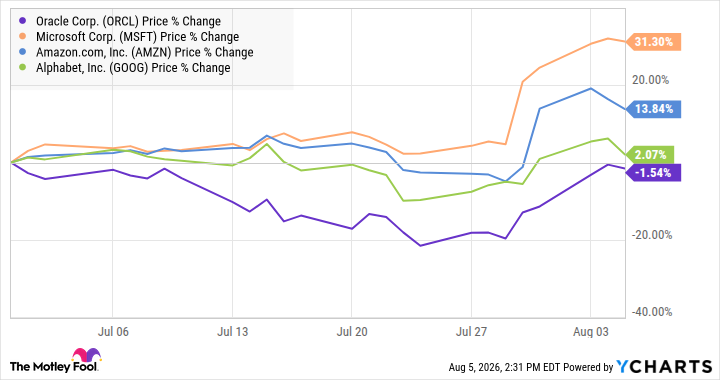
Oracle's (ORCL +4.59%) stock declined by 11.4% in July, according to data from S&P Global Market Intelligence. The move can't be viewed in isolation, as it occurred during a general sell-off of artificial intelligence (AI) related stocks. While stocks exposed to the AI theme (including Oracle) have bounced strongly in early August, it's worth noting that Oracle remains the laggard of the leading hyperscalers.
Oracle continues to underperform
To illustrate the point above, here's a chart of Oracle stock compared to other hyperscalers, Alphabet, Microsoft, and Amazon.com since the start of June.
And then, zooming out for a longer-term view, the stock's underperformance is clear.
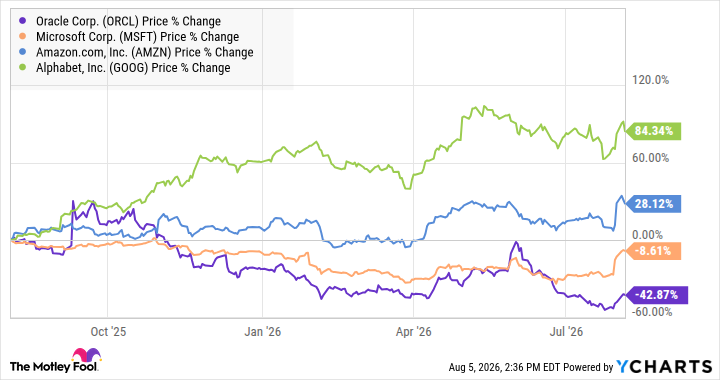
The reason for the underperformance, and that of Microsoft for that matter, comes to a combination of both companies' heavy reliance on OpenAI. In addition, Oracle's balance sheet is deteriorating as it takes on the near-term burden of investing heavily in AI infrastructure before providing compute services to companies such as OpenAI. As a reminder, Oracle has a $300 billion 5-year deal with OpenAI to provide compute starting in 2027.
What the market continues to worry about with Oracle
As demonstrated above, Oracle's stock started going South after the deal with OpenAI was signed in the Autumn. The skepticism over the deal was also expressed in the credit markets, as Oracle's credit default swap prices surged (the price to insure against a bond default). In a nutshell, the market is expressing doubt about OpenAI's ability to either meet its financial obligations or secure funding to support the business.
As S&P Global Ratings credit agency, noted when downgrading Oracle's debt to BBB- (one notch above junk), OpenAI could make up about half of Oracle's $638 billion in remaining performance obligations (RPO).

Image source: Getty Images.
Where next for Oracle
On a more positive note, Oracle won a $7 billion 10-year software deal with the Pentagon in July,,which served to remind investors that it's a lot more than just a play on AI computing services.
In addition, Oracle recently expanded its partnership with Alphabet's Google by incorporating Google's Gemini AI models into its suite of enterprise applications. It's a deal that's likely to keep customers sticky as it offers them a high-performance AI model embedded in its solutions, so they are less likely to consider alternative solution providers for their enterprise applications.
These developments are steps in the right direction and help build the argument that the OpenAI deal isn't the only thing driving its prospects.