Warren Buffett is one of history's most accomplished investors. As the longtime leader of Berkshire Hathaway, the "Oracle of Omaha" transformed a textile firm into a sprawling investment conglomerate through decades of disciplined capital allocation.
Smart investors recognize that Buffett's track record offers a rare demonstration of sustained wealth creation: From 1965 through 2025, Berkshire's market value compounded at an annual rate of 19.7%, far outpacing the S&P 500's (^GSPC +0.55%) 10.5% pace over the same span.
This performance underscores the power of patient, value-oriented ownership. Yet in recent years, Buffett has observed that finding genuine opportunities at a reasonable price has grown difficult precisely because so many investors now prefer "gambling" -- noting the surge in short-term speculative growth stocks and the cultural tilt toward cultivating day trading rather than long-term investing.
Such comments raise important questions about the near-term path of the stock market, where elevated valuations usually leave little margin for error if sentiment shifts.
Image source: Getty Images.
The CAPE ratio can tell you if the stock market is overvalued
Buffett's intuition that a gambling mindset is permeating throughout the capital markets is supported by the cyclically adjusted price-to-earnings (CAPE) ratio. Developed by economist Robert Shiller, this ratio divides the market's current price level by the average of its inflation-adjusted earnings over the last 10 years. This adjustment is important because it smooths out the distortions of temporary profit spikes or troughs that come with economic cycles, yielding a more reliable gauge of valuation than a simple one-time price-to-earnings (P/E) multiple.
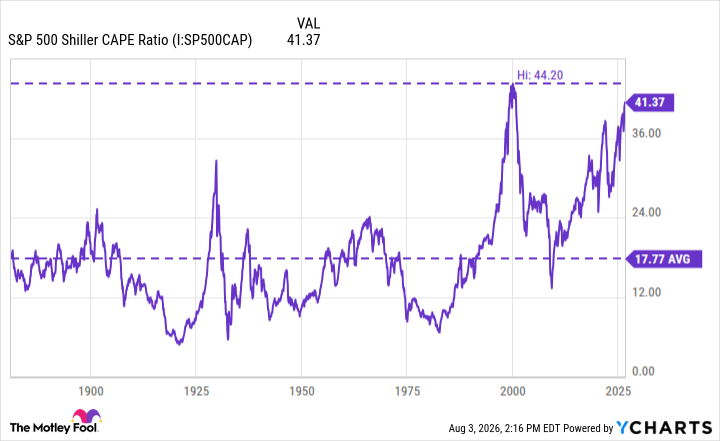
Investors can use the CAPE ratio to assess whether stocks are expensive or inexpensive relative to long-term fundamentals -- helping form expectations about subsequent multiyear returns. As the chart shows, elevated readings have historically been associated with muted future gains.
S&P 500 Shiller CAPE Ratio data by YCharts
When CAPE readings climb, it typically suggests that investors are paying higher prices for each dollar of earnings. This can be a product of rising optimism or outright speculation, as Buffett seems to imply. The ascent stretches valuations beyond sustainable levels supported by actual corporate profits, setting the stage for an eventual disappointment once reality sets in.
Where is the CAPE ratio today, and how does it compare to historical levels?
The CAPE ratio currently hovers near 41, more than double its long-run average of roughly 17 across roughly 155 years of data. This places the market in rare territory, exceeded only by the extreme levels recorded near the close of the 20th century. The last time CAPE readings surpassed today's level occurred during the late stages of the dot-com bubble, when it peaked above 44 in late 1999.
During this period, the S&P 500 reached a high in early 2000 and then experienced a prolonged drawdown lasting until 2002 as the speculative premiums attached to technology and growth stories disappeared. The parallel this time around is hard to dismiss: Elevated CAPE levels have repeatedly marked periods when stock prices have run ahead of underlying earnings power, leaving the market fragile and vulnerable once the hype narrative has lost conviction.
How can investors prepare for a stock market crash?
Should the CAPE ratio continue to climb toward or beyond its prior all-time high, the implication would be that collective sentiment and growth expectations have diverged further from likely economic realities. Frothy valuations do not persist indefinitely; rather, they tend to compress either through falling prices or more lofty expectations.
Luckily, smart investors preparing for a possible sell-off or correction can adopt several time-tested practices. Diversification across asset classes reduces the damage to your portfolio from any single market's setback. A preference for blue chip companies possessing durable competitive advantages and predictable cash flow provides a buffer of intrinsic value. Meanwhile, maintaining a cash reserve affords both psychological comfort and the financial flexibility to buy when bargains reappear.
Most importantly, remaining invested through turbulence is a testament to the fact that the S&P 500 has always advanced to new highs after bottoming. Against this backdrop, practicing patience and discipline -- rather than attempting to time the precise peak -- is the most reliable path to generating wealth, even during periods of speculative excess.