S&P Global (SPGI -0.30%) stock is doing something it rarely does -- it's having a bad year.
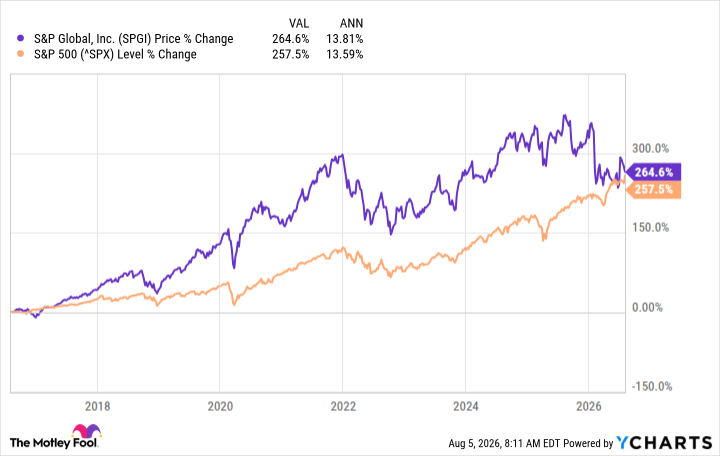
Since it spun off from McGraw Hill in 2016, it has had only one negative year, 2022, when the stock fell 29%. Over the past 10 years since the spinoff, it has beaten the benchmark that it owns with an average annualized return of 13.8%, compared to 13.6% for the S&P 500.
But it is heading for its second negative year this year, as the stock price is down about 16% as of Aug. 5. A good chunk of that decline has come in the past month, as shares have dropped about 6%.
Among the concerns leading up to S&P Global's second-quarter earnings release on July 28 was how the sputtering economy would impact the company, particularly from an interest rate perspective. The July 28-29 meeting of the Federal Open Market Committee (FOMC) supported those concerns.
Why SPGI stock fell
The FOMC kept rates in check at the latest meeting, but there was growing momentum for a rate hike this year, given persistently high inflation rates. Three FOMC members of the 12 dissented on the vote to hold rates at the current range, with all favoring a rate hike.
This is not a good omen for S&P Global's ratings business, as higher rates tend to reduce the amount of corporate borrowing and refinancing, which in turn leads to less debt issuance. That can result in a lower amount of new debt for S&P Global to rate, and that can hurt its revenue.
But S&P Global also released earnings on July 28, and the results were solid. Revenue increased 10% year over year, but on an adjusted basis, excluding the Mobility business, which S&P spun off as its own company on July 1, it rose 11%. Earnings climbed 18% to $4.12 per share, but excluding the spun-off business, they jumped 23% to $4.83 per share.

NYSE: SPGI
Key Data Points
S&P Global beat revenue and earnings estimates, and two of its business lines, ratings and indexes, had record revenue in the quarter. The results generally supported the idea behind the spinoff, to focus resources and drive revenue in its four main businesses -- ratings, indexes, market intelligence, and energy consulting.
Buy the dip?
The strategy behind spinning off Mobility is in large part to reinforce the moats that S&P Global has built in ratings, indexes, and even market intelligence.
The enduring strength of S&P Global is that these businesses are all market leaders, with major competitive advantages. But they are also diverse businesses that balance each other out, with some performing better when others may be down.
The latest dip is a great opportunity to buy a great company with multiple moats at a discount. Because it has been such a strong performer, it has always traded at a premium, but the current price-to-earnings ratio of 25 is as low as it's been since 2022, and well below its average P/E ratio of 32.
At that value, SPGI's reinforced moats are worth it.