Any forecast of a company's future should be taken with a grain of salt -- nobody owns a functioning crystal ball. Nevertheless, a careful, critical examination can help provide a pretty good idea of what awaits.
After spending most of this century off most investors' radars, computer maker Dell Technologies (DELL -6.78%) is not only worth a fresh look, but worth looking at what's likely a few years into the future.
Yes, artificial intelligence (AI) features prominently in that future.
Roaring back into the spotlight
You likely know Dell as a manufacturer of laptops and desktop computers, although most investors aren't surprised to learn that it also makes and markets servers. The two technologies have their similarities, after all.
What does surprise investors is how much of an artificial intelligence company Dell has become. After being conspicuously left out of the conversation when the late 2022 launch of ChatGPT sparked an AI trend, this company has finally caught up. In its fiscal first quarter ending in early May, revenue grew 88% year over year to $43.8 billion, led by 181% improvement in infrastructure solutions sales (to $29 billion), and in particular, the 757% year-over-year growth of AI-optimized servers (to $16.1 billion). Dell's current AI backlog also now stands at $51.3 billion, after booking $24.4 billion in artificial intelligence orders in Q1 alone.
What gives? After a relatively slow start following its 2024 launch, its so-called Dell AI Factory, which is heavily aligned with AI accelerator powerhouse Nvidia, is finally getting some serious traction.

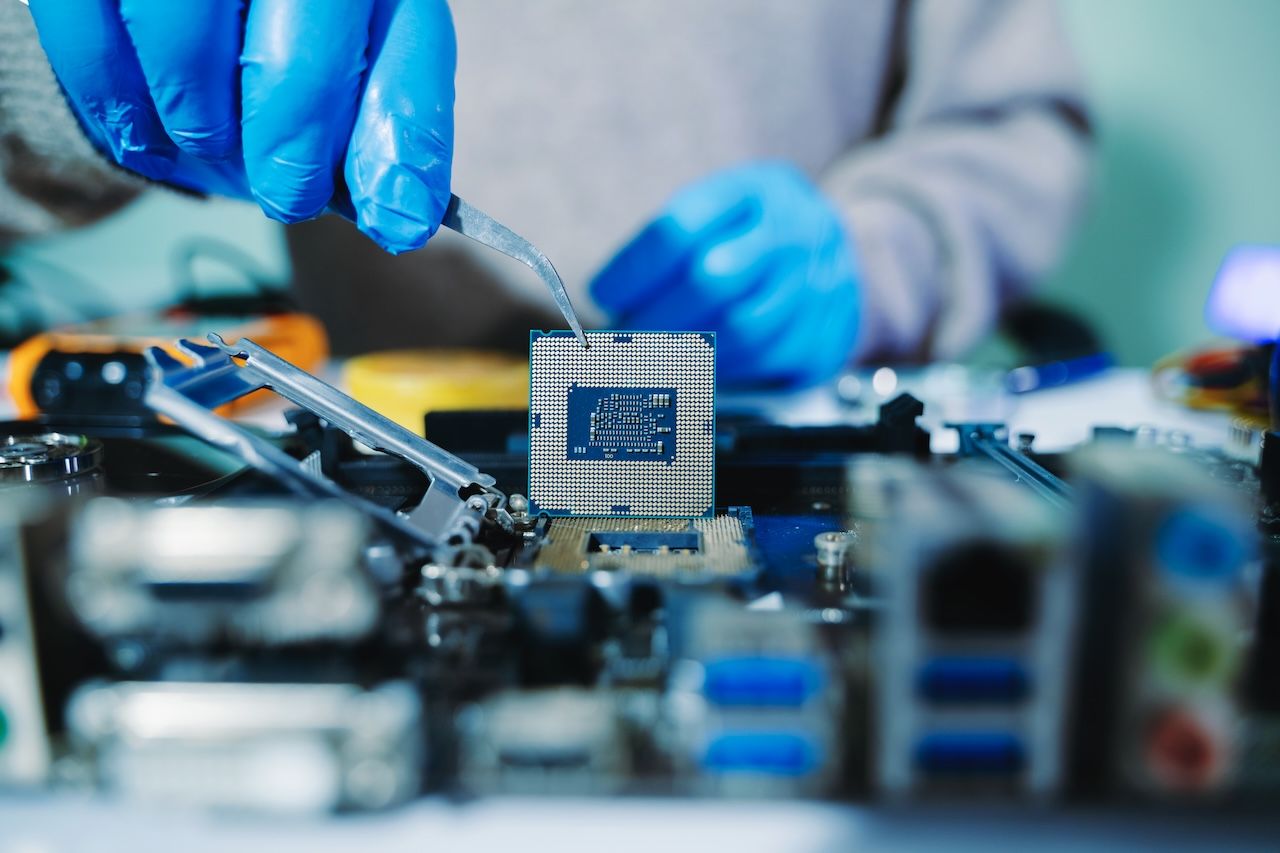
Image source: Getty Images.
Dell's AI Factory offers its customers an end-to-end means of using artificial intelligence in a way that makes the most sense for them. Perhaps most notably, its onsite infrastructure circumvents the need for cloud-based access to AI computing platforms. Although this option comes with steep upfront cost, in the long run, onsite AI computing can be more cost-effective. That's why home improvement retailer Lowe's, Sandisk, and Formula 1 racing team McLaren are just some of this venture's customers.
The business is only apt to continue growing from here. An outlook from technology industry research outfit Technavio suggests the worldwide AI infrastructure market is poised to grow at an average annualized pace of nearly 25% through 2030. For its part in the near term, analysts expect Dell to report top-line growth of almost 51% this fiscal year, although that pace should slow to a more modest 12.6% next year.
In the fast-changing world of artificial intelligence, near-term outlooks don't mean a lot. Much can work for or against the stock in the meantime. Interested investors might want to look at least a little further down the road, giving the stock time to wring out any volatility and reflect its actual value in a future price.
Where will Dell be three years from now?
Nobody truly knows what the future holds. However, we can make reasonable guesses about the future based on what we know in the present, and plausible trajectories.
Here are the three predictions about Dell in 2029 that arguably matter the most to investors.
1. Revenue
There aren't many analyst outlooks that peer this far into the future, but Morningstar expects Dell to report just over $221 billion in sales in 2029 (its fiscal 2030), up from last year's total top line of $113.5 billion. That's a sizable -- but not unbelievable -- leap. The company would only need to achieve an average of about 18% growth per year to reach that mark, and it fared far better than that in its previous quarter.
2. Earnings
Always be even more careful with profit projections than you are with revenue projections. They're a little less predictable, just because technology pricing power isn't always consistent. For that matter, neither is the underlying condition of the economy driving the demand that ultimately determines profit margins. Even so, Morningstar believes Dell will report an adjusted per-share profit of $32.83 in 2029, well up from last year's comparison of $10.30 per share.
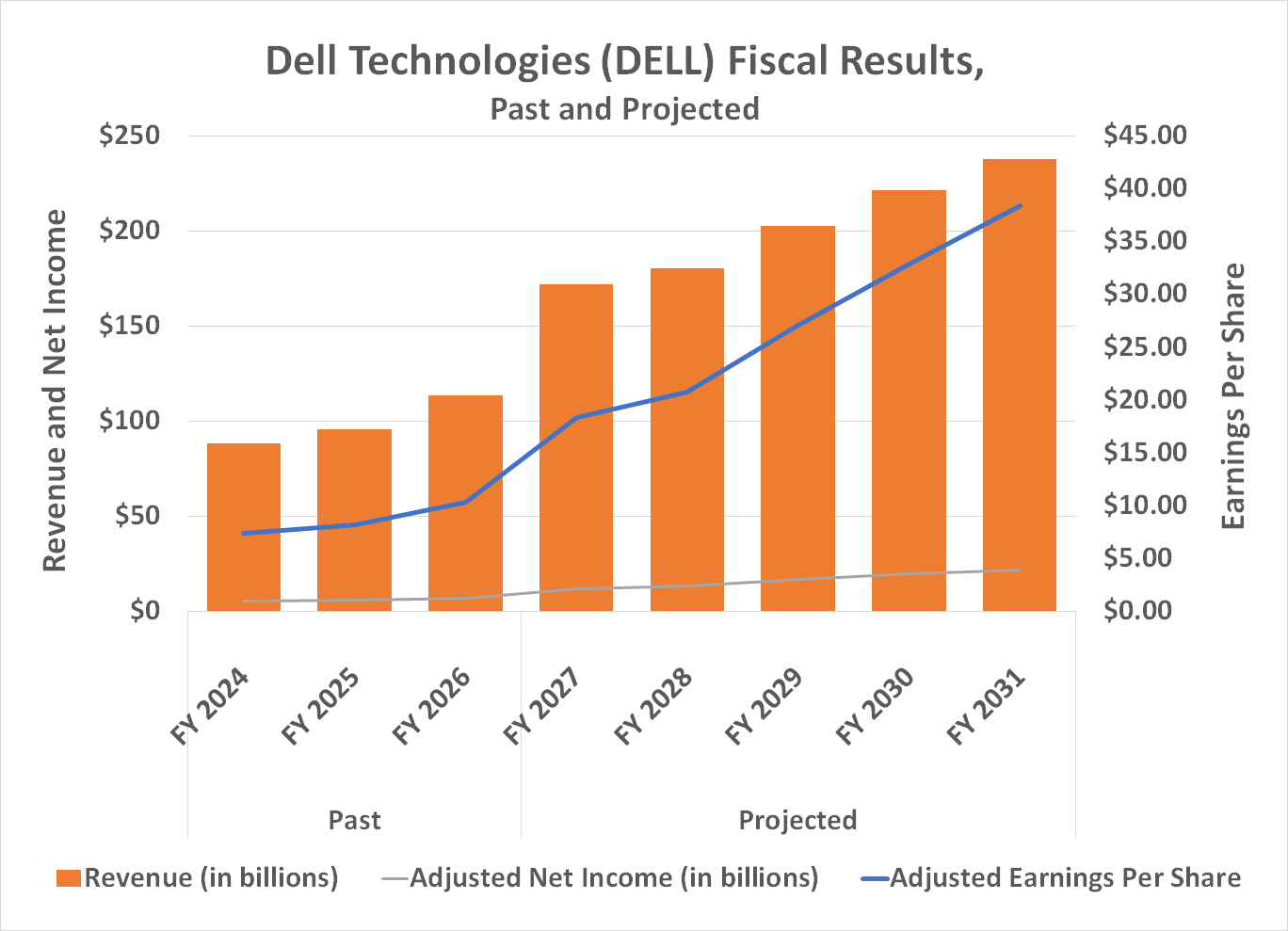
Data source: Morningstar. Chart by author.
Margins could widen this much simply because the company should experience a significant scale-up that doesn't require a dollar-for-dollar increase in spending.
3. Price
Finally, although Morningstar isn't making a long-term prediction of the stock's price, based on recent valuations, it's conceivable that Dell shares could move to near $980 apiece by 2029. That's roughly 30 times 2029's projected per-share earnings of $32.83, and a little more than twice the stock's current price.
DELL Dell Technologies
NYSE · As of 4:00 PM ET 10/22/26

Yes, a great deal of the company's likely future growth has already been priced in by the stock's big run-up earlier this year. Still, that's not bad potential upside for newcomers.
The difference matters
Is the risk worth the reward here? These bold outlooks presume demand for AI solutions will continue growing like it has of late, after all. There's no guarantee that it will.
The AI infrastructure business is evolving. The on-premise option that Dell offers should feature even more prominently in the future, while interest in cloud-based access to AI-capable platforms wanes -- if only for security reasons. Besides, for large-scale users, outright ownership of AI-optimized servers is also now cheaper in the long run. By leveraging its well-established presence in the institutional server market, Dell is quickly becoming a trusted provider of these on-premise artificial intelligence computing platforms.
More to the point for interested investors, Dell is well-positioned to win even if the public AI data center business we're familiar with runs into a headwind. Dell AI Factory's existing and target customers are largely bigger institutions that recognize the value and need of making such a sizable investment, and will likely make these investments regardless of the economic backdrop.
There's not as much risk here as there may seem to be on the surface. The potential reward, however, is exactly what it looks like.