Do you feel like you have so little money left at the end of the month that there's no point in saving any of it for retirement? If so, don't fall into that mental trap! Even just a little now can turn into a lot later on, given enough time. In fact, just tucking away $200 per month could grow into $455,865 in 30 years' time. Here's the math.
The tipping point of exponential growth is years down the road
It's true! The key is just investing wisely and achieving the S&P 500's (^GSPC +0.51%) long-term average annual gain of around 10%.
The graphic below tells the tale. Although your growth wouldn't have been this consistent due to the market's ebbs and flows, earning an average annual return of 10% on monthly investments of $200 over the course of 30 years ends with a sum of $455,865. Only $72,000 of that is your original contributions. The other $383,865 of it is the net growth achieved on those contributions.
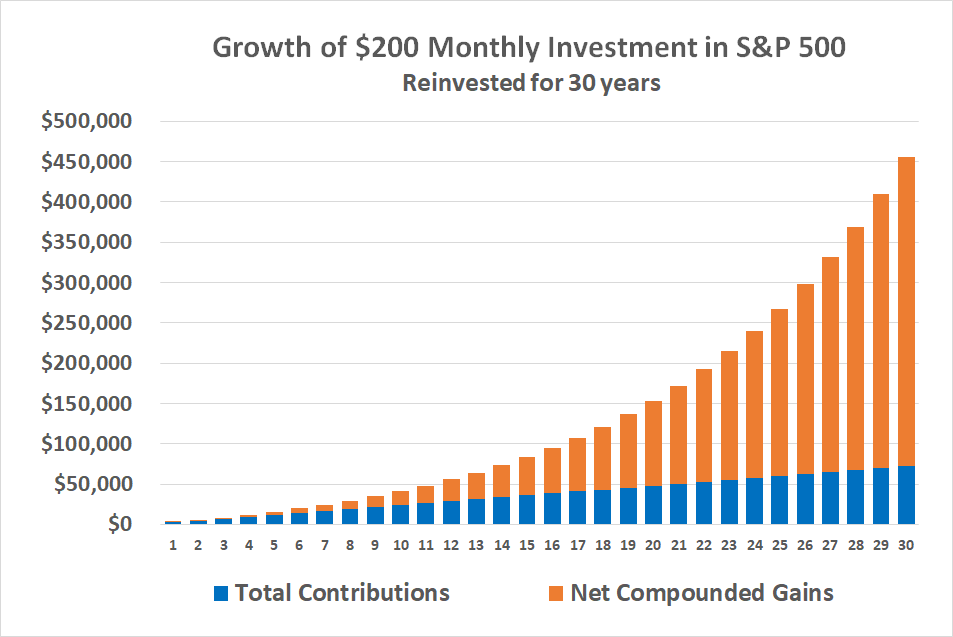
Data source: Calculator.net. Chart by author.
Notice that most of that growth materialized in just the last 10 years of the 30-year time frame. You would have just needed to start those last 10 years with as much capital as possible, even if only $200 at a time.
Just ask your employer or broker
Fortunately, it's very easy to make this happen with minimal effort on your part. Plenty of employers allow you to automate deposits of a portion of your paycheck to a brokerage or retirement account. If your employer isn't one, however, most brokers can help you automate these withdrawals as well. You'll just need to do a little bit of one-time paperwork.

Image source: Getty Images.
Putting that money to work is also pretty easy. See, most brokerage firms and retirement account custodians offer automatic monthly investments of a predetermined amount in a particular growth instrument. These were initially intended to facilitate recurring investments in ordinary mutual funds (often referred to as dollar-cost averaging). Now, many brokerages offer preset dollar purchases of exchange-traded funds (ETFs) such as the Vanguard S&P 500 ETF (VOO +0.54%) or the SPDR S&P 500 ETF Trust (SPY +0.54%), which are designed to mirror the performance of the S&P 500 index.
And that is arguably the best option for most investors to achieve maximum growth in their retirement savings. See, most mutual funds actually underperform the S&P 500 Index. The best odds of achieving the highest-likely returns aren't found by trying to beat the overall market, but rather by simply matching the broad market's long-term performance.
Anything is better than nothing, as long as you start sooner rather than later
Even if you opt for something a little more exciting than a basic index fund, investing a couple of hundred bucks per month in a less-productive fund is still better than doing nothing. In all cases, time does most of the work.
The real trick, therefore, is just getting started by doing something ... anything. And that always starts with filling out a relatively simple form that moves part of your paycheck into some sort of investment account and then actually investing that cash in some sort of growth investment.