Quantum computers can use a concept called superposition to simulate multiple solutions to a problem simultaneously, so they're better than traditional computers at processing data-intensive workloads in areas like science and cryptography. However, despite their incredible potential, even the best quantum computers still make too many errors to be useful for solving real-world problems.
Some estimates suggest this challenge could take decades to overcome, which is bad news for companies trying to commercialize their quantum systems today. Rigetti Computing (RGTI +1.06%) is one of the industry leaders right now, but it's still generating a minimal amount of revenue and burning through a ton of cash. Its stock is currently down by 60% from its peak, and here's where I predict it will be in one year from now.
Image source: Getty Images.
It could take decades to commercialize quantum computers at scale
Rigetti has built its own supply chain, so it can bring updated quantum systems to market much faster than its competitors. It operates its own fabrication facility, it developed its own quantum programming language, and it even built a cloud platform where it can monetize quantum computing capacity by renting it to other businesses.
Rigetti's Cepheus-1-108Q is one of the industry's largest multichip systems. It features 108 qubits, which is three times as many as the company's previous Cepheus-1-36Q system. It also boasts a single qubit gate fidelity of 99.9%, meaning it can be expected to make just one error per every 1,000 quantum operations.
However, qubits are highly sensitive to noise and interference, so getting two or more of them to work together in harmony is one of the biggest challenges in quantum computing. Therefore, Cepheus-1-108Q still only has a 2-qubit gate fidelity of 99.1%, implying nine errors per 1,000 operations, which isn't great when applying the computer to complex problems.
Rigetti believes it could take another three years to achieve a 2-qubit gate fidelity of 99.9%, and it will involve improving chip design, materials, and fabrication processes. The company secured a grant from the U.S. government worth $100 million over the next three years, which will help fund some of those improvements.
But in order for quantum computers to actually make an impact in the real world, Cathie Wood's Ark Investment Management predicts another 20 to 40 years' worth of development is required. That means Rigetti's shareholders might have to endure billions of dollars' worth of research and development spending before they see meaningful revenue.

NASDAQ: RGTI
Key Data Points
Minimal revenue and steep losses
Rigetti's revenue rocketed higher by 185% year over year during the second quarter of 2026 (ended June 30) -- but it totaled just $5.1 million. That is a minuscule amount of money for a company with a market capitalization of nearly $6 billion.
On a positive note, more quarterly revenue growth is likely ahead. Rigetti is currently working on an $8.4 million order for a Cepheus-1-108Q system, which will be delivered to India's Center for Development of Advanced Computing sometime in the fourth quarter of this year.
But Rigetti will have to find significantly more revenue in the near future to offset its soaring costs. It had $30.2 million in total operating expenses during the second quarter, up 48% from the year-ago period. Since that dwarfed the company's revenue, it resulted in a sizable net loss of $52.6 million.
Rigetti had $541 million in cash and cash equivalents on hand as of June 30, so it can afford to sustain its losses for the foreseeable future. But given how long it could take to commercialize quantum computers at scale, I think there is a high chance the company will have to raise more money from investors in the future, which will dilute existing shareholders.
Rigetti stock could be worth this much in one year
Based on Rigetti's modest revenue and sizable market cap, its stock is trading at a sky-high price-to-sales (P/S) ratio of 437. For some perspective, the Nasdaq-100 index has a P/S ratio of 6.2, so Rigetti is a whopping 70 times more expensive than a basket of America's highest-quality technology stocks.
Even if we value the stock based on Wall Street's average 2027 revenue estimate of $44.1 million, its stock still has a forward P/S ratio of 133 -- and there is no guarantee that revenue forecast will prove to be accurate given the unpredictable nature of demand for quantum systems.
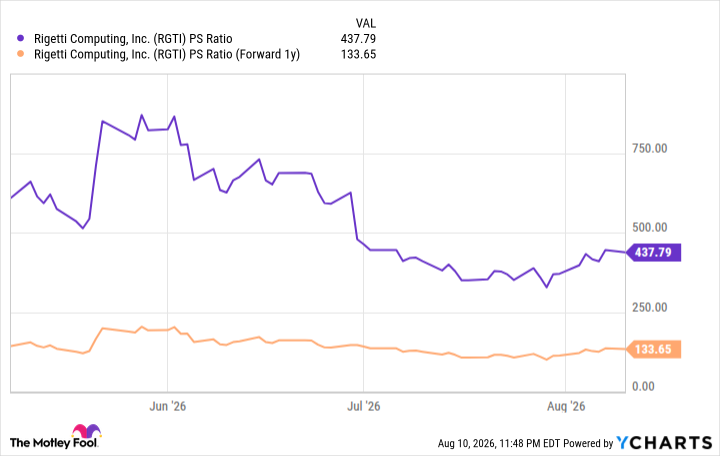
RGTI PS Ratio data by YCharts
Therefore, even if Rigetti stock crashed by 95% from its current price over the next 12 months, it would still be more expensive than the Nasdaq-100. I'm not predicting a decline of that magnitude, because there will always be some investors and investment funds willing to hold quantum computing stocks for their long-term potential.
However, I think it's possible Rigetti stock continues to trend lower and perhaps even falls below $10 over the next year, particularly if it appears the company will miss Wall Street's 2027 revenue forecast. In any case, I certainly won't be a buyer at anywhere near the current price.