After months of stagnant performance, major market indexes are soaring yet again. The S&P 500 (^GSPC +0.51%) and Dow Jones Industrial Average (^DJI +0.93%) have both hit new record highs in August, and the Nasdaq Composite (^IXIC +0.48%) has surged by more than 8% since late July.
Investor sentiment has also shifted in recent weeks. The Fear and Greed Index measures investor sentiment on a scale of 0 to 100, based on data from seven market indicators. Lower numbers suggest that fear is predominantly driving the market, while higher figures imply greed. The index currently sits at 62, which is well within the "greed" range.
While nobody can predict the market's short-term movements, Warren Buffett has a famous warning about times like these -- and investors may want to exercise caution.
Image source: The Motley Fool.
Investors may be "playing with fire"
The downside to a bull market is that the higher prices climb, the greater the chance that the market is overvalued. With concerns about a growing AI bubble, many investors are drawing parallels to the dot-com bear market of the early 2000s.
In 1999, Buffett predicted that the market was due for a pullback, warning investors that stock prices are likely to fall in the coming years. In 2001, he followed up on his prediction in an essay for Fortune.
Buffett explained that he used the ratio between the total value of U.S. stocks and GDP to determine that the market was overvalued -- a metric that has since been nicknamed the Buffett indicator.
"If the percentage relationship falls to the 70% or 80% area, buying stocks is likely to work very well for you," Buffett said of this metric. "If the ratio approaches 200% -- as it did in 1999 and a part of 2000 -- you are playing with fire."
As of this writing, the Buffett indicator is sitting at a record high of around 232%.
History says this is the best move investors can make
Some stocks are overvalued right now, and those investments will likely have the furthest to fall if the market takes a turn. During the dot-com bubble, for instance, hundreds of high-flying tech companies failed to survive the bear market despite their promising IPOs.
But not all tech companies failed during the dot-com bubble burst. A few went on to become some of the largest and most influential companies in the world. Apple, for example, lost more than 70% of its value throughout 2000 alone. Yet in the decade that followed, it earned total returns of more than 700%.
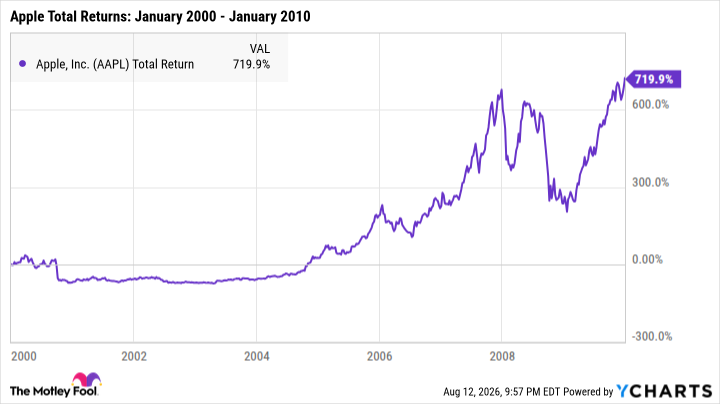
AAPL Total Return Level data by YCharts
In Buffett's 1999 warning to investors, he offered this advice about choosing stocks: "The key to investing is not assessing how much an industry is going to affect society, or how much it will grow, but rather determining the competitive advantage of any given company and, above all, the durability of that advantage."
Nobody can predict the market's short-term future, so it's unclear whether an AI bubble is looming. But if history proves just one thing, it's that investing in quality stocks and holding them for the long term is key to surviving even the worst bouts of volatility.