For companies valued at $1 trillion or more, few can match the growth Micron Technology (MU +1.22%) and Space Exploration Technologies (SPCX +2.21%) (better known as SpaceX) are delivering. In each of their past quarters, Micron delivered an incredible 346% growth, while SpaceX posted 92%. That makes them the fastest-growing trillion-dollar companies.
But which one is the better buy right now? Let's take a look at each stock and see which makes the most sense for your investment dollars.

Image source: Getty Images.
Micron operates a cyclical business
Micron and SpaceX aren't competitors. They are two entirely different companies that may happen to use each other's products but have no relationship beyond that.
Micron makes memory chips, which are in short supply due to the AI build-out, which is taking up nearly all available production capacity. This situation won't last forever, and when demand decreases, it could hurt memory chip pricing and cause Micron stock to be a bust. However, there are few signs of that happening right now, and with more production capacity not arriving until later next year, there is plenty of time for Micron to ride this demand wave.

NASDAQ: MU
Key Data Points
SpaceX's business is more complex, as it owns a space payload delivery business, an internet provider (Starlink), a social media company (X), and an AI platform (xAI). While that is a wide-ranging business conglomerate, each of them fits into what SpaceX is trying to do, and all of them have long-term viability without any cyclical concerns.
As a result, I'm giving SpaceX the business edge here.
Winner: SpaceX
Micron is growing far faster
As mentioned, Micron's growth rate is incredible at 346% year over year. Due to rising prices for its products and higher input costs, Micron's profits are also soaring.
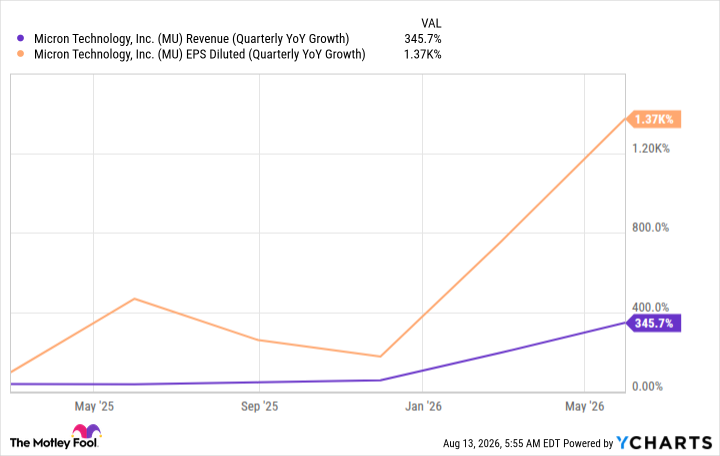
MU Revenue (Quarterly YoY Growth) data by YCharts
SpaceX has no profits to speak of, and while the 92% growth rate is impressive, it just doesn't compare to the results Micron is delivering.
Winner: Micron
Valuing each stock is not easy
With the score being tied up entering this last category, it all comes down to valuation. However, valuing these two stocks isn't easy. Because Micron is a cyclical business, its valuation metrics are often skewed as the market may anticipate a downturn, making its stock appear cheap. But in reality, it will be expensive within a year or two.
SpaceX is difficult to value because it has no profits to speak of, leaving investors to value the stock based on sales, which can be challenging because there's no reference as to what SpaceX's long-term profit margin will be. There isn't a direct comparison because SpaceX is a unique company, unlike Micron, which has several memory peers to compare against. To make matters more difficult, SpaceX doesn't have a year's worth of results available, so the price-to-sales ratio is more of a guess.

NASDAQ: SPCX
Key Data Points
For 2026, Wall Street analysts estimate SpaceX will deliver $44.6 billion in sales, pricing the stock at 43 times 2026 sales estimates. That's very expensive, and even if SpaceX could deliver a 50% profit margin, that would price the stock at 86 times forward earnings.
Meanwhile, Micron's stock trades at just 12.4 times forward earnings for the fiscal year (FY) ending in August 2026 and 5.9 times FY 2027 earnings.
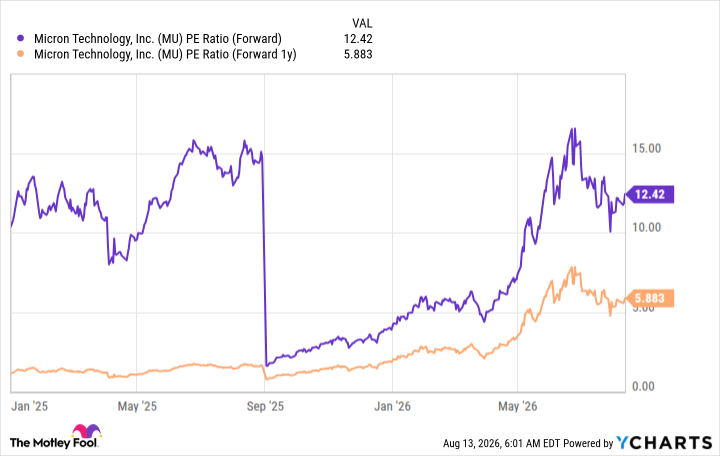
MU PE Ratio (Forward) data by YCharts
However, Micron has informed investors it expects the memory chip shortage to last beyond 2027, so these pessimistic views about falling memory chip market prices may be overstated.
With Micron trading at a reasonable valuation and expected to have a few good years of growth left, I'm going to give this category and the overall win to Micron.