Warren Buffett is a big fan of compounding interest. "My wealth has come from a combination of living in America, some lucky genes, and compound interest," Buffett said back in 2010.
And you don't have to be an oracle to take advantage of it -- you just need patience, discipline, and time.
Image source: The Motley Fool.
Your money making money
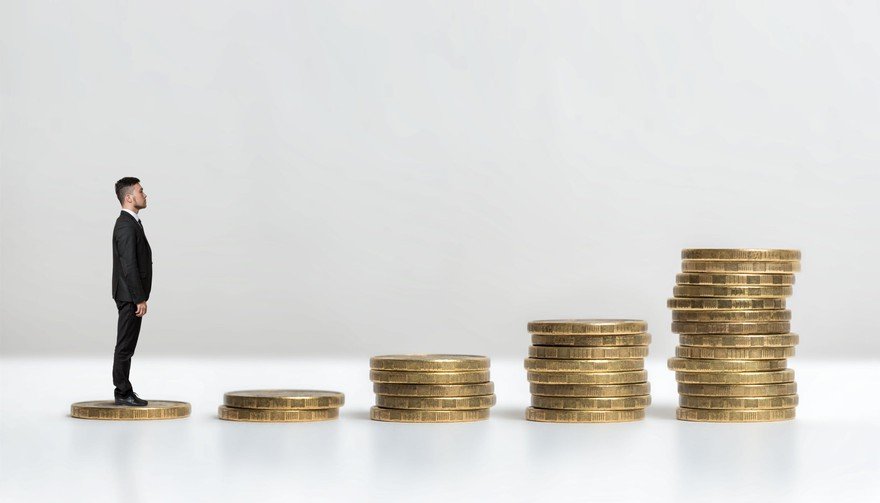
Compound interest, or compounding, is quite simply your money making money. More technically, it is the interest you earn on top of your principal and interest over time.
To keep it simple, let's look at how compounding works in a bank savings account. Say you set aside $10,000 in a savings account that pays out a 3% interest rate.
That $10,000, after one year, would grow to $10,300 -- so you made $300 in interest. After year two, that 3% gain is on $10,300, including the $300 in interest you made the previous year. So now that $10,300 grows to $10,609. That $300 in interest you made last year made $9 on its own.

NYSEMKT: VOO
Key Data Points
That might not sound like much, but when you let compounding do its thing over many, many years, that interest you earn on top of the interest just keeps piling up. After 20 years, that $10,000 becomes $18,061.11.
So thatʻs the concept. Now apply that to investing, where you are making returns instead of interest.
The magic of compounding
The S&P 500 has averaged about a 10% annual return over time, so let's take that as an example. You invest $10,000 in an S&P 500 exchange-traded fund (ETF) like the Vanguard S&P 500 ETF (VOO +0.61%), and that ETF averages a 10% annual return.
After 10 years, that amount would grow to $25,937.42 -- a roughly $16,000 gain on the initial investment. But now look at how compounding kicks into high gear as it works. After 20 years, with a 10% annual return, you would have $67,275 -- a gain of almost $40,000 in just the previous 10 years.
When you calculate 30 years of compounding, that initial $10,000 would grow to $174,494.02, with more than $100,000 of that added in the previous 10 years.
That's what Buffett was talking about.
Now, if you contributed $100 per month to that initial investment, that would compound, too.
Specifically, after 10 years, the $10,000 initial investment, with $100 added every month, with a 10% return, would turn into $45,923.81. After 20 years it would be $139,100.92, and after 30 years $380,778.35. Just $36,000 of that is contributions -- the rest is compounding returns.